Medical News Today: Parabens may increase breast cancer risk in Black women
UC expert comments on implications of recent study

Black women in the United States are 39% more likely to die from breast cancer compared to white women and are more likely to develop breast cancer under the age of 40.
A recent study conducted by researchers at City of Hope in Los Angeles found that compounds called parabens, which are used as preservatives in hair and personal care products, increased the growth of a Black breast cancer cell line but did not increase growth in a white breast cancer cell line.
Xiaoting Zhang, PhD, professor and Thomas Boat Endowed Chair in the University of Cincinnati's Department of Cancer Biology, director of the Breast Cancer Research Program and member of the University of Cincinnati Cancer Center, was not involved in the study but commented on it for Medical News Today.
Zhang said the study findings were interesting and suggest that at least part of the reason why parabens affect cancer cells differently is due to genetic or epigenetic differences.
"It will be highly critical to further study its effect not only in cultured breast cancer cells but also in animal models and eventually in humans,” Zhang said.
Read the Medical News Today story.
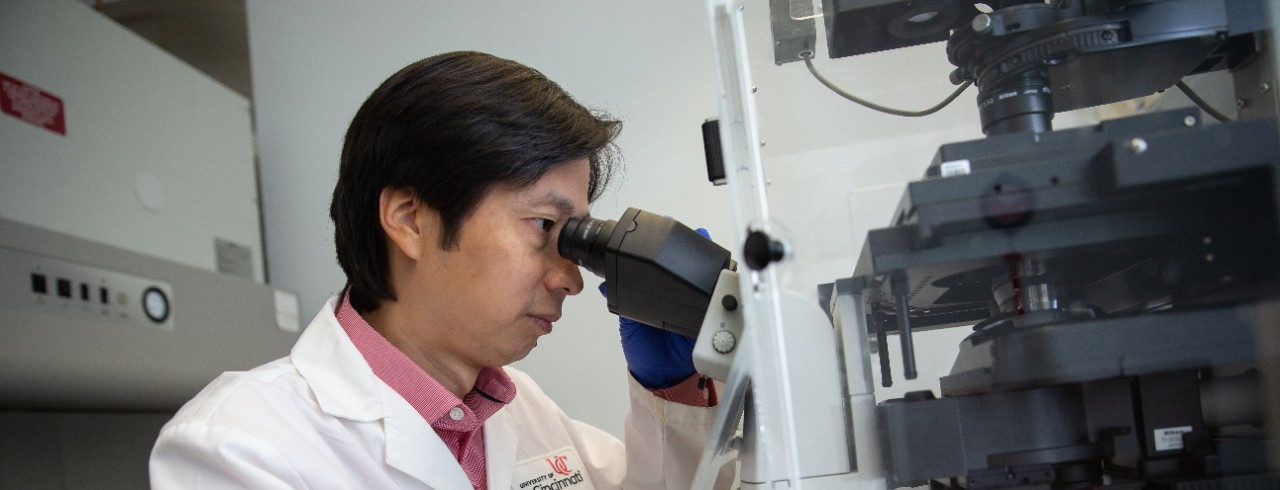
Featured photo at top of Dr. Zhang at microscope. Photo/Andrew Higley/UC Marketing + Brand
Related Stories
Sugar overload killing hearts
November 10, 2025
Two in five people will be told they have diabetes during their lifetime. And people who have diabetes are twice as likely to develop heart disease. One of the deadliest dangers? Diabetic cardiomyopathy. But groundbreaking University of Cincinnati research hopes to stop and even reverse the damage before it’s too late.
Is going nuclear the solution to Ohio’s energy costs?
November 10, 2025

The Ohio Capital Journal recently reported that as energy prices continue to climb, economists are weighing the benefits of going nuclear to curb costs. The publication dove into a Scioto Analysis survey of 18 economists to weigh the pros and cons of nuclear energy. One economist featured was Iryna Topolyan, PhD, professor of economics at the Carl H. Lindner College of Business.
App turns smartwatch into detector of structural heart disease
November 10, 2025

An app that uses an AI model to read a single-lead ECG from a smartwatch can detect structural heart disease, researchers reported at the 2025 Scientific Sessions of the American Heart Association. Although the technology requires further validation, researchers said it could help improve the identification of patients with heart failure, valvular conditions and left ventricular hypertrophy before they become symptomatic, which could improve the prognosis for people with these conditions.