New York Times: Mastodon's tusks reveal life of fighting, roaming
UC study among first to track movements of extinct Ice Age animals using isotopic analysis

The New York Times highlighted research by geologists and anthropologists at the University of Cincinnati who used isotopic analysis to track the seasonal migration of a mastodon that died in a fight with another mastodon more than 13,000 years ago.
UC College of Arts and Sciences researchers Joshua Miller, Brooke Crowley and Bledar Konomi worked with University of Michigan professor Daniel Fisher to study a bull mastodon nicknamed Fred who died at age 34 after being impaled by the tusk of another mastodon.
Researchers studied the strontium and oxygen isotopes from Fred's tusk to track his seasonal movements over what is now Indiana, Ohio, Illinois and Michigan. They found that as a young elephant living with his natal herd, Fred roamed very little. But as an adolescent around age 13, he left the herd much like modern elephants do today to strike out on his own.
He began traveling farther from where he was born. They found evidence that the mastodon made seasonal pilgrimages to northeast Indiana where he met his demise. This time of year coincides with what researchers believe was the mastodon's breeding season.
The study was published in the Proceedings of the National Academy of Sciences.
Miller, an assistant professor of geology, told the New York Times that researchers would like to know if mastodons competed for the same resources as the mammoths that shared their Ice Age world.
“Did they go to the same place, and this is just a crazed region of hormonally-charged proboscideans?” Miller asked.
With new tools, researchers can answer more questions about these long-extinct animals that still inspire our imaginations.
Read the New York Times story.
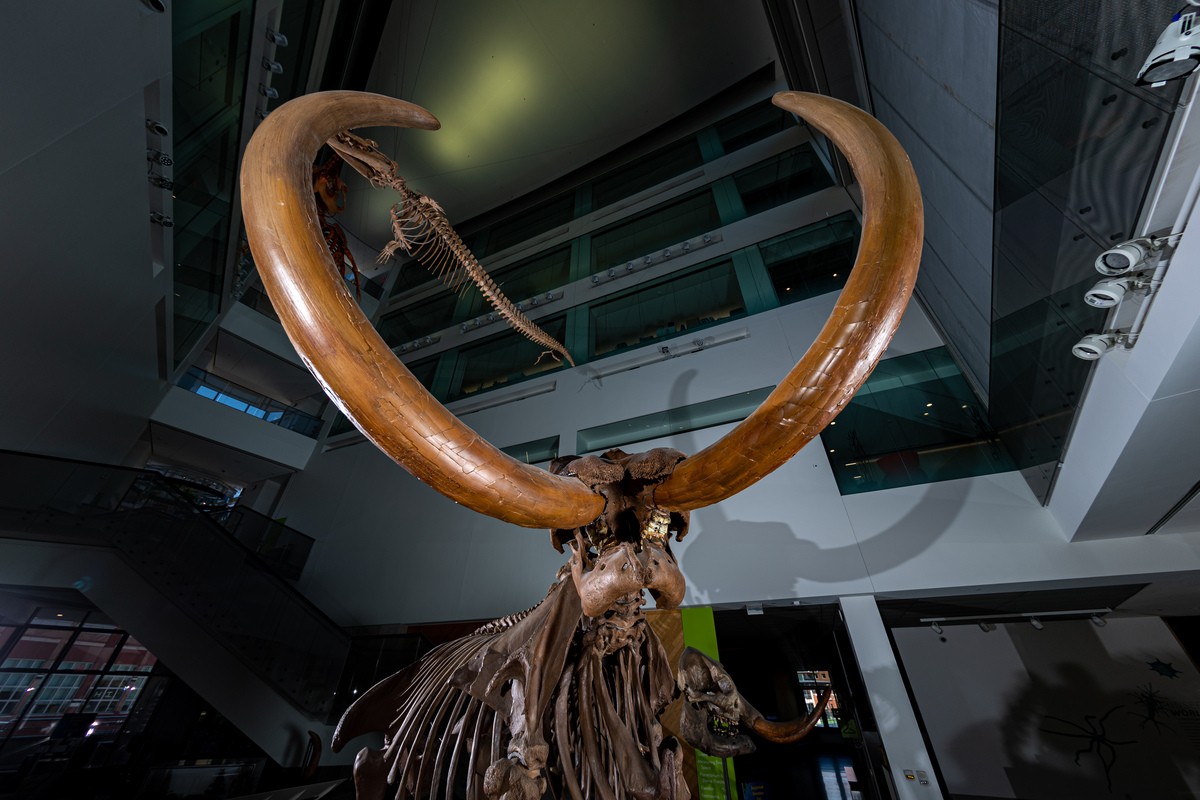
Featured image at top: Fred the mastodon roamed what is now Ohio more than 13,000 years ago. Photo/Eric Bronson/Michigan Photography

UC professor Brooke Crowley, assistant professor Joshua Miller and associate professor Bledar Konomi collaborated with the University of Michigan on a study of a mastodon that died during the Ice Age 13,000 years ago. Photo/Andrew Higley/UC Marketing + Brand
National media covers UC discovery

UC assistant professor Joshua Miller was first author of a study on the seasonal migration of an Ice Age mastodon. Here he stands next to another fossilized mastodon on display at the Cincinnati Museum Center. Photo/Andrew Higley/UC Marketing + Brand
- The Atlantic: A mystery that took 13,200 years to crack
- Discover Magazine: Historic animal migration: First evidence found from mastodon tusk
- NPR's All Things Considered: The story of Fred the mastodon
- CBC's Quirks and Quarks: Fossil tusk tells the life story of a mastodon that died through violence
Related Stories
Sugar overload killing hearts
November 10, 2025
Two in five people will be told they have diabetes during their lifetime. And people who have diabetes are twice as likely to develop heart disease. One of the deadliest dangers? Diabetic cardiomyopathy. But groundbreaking University of Cincinnati research hopes to stop and even reverse the damage before it’s too late.
Is going nuclear the solution to Ohio’s energy costs?
November 10, 2025

The Ohio Capital Journal recently reported that as energy prices continue to climb, economists are weighing the benefits of going nuclear to curb costs. The publication dove into a Scioto Analysis survey of 18 economists to weigh the pros and cons of nuclear energy. One economist featured was Iryna Topolyan, PhD, professor of economics at the Carl H. Lindner College of Business.
App turns smartwatch into detector of structural heart disease
November 10, 2025

An app that uses an AI model to read a single-lead ECG from a smartwatch can detect structural heart disease, researchers reported at the 2025 Scientific Sessions of the American Heart Association. Although the technology requires further validation, researchers said it could help improve the identification of patients with heart failure, valvular conditions and left ventricular hypertrophy before they become symptomatic, which could improve the prognosis for people with these conditions.