Dermatology Times features UC research of nail squamous cell carcinoma treatment

Nail squamous cell carcinomas (nSCC) are rare malignant tumors that grow primarily on the fingernails of patients. There is currently no established standard of care or treatment for nSCC, and University of Cincinnati researchers recently reviewed other published research to assess treatment trends and outcomes.
The research was led by Anne Ning, MD, clinical instructor in the Department of Internal Medicine in UC's College of Medicine, and published in the journal Dermatologic Surgery.
The literature review found there has been a shift from amputation to other surgical tactics including Mohs micrographic surgery (MMS), a procedure where individual layers of skin tissue are removed one at a time until there is no cancer found, and wide surgical excision (WSE), a procedure where a whole tumor and healthy tissue around it are surgically removed.
Researchers found MMS is increasingly being selected as a first-line treatment for nSCC, with data suggesting a low rate of the cancer recurring following MMS or WSE procedures.
The researchers concluded further study and randomized controlled trials are needed to directly compare surgical treatments for nSCC.
Dermatology Times covered the study in a recent article.
Read the Dermatology Times article.
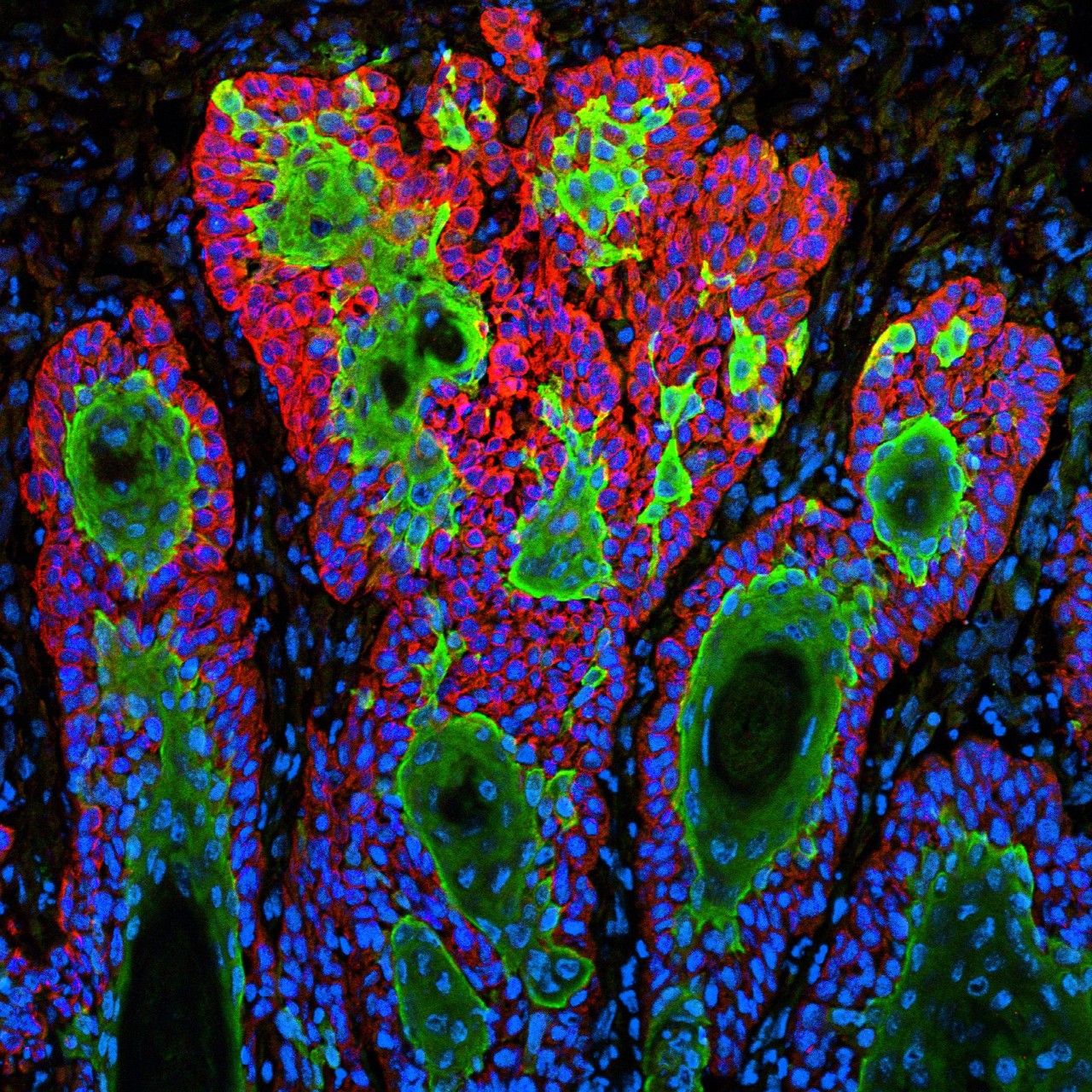
Featured photo at top of squamous cell carcinoma cells by Markus Schober and Elaine Fuchs of The Rockefeller University, provided by National Cancer Institute.
Related Stories
Sugar overload killing hearts
November 10, 2025
Two in five people will be told they have diabetes during their lifetime. And people who have diabetes are twice as likely to develop heart disease. One of the deadliest dangers? Diabetic cardiomyopathy. But groundbreaking University of Cincinnati research hopes to stop and even reverse the damage before it’s too late.
Is going nuclear the solution to Ohio’s energy costs?
November 10, 2025

The Ohio Capital Journal recently reported that as energy prices continue to climb, economists are weighing the benefits of going nuclear to curb costs. The publication dove into a Scioto Analysis survey of 18 economists to weigh the pros and cons of nuclear energy. One economist featured was Iryna Topolyan, PhD, professor of economics at the Carl H. Lindner College of Business.
App turns smartwatch into detector of structural heart disease
November 10, 2025

An app that uses an AI model to read a single-lead ECG from a smartwatch can detect structural heart disease, researchers reported at the 2025 Scientific Sessions of the American Heart Association. Although the technology requires further validation, researchers said it could help improve the identification of patients with heart failure, valvular conditions and left ventricular hypertrophy before they become symptomatic, which could improve the prognosis for people with these conditions.