Environmental engineer named Distinguished Research Professor
UC honored Dion Dionysiou for extensive research in identifying and treating water pollutants
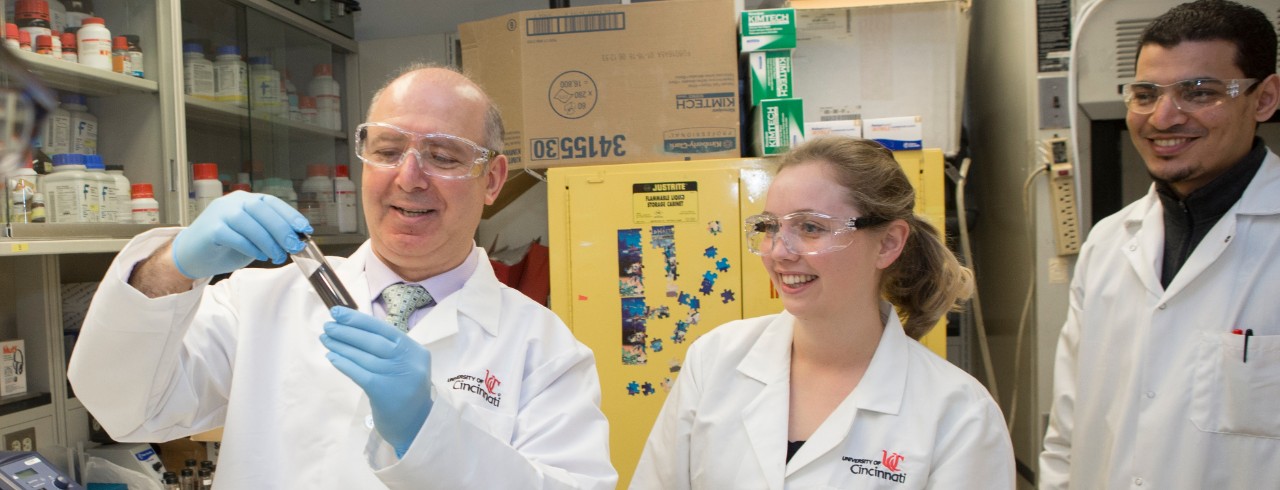
Dion Dionysiou, professor of environmental engineering at the University of Cincinnati, was awarded the UC Distinguished Research Professor for his work developing sensors and strategies to identify and treat water pollutants.

Dionysiou grew up in Cyprus, a semi-arid island in the Mediterranean Sea, where water scarcity has always been an issue. After his B.S. studies in chemical engineering in Greece and subsequent M.S. studies in the same field at Tufts, he was thrilled to have the opportunity to pursue Ph.D. studies in environmental engineering at UC in the field of water treatment using sustainable technologies.
Becoming a researcher was his dream in high school, so he was delighted to join UC’s faculty in 2000. Having the privilege to receive tutelage by excellent academic mentors early on during his academic career, he focused on exciting research ideas, recruiting and training talented students, innovative and systematic research work, and starting effective collaborations in the U.S. and abroad. His work focused on emerging technologies for removing difficult to treat pollutants in water, regional issues such as problems of harmful algae blooms, excessive nutrients in non-point sources of water, and emerging pollutants such as pharmaceuticals and personal care product residues in source waters.
As detailed in a paper he co-authored in the journal Science on the path for securing clean water, Dionysiou's work also emphasizes the need to consider the precautionary principle and eliminate, or at least minimize, pollution at the source. In addition, his research includes mechanistic aspects of removing the pollutants, evaluation of treatment efficiencies, and development and optimization of new treatment technologies. He has been a prolific researcher with over 600 peer-reviewed journal publications and over 60,000 citations, but he credits this outcome to the synergistic work between his students and collaborators. He values creativity, passion for scientific research, systematic work, and completion of assigned projects, theses, and dissertations. He always strives to learn new things when researching, gets excited when his students come up with new ideas, and is not afraid to take risks by venturing into new research areas.
He serves in numerous research, educational, outreach committees, and leadership roles. As a testament to his contribution at the international level, he has been elected academician of the European Academy of Sciences and a fellow of four other professional societies (International Water Association, American Chemical Society, Royal Society of Chemistry, and Association of Environmental Engineering and Science Professors). He serves as a guest/visiting/honorary professor in nine international universities. He has organized numerous conferences, including symposia, to highlight the pioneering work of women in environmental engineering and science. Dionysiou received over 50 awards, including the ARCADIS Frontier in Research Award, the Outstanding Publication Award from the Association of Environmental Engineering and Science Professors, and the Sustainable Water Award from the Royal Society of Chemistry. He strives to provide opportunities and support his students by promoting their work for recognition and rewards.
As a result, his students received over 130 university, state, national and international awards. In 2021, Dionysiou received the W. Wesley Eckenfelder Graduate Research Faculty Advisor Award for Outstanding Lifetime Achievements for Advancement of Environmental Protection for his mentor role.
Related Stories
Sugar overload killing hearts
November 10, 2025
Two in five people will be told they have diabetes during their lifetime. And people who have diabetes are twice as likely to develop heart disease. One of the deadliest dangers? Diabetic cardiomyopathy. But groundbreaking University of Cincinnati research hopes to stop and even reverse the damage before it’s too late.
Is going nuclear the solution to Ohio’s energy costs?
November 10, 2025

The Ohio Capital Journal recently reported that as energy prices continue to climb, economists are weighing the benefits of going nuclear to curb costs. The publication dove into a Scioto Analysis survey of 18 economists to weigh the pros and cons of nuclear energy. One economist featured was Iryna Topolyan, PhD, professor of economics at the Carl H. Lindner College of Business.
App turns smartwatch into detector of structural heart disease
November 10, 2025

An app that uses an AI model to read a single-lead ECG from a smartwatch can detect structural heart disease, researchers reported at the 2025 Scientific Sessions of the American Heart Association. Although the technology requires further validation, researchers said it could help improve the identification of patients with heart failure, valvular conditions and left ventricular hypertrophy before they become symptomatic, which could improve the prognosis for people with these conditions.