Spectrum News: Researchers place logs to protect Ohio's streams
UC biologists investigate low-cost ways to improve urban wildlife habitat

Spectrum News highlighted a demonstration project by biologists at the University of Cincinnati investigating low-cost ways to improve the health of urban streams.
UC biologists Michael Booth and Stephen Matter are working with the Hamilton County Conservation District on a pilot project to add heavy timber to Cooper Creek to create standing pools of water for fish and other aquatic life.

Adam Lehmann, stream conservation program manager for the Hamilton County Conservation District, oversees the pilot project. Photo/Michael Booth
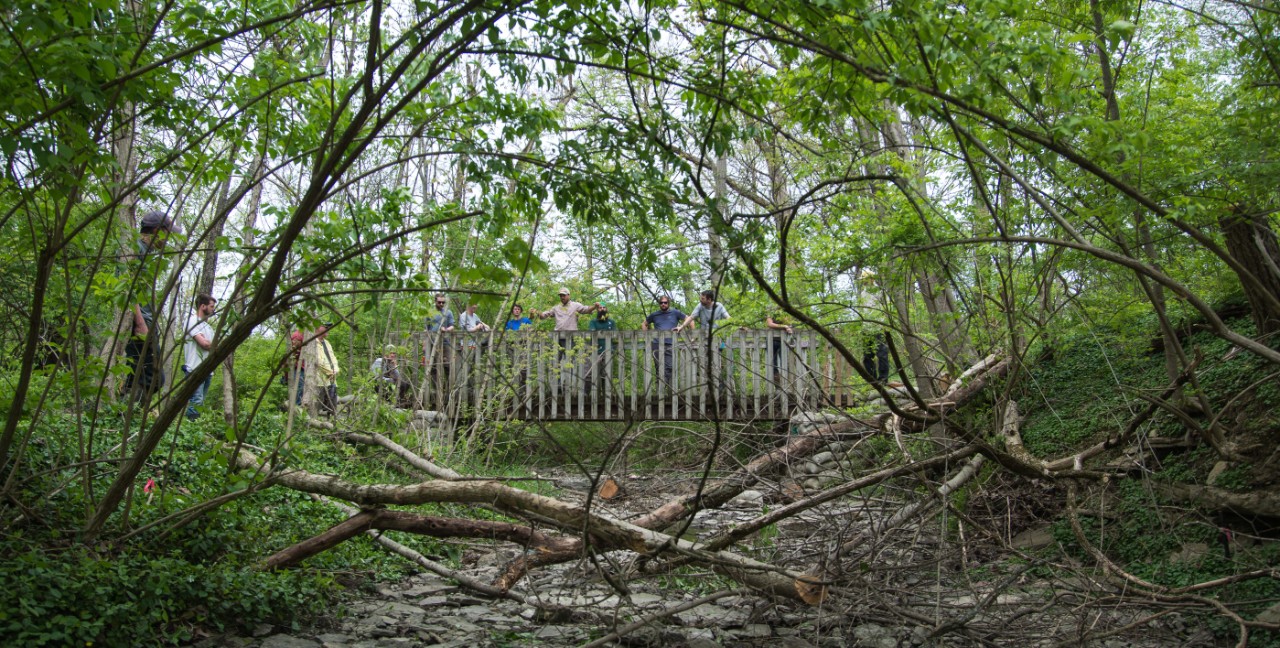
The creek flows into Mill Creek and eventually the Ohio River. Biologists and a team of volunteers placed logs in strategic places to facilitate the creation of drought-resistant pools that can support wildlife in the hottest summer months. The logs also could help slow the flow of water during heavy storms, which can threaten to wash fish and other aquatic life far downstream.
Adam Lehmann, a stream specialist with the Hamilton County Conservation District, told Spectrum News that flood-mitigation efforts used streams to divert water quickly to the detriment of aquatic wildlife.
“The watershed is covered by 50% concrete and impervious surfaces, so when it rains it all just comes straight down here,” he said. “It’s a ubiquitous problem in urban and suburban areas.”
Researchers will study the creek over the next year to see if volunteers' hard work placing the logs was effective at creating aquatic habitat.
Watch the Spectrum News story.
Featured image at top: Volunteers help place heavy timber in Cooper Creek in places where the logs will not easily get washed downstream during storms. UC biologists will monitor the creek to see if the timber has the desired effect of creating wildlife habitat for fish and other aquatic life. Photo/Michael Booth

UC biology student Jayla Brown, left, and graduate student Peter Grap install transponders in timber to study how well it remains in place during periodic storms in the Cooper Creek. Photo/Michael Booth
Related Stories
Sugar overload killing hearts
November 10, 2025
Two in five people will be told they have diabetes during their lifetime. And people who have diabetes are twice as likely to develop heart disease. One of the deadliest dangers? Diabetic cardiomyopathy. But groundbreaking University of Cincinnati research hopes to stop and even reverse the damage before it’s too late.
Is going nuclear the solution to Ohio’s energy costs?
November 10, 2025

The Ohio Capital Journal recently reported that as energy prices continue to climb, economists are weighing the benefits of going nuclear to curb costs. The publication dove into a Scioto Analysis survey of 18 economists to weigh the pros and cons of nuclear energy. One economist featured was Iryna Topolyan, PhD, professor of economics at the Carl H. Lindner College of Business.
App turns smartwatch into detector of structural heart disease
November 10, 2025

An app that uses an AI model to read a single-lead ECG from a smartwatch can detect structural heart disease, researchers reported at the 2025 Scientific Sessions of the American Heart Association. Although the technology requires further validation, researchers said it could help improve the identification of patients with heart failure, valvular conditions and left ventricular hypertrophy before they become symptomatic, which could improve the prognosis for people with these conditions.