UC industrial design students use VR technology to model the future of transportation
UC's Future Mobility Design Lab aided by corporate partner

Two decades ago, an all-electric vehicle was a faraway – and likely impossible thought – for the average person. Now, electric cars, trucks and buses are commonplace.

The Hex Pod designed by third-year industrial design student Jimmy Tran. Photo/provided.
Fast forward to 2040, and the next evolution in transportation, say experts and students in UC’s industrial design program, will be the self-driving vehicle; and at UC, they are using VR technology to perfect the design process.
“It (VR design) was a little bit of a learning curve at the beginning, but it was amazing once you understand it,” says third year industrial design student Jimmy Tran whose design for the Canoo Hex Pod was featured in a WVXU “Focus on Technology” segment.
“When I was a student, it really took me about three years to be at a level where I was competent in transportation design, but these students pick it up in a month,” using VR software, says Alejandro Lozano Robledo who oversees UC’s Future Mobility Design Lab at the College of Design, Architecture, Art and Planning.
His third-year industrial design students are among the first here to use the VR software and headsets provided by the VR software developer Gravity Sketch. This software, Robledo says, allows students to mockup designs for something as large as a vehicle “in a matter of hours and understand the size and scale more quicky.”

Third-year industrial design student Kate Faas takes a VR tour of Toyoko in the autonomous hotel pod she designed in the Future Mobility Design Lab at DAAP. Photo/Koenig
“It’s a tool that helps you to visualize in 3D before you have a physical 3D model,” and shaves years off the old school design process of sketching on paper, says Matt Whitby, the Gravity Sketch representative on hand at the end of semester exhibit: Autonomous Journey in 2040.
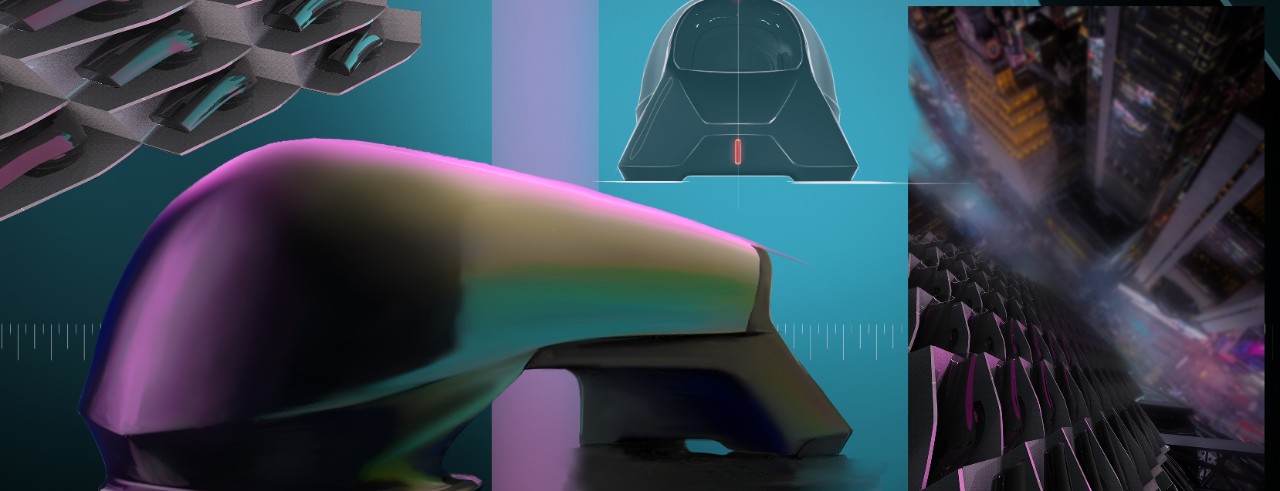
The premise of the project was 20 years out, with each student designing a mobility solution in one of four cities: Tokyo, Shanghai, New York, or Los Angeles. The Hex Pod, for example, is designed for solitary use, which could be an advantage should there be another pandemic.
“Partnering with companies like Gravity Sketch is a valuable part of our process,” to train the next generation of transportation designers, Robledo says, explaining that DAAP students go on to co-op for the world’s leading automotive manufacturers and will become leaders in transportation design.
Featured image at top is the 2D model of Kate Faas's hotel pod, called "Saya."
Innovation Lives Here
The University of Cincinnati is leading public urban universities into a new era of innovation and impact. Our faculty, staff and students are saving lives, changing outcomes and bending the future in our city's direction. Next Lives Here.
Related Stories
Sugar overload killing hearts
November 10, 2025
Two in five people will be told they have diabetes during their lifetime. And people who have diabetes are twice as likely to develop heart disease. One of the deadliest dangers? Diabetic cardiomyopathy. But groundbreaking University of Cincinnati research hopes to stop and even reverse the damage before it’s too late.
Is going nuclear the solution to Ohio’s energy costs?
November 10, 2025

The Ohio Capital Journal recently reported that as energy prices continue to climb, economists are weighing the benefits of going nuclear to curb costs. The publication dove into a Scioto Analysis survey of 18 economists to weigh the pros and cons of nuclear energy. One economist featured was Iryna Topolyan, PhD, professor of economics at the Carl H. Lindner College of Business.
App turns smartwatch into detector of structural heart disease
November 10, 2025

An app that uses an AI model to read a single-lead ECG from a smartwatch can detect structural heart disease, researchers reported at the 2025 Scientific Sessions of the American Heart Association. Although the technology requires further validation, researchers said it could help improve the identification of patients with heart failure, valvular conditions and left ventricular hypertrophy before they become symptomatic, which could improve the prognosis for people with these conditions.