Older workers are just as capable as younger ones
UC professor encourages businesses to look beyond stereotypes

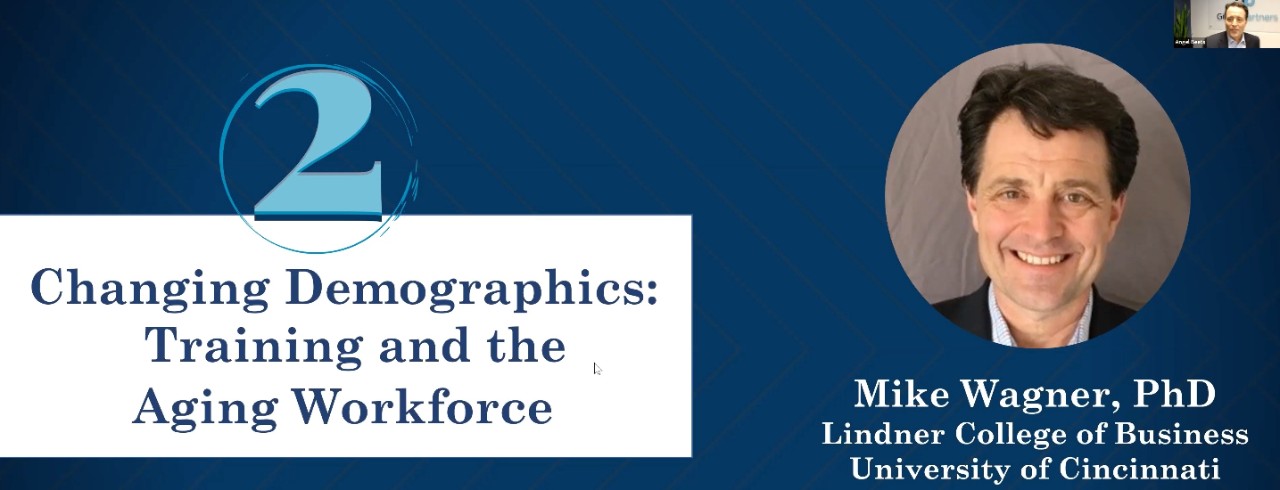
Employees 65 and older, who make up the fastest growing group in the United States workforce, are just as capable at learning new technologies as younger workers when they’re given the proper training, University of Cincinnati assistant professor Mike Wagner said.
Wagner, the director of the Master of Arts in Human Resources program in UC’s Carl H. Lindner College of Business, was one of seven speakers featured at an event presented by Gilman Partners, a Cincinnati executive search, talent acquisition and leadership development firm. Each presenter spoke for seven minutes via Zoom to more than 100 business professionals about attracting, retaining or developing talent.
Wagner’s presentation focused on training and the aging workforce, a topic that’s gaining importance as America’s population gets older. From 2006 to 2016, the number of people 65 and older in the U.S. grew from 37 million to 49 million. By 2060, that number is expected to approach 100 million.
Older workers are just as capable and just as willing to learn new technologies as people in other generations.
Mike Wagner Director of the Master of Arts in Human Resources Program in UC’s Carl H. Lindner College of Business
Those older Americans are remaining in the workforce longer, but often their abilities are underestimated because of stereotypes, Wagner said.
“The research shows that this group of people, age 65 and older, very often are passed over for training opportunities in the workforce,” he said. “And this is because of stereotypes that people have of them — that they’re technophobic or they’re inflexible or they’re not adaptable. Another thing that the research shows is that these are just stereotypes. Older workers are just as capable and just as willing to learn new technologies as people in other generations.”
Older people do tend to be lower in “self-efficacy,” or an individual’s belief in their own capacity to perform a specific task, Wagner said. Employees can gain self-efficacy, though, regardless of generation, by learning from role models, through verbal encouragement and from previous successes, Wagner said.
“Self-efficacy just on its own helps people to do better on their task,” he said.
Next Lives Here
The University of Cincinnati is classified as a Research 1 institution by the Carnegie Commission and is ranked in the National Science Foundation's Top-35 public research universities. UC's undergraduate, graduate and medical students and faculty investigate problems and innovate solutions with real-world impact. Next Lives Here.
Related Stories
Lindner graduate students shine in international simulation competition
November 10, 2025
Five master’s of information systems (MS IS) students took home fifth place out of 23 universities at the International ERPsim Competition hosted by HEC Montreal during the recent spring semester. The competition tests students’ knowledge of enterprise resource planning (ERP) software and their ability to adapt to challenging business problems.
Sugar overload killing hearts
November 10, 2025
Two in five people will be told they have diabetes during their lifetime. And people who have diabetes are twice as likely to develop heart disease. One of the deadliest dangers? Diabetic cardiomyopathy. But groundbreaking University of Cincinnati research hopes to stop and even reverse the damage before it’s too late.
Is going nuclear the solution to Ohio’s energy costs?
November 10, 2025

The Ohio Capital Journal recently reported that as energy prices continue to climb, economists are weighing the benefits of going nuclear to curb costs. The publication dove into a Scioto Analysis survey of 18 economists to weigh the pros and cons of nuclear energy. One economist featured was Iryna Topolyan, PhD, professor of economics at the Carl H. Lindner College of Business.