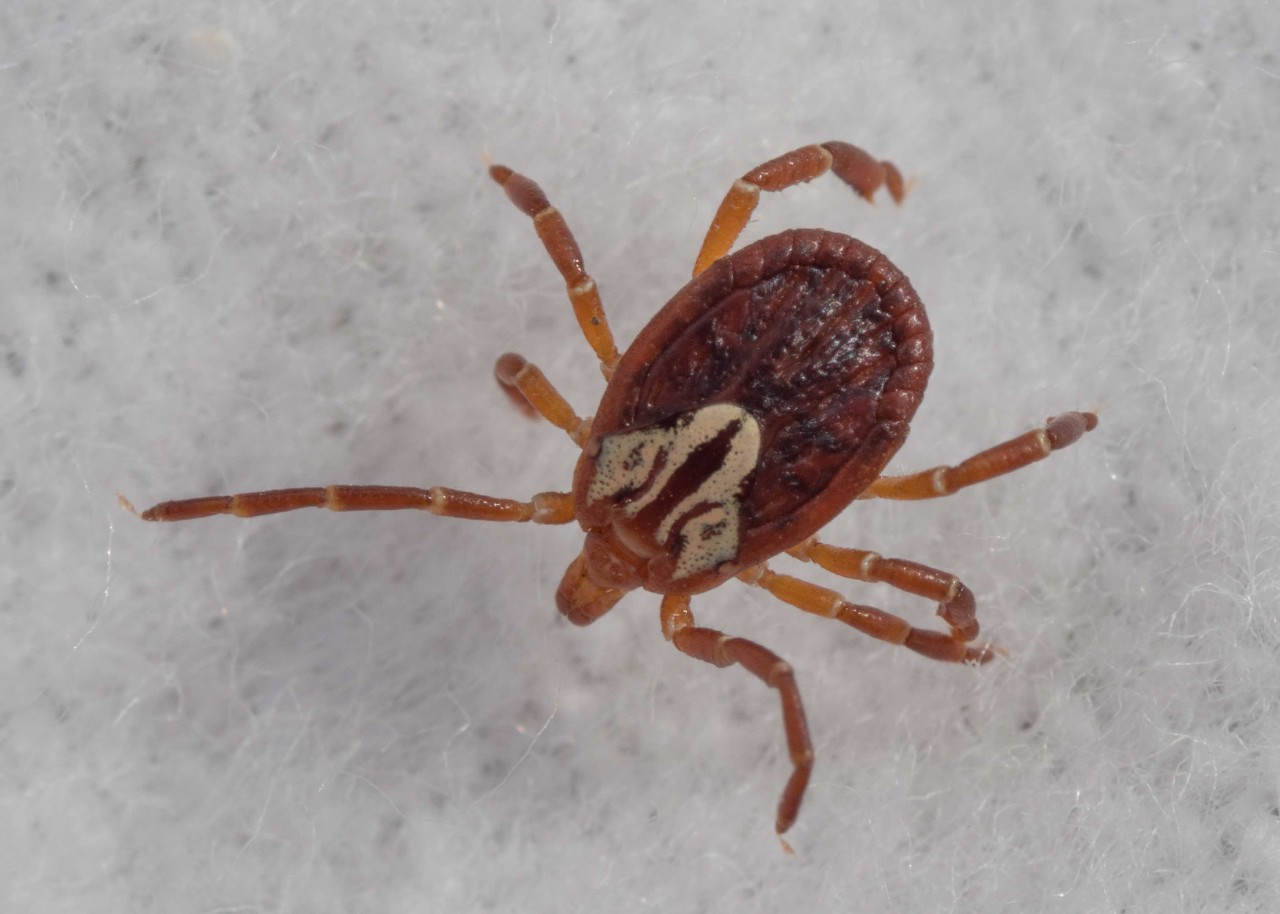
UC research helps develop new medicines for treating heart patients
Genetic sequencing from ticks key in drug development

New UC research discovered a unique class of medications that act as blood thinners by inhibiting an enzyme in the genes of tick saliva.
The research focused on novel direct thrombin inhibitors (DTI) from tick salivary transcriptomes, or messenger RNA molecules expressed by an organism. The result is the development of new anticoagulant medications that can be used to treat patients with a variety of coronary issues, including heart attacks. The study was published in Nature Communication.
“Interest in ticks as a model for developing drugs that prevent blood clotting — [often] the cause of heart attacks and strokes — is firmly rooted in evolutionary biology,” says Richard Becker, MD, professor and director of the UC Heart, Lung and Vascular Institute and UC Division of Cardiovascular Health and Disease at the UC College of Medicine.
“Analysis of backbone structures suggest a novel evolutionary pathway by which different blood clot inhibiting properties evolved through a series of gene duplication events. Comparison of naturally occurring blood clot inhibitors of differing tick species suggests an evolutionary divergence approximately 100 million years ago.”

Richard Becker, MD, professor and director, UC Heart, Lung and Vascular Institute and UC Division of Cardiovascular Health and Disease/Photo/Colleen Kelley/UC Creative + Brand
Becker, a co-author on the study, collaborated with researchers from the National University of Singapore, Duke University and the University of North Carolina on the study, which discovered DTIs from tick salivary transcriptomes and optimized their use as a pharmaceutical. The most potent is a key regulating enzyme in blood clot formation with very high specificity and binding capacity that is almost 500 times that of bivalirudin, a drug used during a typical nonsurgical procedure used to treat narrowing of the coronary arteries. Those minimally invasive procedures are performed in roughly 1 million persons yearly in the United States.
“Despite their greater ability to reduce the incidence of the formation of blood clots, the drugs demonstrated less bleeding, achieving a wider therapeutic index in nonhuman models,” Becker says. “The higher potency of the drug means it’s not necessary to use a lot of it in treating patients, which holds the cost of goods and manufacturing down.”
Becker says tick saliva, as in others that feed on blood like mosquitoes, sand flies, tsetse and black flies, contains pharmacological and immunological active compounds, which modulate immune responses and induce antibody production. This research leveraged an understanding of tick-host interactions and antibody formation.
“The holy grail of anticoagulant therapy has always been specificity, selectivity, efficacy and safety,” says Becker. “Clinician-scientists must have the training and an environment that embraces asking questions and finding solutions, including those potential found deep within nature. An ability to both measure and adjust the drug dose and rapidly reverse its effects is particularly important for safety purposes. The next step is to complete pharmacology, toxicology, drug stability and other important regulatory steps before conducting clinical trials in humans.”
Lead photo/Jay Yocis/UC Creative + Brand
Next Lives Here
The University of Cincinnati is classified as a Research 1 institution by the Carnegie Commission and is ranked in the National Science Foundation's Top-35 public research universities. UC's medical, graduate and undergraduate students and faculty investigate problems and innovate solutions with real-world impact. Next Lives Here.
Related Stories
Sugar overload killing hearts
November 10, 2025
Two in five people will be told they have diabetes during their lifetime. And people who have diabetes are twice as likely to develop heart disease. One of the deadliest dangers? Diabetic cardiomyopathy. But groundbreaking University of Cincinnati research hopes to stop and even reverse the damage before it’s too late.
App turns smartwatch into detector of structural heart disease
November 10, 2025

An app that uses an AI model to read a single-lead ECG from a smartwatch can detect structural heart disease, researchers reported at the 2025 Scientific Sessions of the American Heart Association. Although the technology requires further validation, researchers said it could help improve the identification of patients with heart failure, valvular conditions and left ventricular hypertrophy before they become symptomatic, which could improve the prognosis for people with these conditions.
Combination immunotherapy helps overcome melanoma treatment resistance
November 10, 2025

MSN highlighted research led by the University of Cincinnati Cancer Center's Trisha Wise-Draper showing a combination of immunotherapy medications can activate a robust immune response and help overcome treatment resistance in patients with refractory melanoma.