Medical Xpress: Researchers identify new target to treat pediatric brain tumors
UC's Timothy Phoenix part of team researching pediatric diffuse midline gliomas

Researchers have identified the role of a key gene that helps a type of pediatric brain tumor to grow, which could help develop better treatments.
Diffuse midline gliomas, formerly referred to as Diffuse Intrinsic Pontine Gliomas (DIPG), are tumors of the primary central nervous system, meaning they begin in the brain or spinal cord. Each year, approximately 200-300 children in the United States are diagnosed with this tumor that is commonly located in the brain stem, with a nearly zero percent survival rate.
Recent research published by the University of Cincinnati's Timothy Phoenix, PhD, assistant professor in UC’s James L. Winkle College of Pharmacy Division of Pharmaceutical Sciences and a UC Cancer Center member, as well as colleagues from the Dana-Farber Cancer Insitute, Broad Institute of MIT and Harvard and others, focused on a gene called PPM1D.
The researchers found PPM1D is a gene that helps promote the growth of the tumors and that drugs could potentially target this gene to treat patients. In animal models of the tumors, the tumor cells died when the gene was disabled.
Read the Medical Xpress article.
Read more about Dr. Phoenix's research into diffuse midline gliomas.
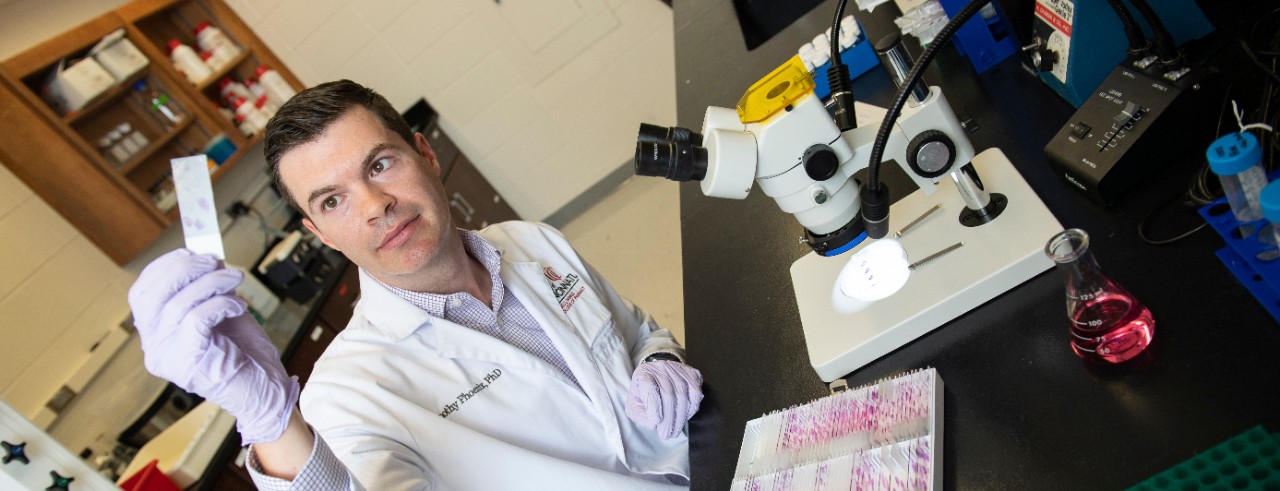
Featured photo at top of Dr. Phoenix: Photo/Colleen Kelley/UC Creative + Brand
Related Stories
Sugar overload killing hearts
November 10, 2025
Two in five people will be told they have diabetes during their lifetime. And people who have diabetes are twice as likely to develop heart disease. One of the deadliest dangers? Diabetic cardiomyopathy. But groundbreaking University of Cincinnati research hopes to stop and even reverse the damage before it’s too late.
Is going nuclear the solution to Ohio’s energy costs?
November 10, 2025

The Ohio Capital Journal recently reported that as energy prices continue to climb, economists are weighing the benefits of going nuclear to curb costs. The publication dove into a Scioto Analysis survey of 18 economists to weigh the pros and cons of nuclear energy. One economist featured was Iryna Topolyan, PhD, professor of economics at the Carl H. Lindner College of Business.
App turns smartwatch into detector of structural heart disease
November 10, 2025

An app that uses an AI model to read a single-lead ECG from a smartwatch can detect structural heart disease, researchers reported at the 2025 Scientific Sessions of the American Heart Association. Although the technology requires further validation, researchers said it could help improve the identification of patients with heart failure, valvular conditions and left ventricular hypertrophy before they become symptomatic, which could improve the prognosis for people with these conditions.