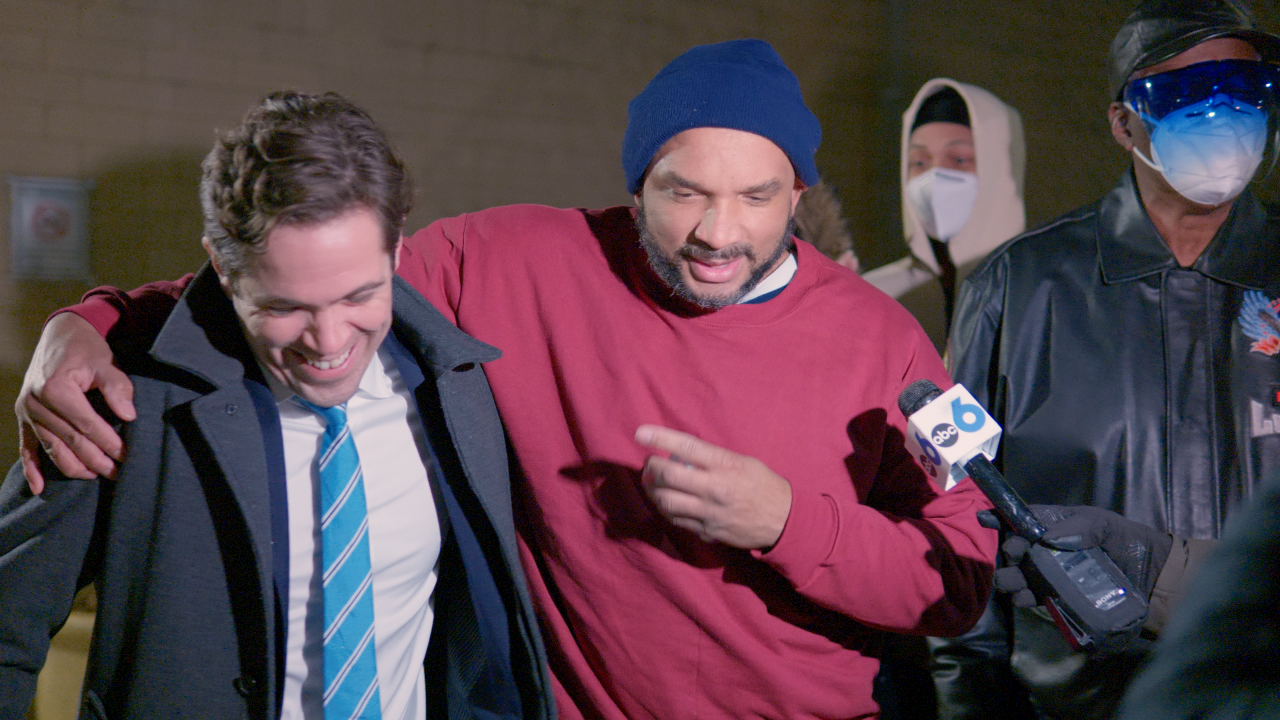
BNC News: Richard Horton discusses new trial, 16-year prison sentence
Ohio Innocence Project client grateful for a chance to clear his name

Richard Horton’s first day of freedom consisted of simply joys.
“Nothing extravagant,” Horton told BNC News for a video segment. “I don’t want to be famous, but I want to be around the people who supported me.”
Horton enjoyed a meal with his family along with attorney, Brian Howe of the Ohio Innocence Project (OIP) at the University of Cincinnati College of Law, and law students who supported his case for a new trial.
Horton, 45, was convicted in 2006 and sentenced to 23 years in prison for allegedly breaking into a home in Columbus and shooting a victim in the leg during an armed robbery. He was released last week after 16 years and will receive a new trial thanks to the efforts of a team of attorneys and law students from OIP.
Howe says that new technological advances with DNA analysis helped convince a judge that Horton deserved a new trial. This case came out of an armed robbery in 2004 in Columbus, Ohio, during which a couple were robbed in a home by an individual with a gray hoodie. A victim was shot with a 9mm pistol and police found a casing with a fingerprint on it. Horton offered an alibi but an eyewitness statement led to a conviction.
“In 2004, it was possible to get DNA testing on obvious things like blood and bodily fluids,” Howe told BNC News. “We are talking about DNA from a person who deposited skin cells on a shell casing when they touched it. The casing was fired so it was on a piece of metal that was very difficult to recover DNA from and subjected to a lot of heat.”
Howe says that only the past few years has the technology advanced to allow minute skin cells deposited on that tracing to be useful for analysis.
Listen to the video segment from BNC News online
Featured image of Richard Horton hugging Brian Howe of the Ohio Innocence Project. Photo submitted.
Related Stories
Sugar overload killing hearts
November 10, 2025
Two in five people will be told they have diabetes during their lifetime. And people who have diabetes are twice as likely to develop heart disease. One of the deadliest dangers? Diabetic cardiomyopathy. But groundbreaking University of Cincinnati research hopes to stop and even reverse the damage before it’s too late.
Is going nuclear the solution to Ohio’s energy costs?
November 10, 2025

The Ohio Capital Journal recently reported that as energy prices continue to climb, economists are weighing the benefits of going nuclear to curb costs. The publication dove into a Scioto Analysis survey of 18 economists to weigh the pros and cons of nuclear energy. One economist featured was Iryna Topolyan, PhD, professor of economics at the Carl H. Lindner College of Business.
App turns smartwatch into detector of structural heart disease
November 10, 2025

An app that uses an AI model to read a single-lead ECG from a smartwatch can detect structural heart disease, researchers reported at the 2025 Scientific Sessions of the American Heart Association. Although the technology requires further validation, researchers said it could help improve the identification of patients with heart failure, valvular conditions and left ventricular hypertrophy before they become symptomatic, which could improve the prognosis for people with these conditions.