Innovate Healthcare: How AI changes radiologists' approach to stroke care
UC expert says strategic use of AI can augment, not replace human analysis

As artificial intelligence (AI) capabilities increase, there is sometimes concern that machine learning will replace the work done by human experts.
In the field of radiology and stroke care, however, radiologists see the progression of AI as an opportunity to bolster the work they do.
Achala Vagal, MD, vice chair of research and professor of radiology in the University of Cincinnati’s College of Medicine and a UC Health neuroradiologist, cowrote a recent editorial in the journal Radiology with Luca Saba, MD, of the University of Cagliari in Italy. Innovate Healthcare's Health Imaging, an online publication, recently highlighted the editorial, noting Vagal and Saba said that AI will not replace radiologists, but rather will "augment our intelligence and workflow."
The radiologists said AI is helpful in improving workflows, detecting issues the human eye cannot see and offering suggested decision-making support in time-sensitive triage scenarios, but AI being used as the standalone decision maker for treatments has led to medical errors.
“It is important to understand the intended clinical use of the technology,” the doctors explained. “The best use case scenario is not autonomous AI, but rather AI partnered with human supervision.”
Read the Innovate Healthcare article.
Read more about Dr. Vagal's current stroke recovery research.
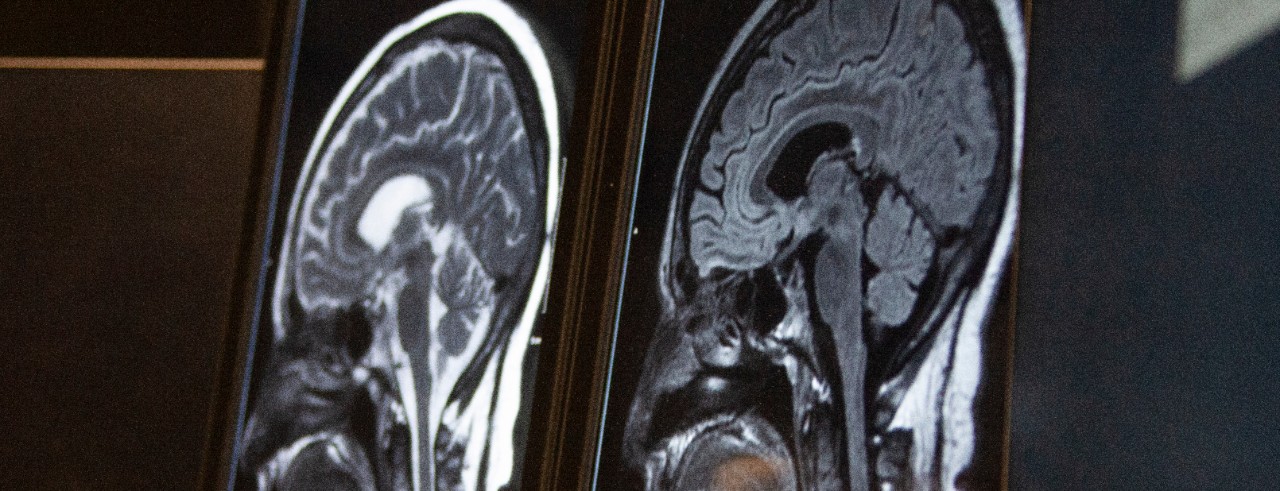
Featured photo at top of brain scans. Photo/Ravenna Rutledge/University of Cincinnati.
Related Stories
Sugar overload killing hearts
November 10, 2025
Two in five people will be told they have diabetes during their lifetime. And people who have diabetes are twice as likely to develop heart disease. One of the deadliest dangers? Diabetic cardiomyopathy. But groundbreaking University of Cincinnati research hopes to stop and even reverse the damage before it’s too late.
Is going nuclear the solution to Ohio’s energy costs?
November 10, 2025

The Ohio Capital Journal recently reported that as energy prices continue to climb, economists are weighing the benefits of going nuclear to curb costs. The publication dove into a Scioto Analysis survey of 18 economists to weigh the pros and cons of nuclear energy. One economist featured was Iryna Topolyan, PhD, professor of economics at the Carl H. Lindner College of Business.
App turns smartwatch into detector of structural heart disease
November 10, 2025

An app that uses an AI model to read a single-lead ECG from a smartwatch can detect structural heart disease, researchers reported at the 2025 Scientific Sessions of the American Heart Association. Although the technology requires further validation, researchers said it could help improve the identification of patients with heart failure, valvular conditions and left ventricular hypertrophy before they become symptomatic, which could improve the prognosis for people with these conditions.