Daily Mail: Meet a colorful but colorblind spider
University of Cincinnati biologists found that one jumping spider could not see its own vivid reds

The UK Daily Mail highlighted research by the University of Cincinnati and an international team of scientists looking at the vision of a colorful jumping spider.
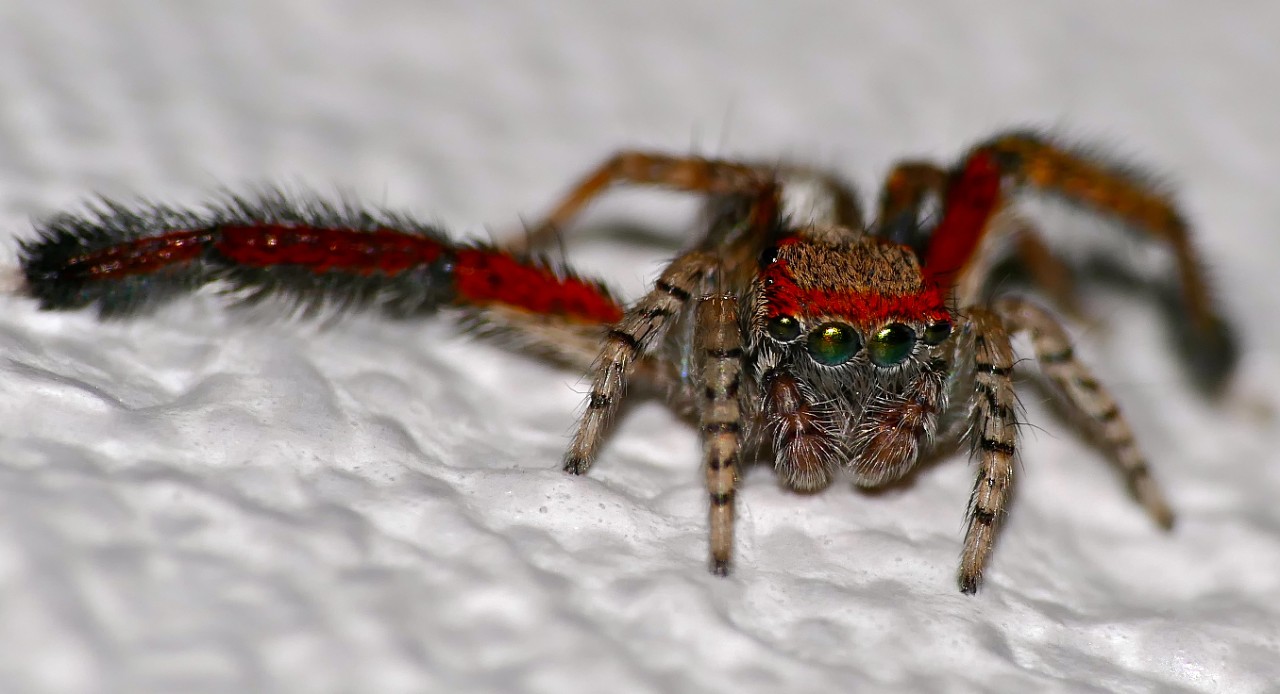
UC College of Arts and Sciences biologist Nathan Morehouse and former UC postdoctoral researcher David Outomuro worked with researchers in Europe to examine Saitis barbipes, a jumping spider with vibrant red markings on its face and legs.
“We assumed they were using color for communication. But we didn’t know if their visual system even allowed them to see those colors,” said David Outomuro, a UC postdoctoral researcher now at the University of Pittsburgh.
Biologists collected spiders in Slovenia for lab study in Germany and used microspectrophotometry at UC to identify photoreceptors sensitive to various light wavelengths or colors. Unexpectedly, they found no evidence of a red photoreceptor. Likewise, they looked for colored filters within the eye that might shift green sensitivity to red, but found none.
Instead, they identified patches on the spider that strongly absorb ultraviolet wavelengths to appear as bright “spider green” to other jumping spiders. The red colors that are so vivid to us likely appear no different than black markings to jumping spiders.
“It’s a bit of a head-scratcher what’s going on here,” professor Morehouse said. “We haven’t solved the mystery of what the red is doing.”
The study was published in the journal The Science of Nature.
Featured image at top: An international team of researchers examined the color vision of the brightly colored jumping spider Saitis barbipes. Photo/Bernard Dupont/Wikimedia Commons

UC College of Arts and Sciences associate professor Nathan Morehouse worked with a team of international partners to examine the color vision of a jumping spider. Photo/Jay Yocis/UC Creative + Brand
More UC biology in the news

A jumping spider in a UC lab. Photo/Jay Yocis/UC Creative
- Science Daily: Meet a colorful but colorblind spider
- Technology Networks: The mystery of the colorful but colorblind spider
- Bioengineer.org: Meet a colorful but colorblind spider
- Euronews: Meet the bright red spider that can't appreciate its beauty
- Science Alert: This adorable jumping spider can't see its most vivid color
Related Stories
Sugar overload killing hearts
November 10, 2025
Two in five people will be told they have diabetes during their lifetime. And people who have diabetes are twice as likely to develop heart disease. One of the deadliest dangers? Diabetic cardiomyopathy. But groundbreaking University of Cincinnati research hopes to stop and even reverse the damage before it’s too late.
Is going nuclear the solution to Ohio’s energy costs?
November 10, 2025

The Ohio Capital Journal recently reported that as energy prices continue to climb, economists are weighing the benefits of going nuclear to curb costs. The publication dove into a Scioto Analysis survey of 18 economists to weigh the pros and cons of nuclear energy. One economist featured was Iryna Topolyan, PhD, professor of economics at the Carl H. Lindner College of Business.
App turns smartwatch into detector of structural heart disease
November 10, 2025

An app that uses an AI model to read a single-lead ECG from a smartwatch can detect structural heart disease, researchers reported at the 2025 Scientific Sessions of the American Heart Association. Although the technology requires further validation, researchers said it could help improve the identification of patients with heart failure, valvular conditions and left ventricular hypertrophy before they become symptomatic, which could improve the prognosis for people with these conditions.