Cincinnati Magazine's Realm highlights UC partnership
GE invests $5 million on a college-readiness program to improve diversity in engineering

Realm, Cincinnati Magazine's journal for Cincinnati CEOs, highlighted a new partnership between the University of Cincinnati and GE to improve diversity in engineering.
GE selected Cincinnati as one of four inaugural locations, aiming to inspire more than 3,500 local students ages 13 to 18, provide firsthand experiences of engineering and award financial support to pursue education in engineering. GE launched similar initiatives in South Africa, England and South Carolina as part of its goal to reach 85,000 students in 25 cities around the world over the next decade.
GE Foundation in 2021 announced the $100 million program to reach out to middle school and high school girls and students of color through its Next Engineers program.
"If students from those backgrounds aren't exposed to engineering before college, it can be really discouraging to step into a college classroom and not feel ready for that challenge," GE Aviation chief diversity officer Joe Allen told Realm.
UC will serve as GE's local partner.
UC College of Engineering and Applied Science Dean John Weidner told Cincinnati Magazine's Realm that the Next Engineers program is just one of many ways UC is addressing inclusion, including its Marian Spencer Scholars Program for high-achieving students in Cincinnati Public Schools.
"The bottom line for GE and for us as well is we need more engineers," Weidner told Realm. "We have to connect with students early to get them excited about engineering."
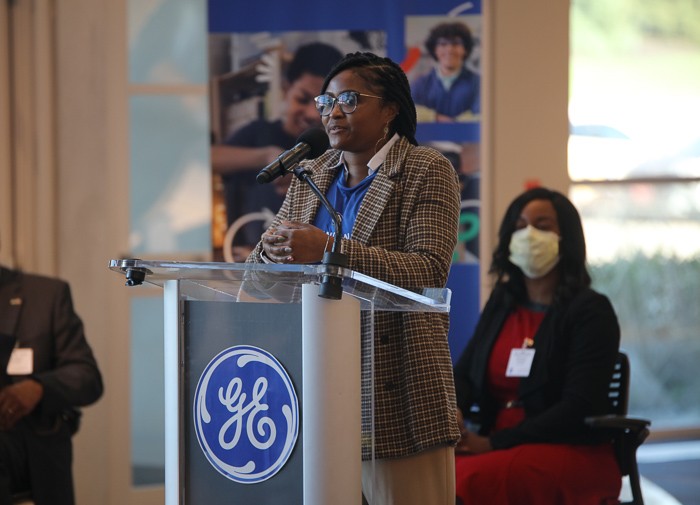
Featured image at top: GE Aviation engineer Alisha Kent-Davis talks about her experience as a young engineer during GE's announcement of Next Engineers. Photo/GE

UC President Neville Pinto, who spent his career teaching engineering, speaks about UC's partnership with GE to improve diversity in engineering. Photo/GE
Related Stories
Sugar overload killing hearts
November 10, 2025
Two in five people will be told they have diabetes during their lifetime. And people who have diabetes are twice as likely to develop heart disease. One of the deadliest dangers? Diabetic cardiomyopathy. But groundbreaking University of Cincinnati research hopes to stop and even reverse the damage before it’s too late.
Is going nuclear the solution to Ohio’s energy costs?
November 10, 2025

The Ohio Capital Journal recently reported that as energy prices continue to climb, economists are weighing the benefits of going nuclear to curb costs. The publication dove into a Scioto Analysis survey of 18 economists to weigh the pros and cons of nuclear energy. One economist featured was Iryna Topolyan, PhD, professor of economics at the Carl H. Lindner College of Business.
App turns smartwatch into detector of structural heart disease
November 10, 2025

An app that uses an AI model to read a single-lead ECG from a smartwatch can detect structural heart disease, researchers reported at the 2025 Scientific Sessions of the American Heart Association. Although the technology requires further validation, researchers said it could help improve the identification of patients with heart failure, valvular conditions and left ventricular hypertrophy before they become symptomatic, which could improve the prognosis for people with these conditions.