UC nursing faculty helps develop framework to improve maternal health outcomes
Expert committee releases report with short- and long-term recommendations


Beth Ann Clayton, DNP, CRNA, FAANA, FAAN
An expert committee that included a University of Cincinnati College of Nursing professor has released a new report with practical recommendations for enhancing maternal morbidity and mortality measurement to improve maternal health outcomes in the United States.
Beth Ann Clayton, DNP, CRNA, FAANA, FAAN, director of UC's nurse anesthesia program, was selected in 2019 to serve on the Maternal Morbidity and Mortality Committee, convened by the National Quality Forum (NQF) and funded by the Centers for Medicare & Medicaid Services. Throughout a 24-month period, the committee guided an assessment of current maternal morbidity and mortality measurements and recommended ways to enhance these measurements and improve health outcomes in maternity care.
Maternal morbidity and mortality indicators have steadily increased since 2000 in the U.S., according to the Centers for Disease Control & Prevention. In 2018, the maternal mortality ratio reached 17.4 maternal deaths per 100,000 live births – two to 10 times higher than nearly a dozen other developed countries with comparable inputs. This ratio is more than double for non-Hispanic Black women – 37.3 deaths per 100,000 live births. Women living in rural areas are also at greater risk for maternal mortality or severe maternal morbidity.
"Maternal health remains a tremendous challenge," Clayton says, adding that, each year in the U.S., 700 women die from pregnancy or delivery complications and more than 50,000 women suffer from unexpected outcomes of labor and delivery that result in negative health consequences.
The final NQF report includes two key measurement frameworks that account for the various influences on an individual's health outcomes related to maternal morbidity and mortality. These influences include health literacy, race, ethnicity, and other social determinants of health that are shown to exacerbate health disparities. The report offers recommendations and tangible steps for short and long-term measurement approaches throughout the maternal life cycle.
Clayton, a certified registered nurse anesthetist, has been providing obstetric anesthesia care in a variety of clinical settings for over 20 years. In addition, through the AANA Foundation, she led the obstetric anesthesia closed malpractice claims analysis. This work identified patterns of injuries and precipitating events and provided recommended interventions to improve care. Following this research, she was a primary author for the national "AANA Analgesia and Anesthesia for the Obstetric Patient Practice Guidelines" which provides clinicians a standardized approach to decrease maternal morbidity and mortality.
"It was a unique opportunity to participate on the committee to address gaps in health equity and improve maternal health through the development of recommendations and steps for short and long-term measurement of maternal health," Clayton says. "It was an honor to represent the University of Cincinnati on this important NQF work and contribute to the advancement of maternal care."
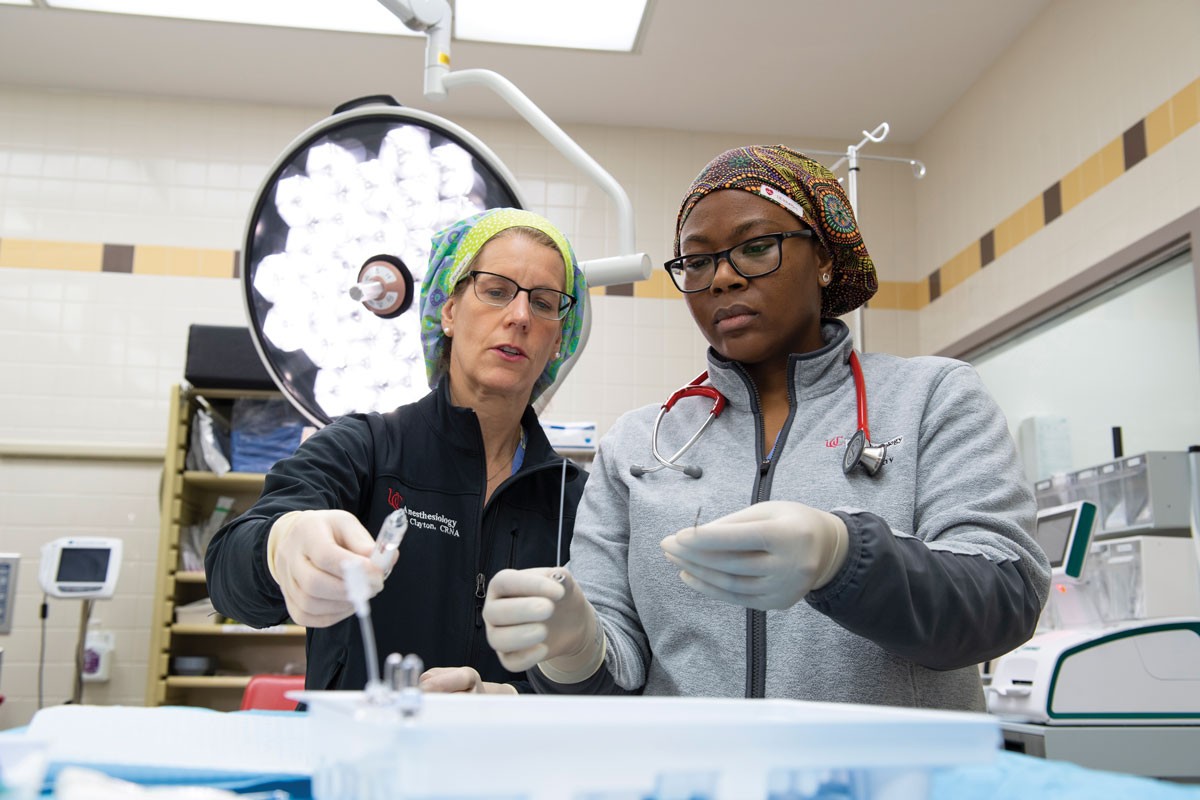
Image at top: Beth Ann Clayton and alumna Candace Holloway/Photo/Colleen Kelley/UC Creative + Brand
Related Stories
Sugar overload killing hearts
November 10, 2025
Two in five people will be told they have diabetes during their lifetime. And people who have diabetes are twice as likely to develop heart disease. One of the deadliest dangers? Diabetic cardiomyopathy. But groundbreaking University of Cincinnati research hopes to stop and even reverse the damage before it’s too late.
Is going nuclear the solution to Ohio’s energy costs?
November 10, 2025

The Ohio Capital Journal recently reported that as energy prices continue to climb, economists are weighing the benefits of going nuclear to curb costs. The publication dove into a Scioto Analysis survey of 18 economists to weigh the pros and cons of nuclear energy. One economist featured was Iryna Topolyan, PhD, professor of economics at the Carl H. Lindner College of Business.
App turns smartwatch into detector of structural heart disease
November 10, 2025

An app that uses an AI model to read a single-lead ECG from a smartwatch can detect structural heart disease, researchers reported at the 2025 Scientific Sessions of the American Heart Association. Although the technology requires further validation, researchers said it could help improve the identification of patients with heart failure, valvular conditions and left ventricular hypertrophy before they become symptomatic, which could improve the prognosis for people with these conditions.