Vanity Fair: Spiders play mind games
UC biologist explains how jumping spiders display surprising intelligence

Vanity Fair turned to University of Cincinnati spider expert Nathan Morehouse to explain the surprising intelligence demonstrated by certain spiders.
While people often associate intelligence with brain size, the tiny brains of these Tic Tac-sized spiders seem to support complex mental processes.
Nathan Morehouse, an associate professor of biological sciences in UC's College of Arts and Sciences, told Vanity Fair that jumping spiders, in particular, demonstrate smarts.
“Jumping spiders are remarkably clever animals,” Morehouse told Vanity Fair. “I always find it delightful when something like a humble jumping spider punctures our sense of biological superiority.”
One kind of jumping spider, Portia, hunts other spiders. BBC Earth chronicled how the spider uses a variety of hunting tactics to reach prey depending on the scenario — in some cases luring the prey closer by plucking its web like a captured fly. The spider also has an uncanny ability to study its environment to plot the best path to reach unsuspecting spiders by dropping down a line of silk above them.
“Even amongst this surprisingly intelligent group, Portia stands out as being oddly brilliant,” Morehouse said. “They are, after all, hunting very dangerous prey, so caution and cleverness are useful tools.”
Morehouse, who studies the visual acuity of spiders around the world in his lab, is director of UC's new Institute for Research in Sensing. The institute will host the second of eight public talks on senses 7 to 9 p.m. Nov. 18 at Lunken Airport's Greater Cincinnati Airmen Club. The night's topic: biomimicry and the future of sensing.

UC associate professor Nathan Morehouse studies the sensory abilities of spiders around the world. He is director of UC's Institute for Research in Sensing. Photo/Jay Yocis/UC Creative + Brand
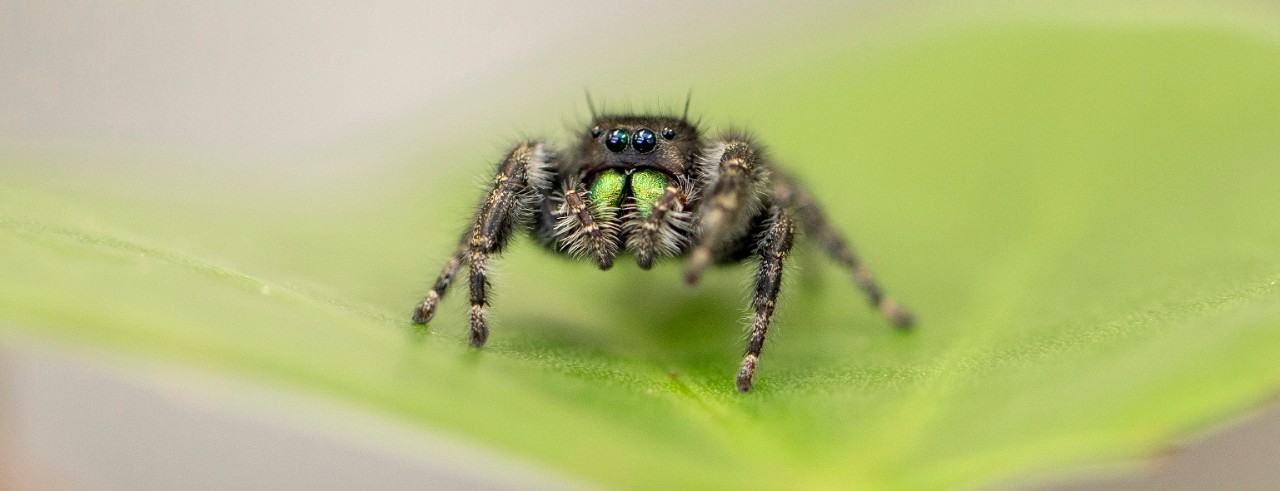
Featured image at top: A jumping spider. Photo/Joseph Fuqua II/UC Creative + Brand
Related Stories
Sugar overload killing hearts
November 10, 2025
Two in five people will be told they have diabetes during their lifetime. And people who have diabetes are twice as likely to develop heart disease. One of the deadliest dangers? Diabetic cardiomyopathy. But groundbreaking University of Cincinnati research hopes to stop and even reverse the damage before it’s too late.
Is going nuclear the solution to Ohio’s energy costs?
November 10, 2025

The Ohio Capital Journal recently reported that as energy prices continue to climb, economists are weighing the benefits of going nuclear to curb costs. The publication dove into a Scioto Analysis survey of 18 economists to weigh the pros and cons of nuclear energy. One economist featured was Iryna Topolyan, PhD, professor of economics at the Carl H. Lindner College of Business.
App turns smartwatch into detector of structural heart disease
November 10, 2025

An app that uses an AI model to read a single-lead ECG from a smartwatch can detect structural heart disease, researchers reported at the 2025 Scientific Sessions of the American Heart Association. Although the technology requires further validation, researchers said it could help improve the identification of patients with heart failure, valvular conditions and left ventricular hypertrophy before they become symptomatic, which could improve the prognosis for people with these conditions.