UC grant will increase training of clinicians to work with at-risk youth
Program reaches across several disciplines

A nearly $2 million grant to the University of Cincinnati’s College of Allied Health Sciences will establish the UC Bear-CAT Fellowship Program.
The goal of the project is to increase the number of adequately prepared graduate-level behavioral health clinicians entering and continuing practice with at-risk children, adolescents and transitional-age youth (ages 18-24) in the Greater Cincinnati region.
The UC Bear-CAT (Children, Adolescents and Transitional-Age Youth) Fellowship Program is a collaboration between the School of Social Work and the UC College of Education, Criminal Justice, and Human Services’ mental health counseling, school counseling and the doctoral-level school psychology programs.
Program participants will receive financial support, behavioral health training specific to the child, adolescent and transitional-age youth population, with additional training focused on team-based care in integrated behavioral health and primary care settings and telebehavioral health.

Molly Swaidan, Corey Whitworth and Julia Villareal, students in the Bear-CAT program/Photo/Colleen Kelly/UC Creative + Brand
“This project is similar to other behavioral health workforce training grants that the School of Social Work and Counseling Program has received in the past,” says Dana Harley, PhD, associate professor in the School of Social Work in the UC College of Allied Health Sciences. “Shauna Acquavita, PhD, in the School of Social Work, Michael Brubaker, PhD, and Amanda La Guardia, PhD, in mental health counseling and Tai Collins, PhD, in the doctoral school psychology program came together to brainstorm strategies to meet the behavioral health needs of youth in the region,” Harley said. “Through this collaboration, the Bear-CAT Fellowship was formed.”
More than a hundred students will be accepted over the course of four years. Stipends of $10,000 will be offered to master’s level students while doctoral level students will receive $25,000 stipends.
Julia Villarreal is a graduate student in the UC School of Psychology and says collaborating with students from different disciplines to create a comprehensive care model for patients is very appealing.
“I think there is a huge need to make sure that we’re developing our cultural competencies in terms of working with youth, making sure we’re taking a strengths-based, culturally sensitive approach for children and adolescents we’re working with,” says Villarreal. “I’m currently getting my school psychology degree, so the hope is to continue working either in schools or clinics with minoritized youth, so I think this is going to provide even more emphasis and background for that in the future.”
I think a lot of underlying issues that we see in social work can be addressed through mental health. I think a lot of people who have mental health problems are underserved.
Molly Swaidan of the School of Social Work
“I am excited about the interdisciplinary nature of this project,” says professor Harley. “It's always a pleasure to work with a skilled team of experts to plan the training of the next generation of behavioral health providers for children, adolescents and transitional-age youth.”
According to the Centers for Disease Control and Prevention (CDC), ADHD, behavior problems, anxiety and depression are the most commonly diagnosed mental disorders in children. The CDC reports that one in six children between the ages of two and eight in the United States (17.4%) had a diagnosed mental behavioral or developmental disorder.
Molly Swaidan, a second-year student in the School of Social Work is looking to this program to increase her training in the area of mental health.
“I think social work in general is really needed but specifically mental health,” says Swaidan. “I think a lot of underlying issues that we see in social work can be addressed through mental health. I think a lot of people who have mental health problems are underserved.”
Harley says the Bear-CAT program takes education out of the classroom and into the community.
“The students will take with them a plethora of knowledge, training, skills and experiences,” says Harley. “It also excites me the youth in the Greater Cincinnati region will have some of the best and brightest behavioral health professionals trained to meet their needs.”
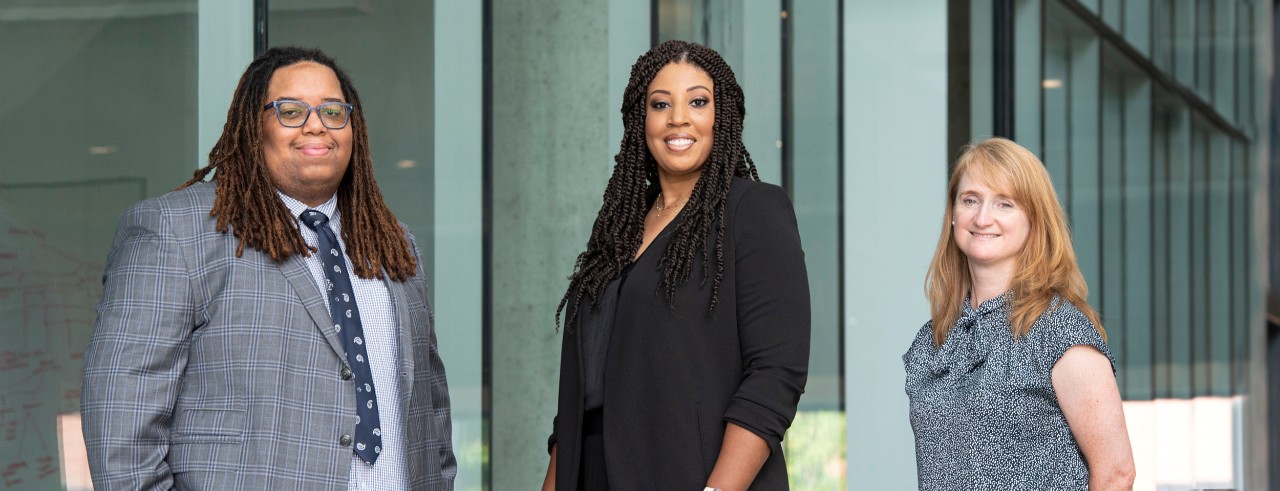
Lead photo of Tai Collins, Dana Harley and Shauna Acquavita/Colleen Kelley/UC Creative + Brand
Next Lives Here
The University of Cincinnati is classified as a Research 1 institution by the Carnegie Commission and is ranked in the National Science Foundation's Top-35 public research universities. UC's medical, graduate and undergraduate students and faculty investigate problems and innovate solutions with real-world impact. Next Lives Here.
Related Stories
Sugar overload killing hearts
November 10, 2025
Two in five people will be told they have diabetes during their lifetime. And people who have diabetes are twice as likely to develop heart disease. One of the deadliest dangers? Diabetic cardiomyopathy. But groundbreaking University of Cincinnati research hopes to stop and even reverse the damage before it’s too late.
Is going nuclear the solution to Ohio’s energy costs?
November 10, 2025

The Ohio Capital Journal recently reported that as energy prices continue to climb, economists are weighing the benefits of going nuclear to curb costs. The publication dove into a Scioto Analysis survey of 18 economists to weigh the pros and cons of nuclear energy. One economist featured was Iryna Topolyan, PhD, professor of economics at the Carl H. Lindner College of Business.
App turns smartwatch into detector of structural heart disease
November 10, 2025

An app that uses an AI model to read a single-lead ECG from a smartwatch can detect structural heart disease, researchers reported at the 2025 Scientific Sessions of the American Heart Association. Although the technology requires further validation, researchers said it could help improve the identification of patients with heart failure, valvular conditions and left ventricular hypertrophy before they become symptomatic, which could improve the prognosis for people with these conditions.