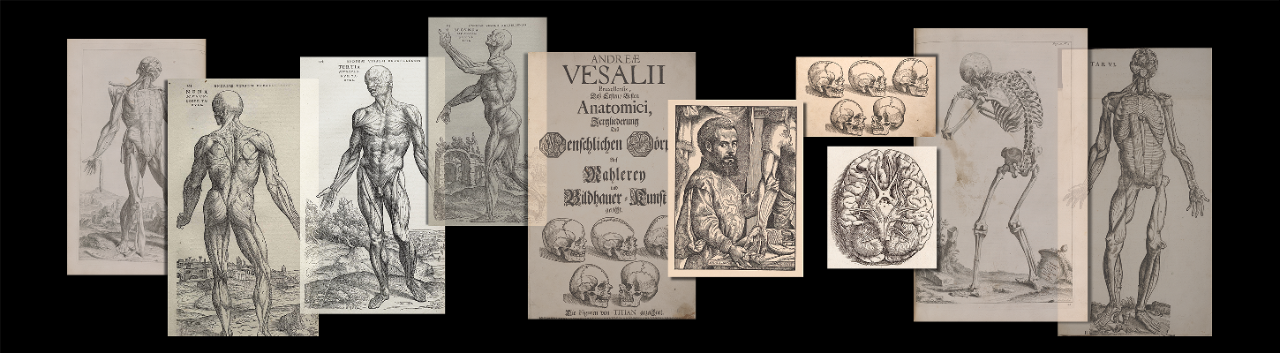
Lecture series and exhibits to examine works of Andreas Vesalius
'The Illustrated Human: The Impact of Andreas Vesalius' runs Oct. 26-March 15

Event Information (passed)
The Henry R. Winkler Center for the History of the Health Professions, along with University of Cincinnati Libraries and the UC College of Medicine, will celebrate the seminal work of Andreas Vesalius with a series of online and in-person lectures and exhibits. The series, titled “The Illustrated Human: The Impact of Andreas Vesalius,” is scheduled to run from Oct. 26, 2021, through March 15, 2022.

Andreas Vesalius
Andreas Vesalius was a Renaissance anatomist and physician who revolutionized the study and practice of medicine through his careful description of the anatomy of the human body. Basing his observations on dissections he made himself, he authored the first comprehensive textbook of anatomy, “De humani corporis fabrica libri septem” (“On the Fabric of the Human Body in Seven Books”). Published in 1543, “Fabrica” was the most extensive and accurate description of the human body of its time. Most likely drawn by Vesalius colleague Jan Stephan a Calcar and Italian artist Titian, “Fabrica” is widely known for its illustrations, where skeletons and bodies with exposed muscular structures pose in scenic, pastoral settings.
At the inaugural lecture, scheduled for 7 p.m., Tuesday, Oct. 26 via Zoom (register for event link), Philip M. Diller, MD, PhD, senior associate dean for educational affairs in the College of Medicine, and Gino Pasi, archivist and curator for the Winkler Center, will introduce the inspiration for and goals of the six-part lecture series, provide an overview of the storied life of Vesalius, introduce the speakers and planned topics, and describe the multiple exhibits available for viewing, including copies of Vesalius’ famous book.
The following lectures will feature noted scholars, researchers and medical professionals who will discuss Vesalius’ life story, his formative experiences and mentors, as well as the impact and controversies surrounding Vesalius and “Fabrica.” Panelists will discuss what Vesalius got right, what he got wrong and how the teaching of anatomy is relevant for other non-medical professions. In-person activities will be provided under CDC guidelines or local COVID-19 restrictions, with the well-being of all guests remaining the top priority.
Accompanying the lectures will be online and in-person exhibits. On display in the Donald C. Harrison Health Sciences Library beginning Nov. 16 will be the first (1543) and second (1555) editions of the “Fabrica,” the “Epitomie” (1543), a significantly scaled-down version for medical students, “ICONE” (1934), when the original book plates were last used), and the 2014 English translation, “The Fabric of the Human Body” by Daniel Garrison and Malcolm Hast. These books also will be complemented by story board displays that will rotate throughout the series in the Winkler Center’s Stanley J. Lucas, MD Board Room.
On display now through March 2022 in the John Miller Burnam Classics Library, located on the 400 level of Blegen Library, “Before Andreas Vesalius: Medicine in Antiquity,” features works from the library’s collection that could have influenced the work of Andreas Vesalius. In addition to rare books and manuscript facsimiles of works by and about ancient medicine, the exhibit includes an original Greek coin depicting the Greek “God of Medicine,” Asclepius, and a Roman coin of Salus, personification of “Health.”
COMING SOON: “The Illustrated Human” online exhibit will contain images from the “Fabrica” as well as supplemental information about Vesalius.
A full schedule, event location and registration details, as well as information about the accompanying exhibits, is included on the Vesalius web page.
“The Illustrated Human: The Impact of Andreas Vesalius” is sponsored by Stephen and Sandra Joffe.
Related Stories
Sugar overload killing hearts
November 10, 2025
Two in five people will be told they have diabetes during their lifetime. And people who have diabetes are twice as likely to develop heart disease. One of the deadliest dangers? Diabetic cardiomyopathy. But groundbreaking University of Cincinnati research hopes to stop and even reverse the damage before it’s too late.
App turns smartwatch into detector of structural heart disease
November 10, 2025

An app that uses an AI model to read a single-lead ECG from a smartwatch can detect structural heart disease, researchers reported at the 2025 Scientific Sessions of the American Heart Association. Although the technology requires further validation, researchers said it could help improve the identification of patients with heart failure, valvular conditions and left ventricular hypertrophy before they become symptomatic, which could improve the prognosis for people with these conditions.
Combination immunotherapy helps overcome melanoma treatment resistance
November 10, 2025

MSN highlighted research led by the University of Cincinnati Cancer Center's Trisha Wise-Draper showing a combination of immunotherapy medications can activate a robust immune response and help overcome treatment resistance in patients with refractory melanoma.