UC professor provides insight on disaster preparedness
Research aims to offer cost-effective solutions, reduce suffering

With hurricanes, floods, wildfires, earthquakes, the COVID-19 pandemic and more, the world has seen a multitude of natural disasters recently.
Research by University of Cincinnati professor Michael J. Fry that published in the Annals of Operations Research has provided insight into how the government and relief organizations could best prepare to respond to disasters, providing aid in an efficient and cost-effective manner while reducing human suffering.
“Anything that has a large impact on the public with uncertainty, we have to do some planning for that,” said Fry, who is a professor in UC’s Department of Operations, Business Analytics, and Information Systems in the Carl H. Lindner College of Business. “If you have a natural disaster and people can’t get food or water or medical supplies, the cost to society is huge because it can be life, death and human suffering.”

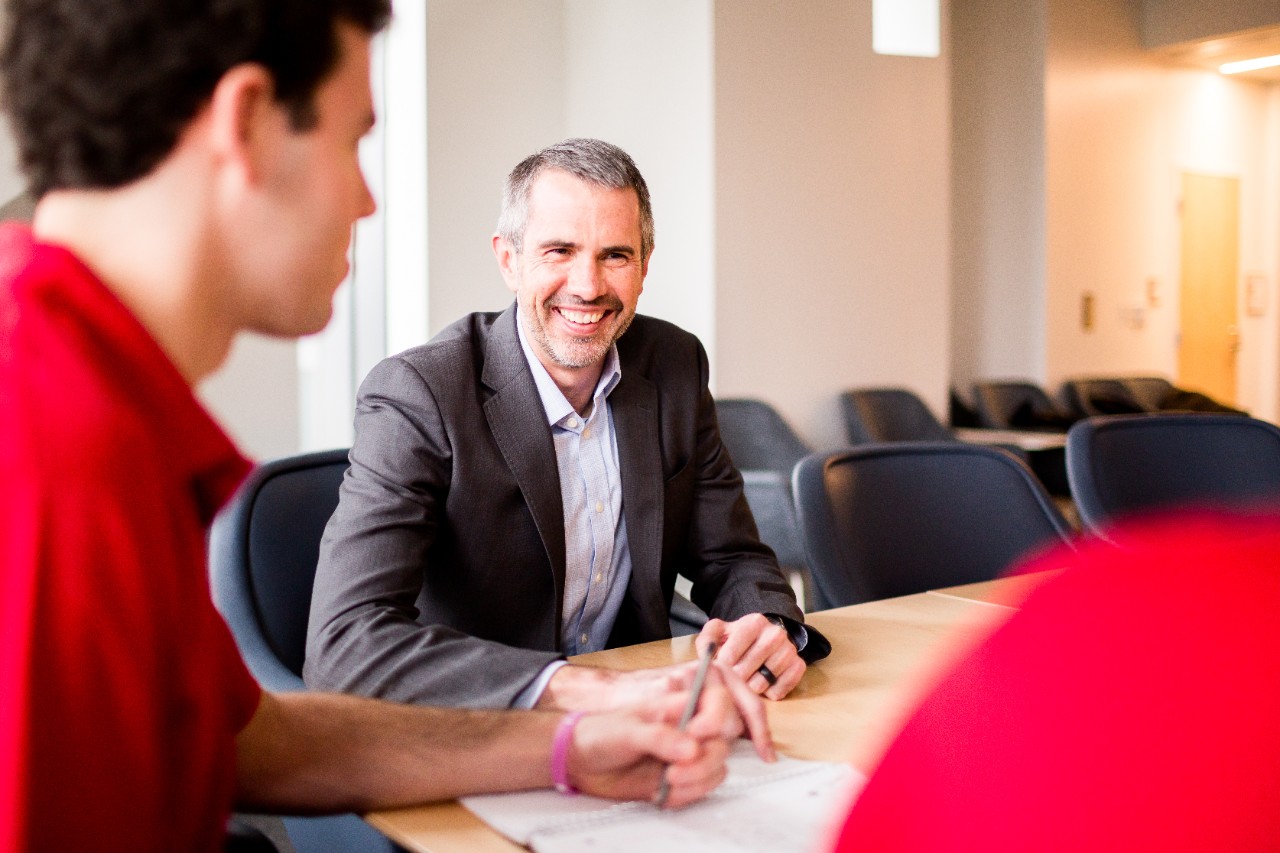
Michael Fry, a professor in the University of Cincinnati’s Department of Operations, Business Analytics, and Information Systems in the Carl H. Lindner College of Business, and colleagues from the University of St. Thomas and Georgia Southern University researched how the government and relief organizations could best prepare to respond to disasters. Photo/UC Foundation.
Balancing risks, costs
Fry has worked alongside Muer Yang and Sameer Kumar from the University of St. Thomas in Minnesota and Xinfang Wang from Georgia Southern University in Statesboro, Georgia, for several years on research into “robust optimization” — how you think about decision making under uncertain circumstances. Prior to looking at disaster preparedness, they applied their research to voting applications.
Wang, who earned a doctorate in business analytics from UC, suggested their studies into uncertainty would have applications in disaster preparedness.
Their research determined a single warehouse for the nation’s disaster relief supplies would be very cost efficient. However, a single location would be vulnerable to being damaged or destroyed by a disaster.
Having many small warehouses would help mitigate the risk of a disaster destroying supplies but could be very costly.
The researchers concluded having fewer, large facilities likely would be the best approach — although Fry said the exact solution is dependent on scenario-specific factors.
“The challenge is trying to think about given that we have limited information on where hurricanes are going to hit or earthquakes or whatever disaster you’re talking about, how many facilities do I need and where should I put them to keep this emergency response stock so then I can respond when an actual natural disaster happens?” he said.

Michael Fry, a professor at the University of Cincinnati, collaborated with researchers from the University of St. Thomas and Georgia Southern University on his research. Photo/UC Foundation.
Cooperation leads to best results
The research also found cooperation between the government and relief organizations, which Fry called “risk pooling,” can allow inventory to go where it’s most needed and provide the best possible response.
“If we can kind of centralize this and coordinate it, then it makes it much easier and more effective to respond,” he said. “If you have every regional municipality, city, state doing this, you’re going to end up with lots of different places of inventory who don’t share well. It’s going to be really expensive and really inefficient.”
Fry, who has studied “decision making under uncertainty” for more than 20 years, said people in government and academia seem to be coming to an agreement on how to best prepare for natural disasters. He thinks the research he and his colleagues worked on can further improve the planning as it accounts for uncertainty about when and where future disasters will occur — something that is happening more frequently as a result of climate change.
“What climate change is doing, it seems to be saying that historical data is less meaningful for the future because things have changed,” Fry said.
Featured image at top/UC Foundation
Next Lives Here
The University of Cincinnati is classified as a Research 1 institution by the Carnegie Commission and is ranked in the National Science Foundation's Top-35 public research universities. UC's medical, graduate and undergraduate students and faculty investigate problems and innovate solutions with real-world impact. Next Lives Here.
Related Stories
Lindner graduate students shine in international simulation competition
November 10, 2025
Five master’s of information systems (MS IS) students took home fifth place out of 23 universities at the International ERPsim Competition hosted by HEC Montreal during the recent spring semester. The competition tests students’ knowledge of enterprise resource planning (ERP) software and their ability to adapt to challenging business problems.
Sugar overload killing hearts
November 10, 2025
Two in five people will be told they have diabetes during their lifetime. And people who have diabetes are twice as likely to develop heart disease. One of the deadliest dangers? Diabetic cardiomyopathy. But groundbreaking University of Cincinnati research hopes to stop and even reverse the damage before it’s too late.
Is going nuclear the solution to Ohio’s energy costs?
November 10, 2025

The Ohio Capital Journal recently reported that as energy prices continue to climb, economists are weighing the benefits of going nuclear to curb costs. The publication dove into a Scioto Analysis survey of 18 economists to weigh the pros and cons of nuclear energy. One economist featured was Iryna Topolyan, PhD, professor of economics at the Carl H. Lindner College of Business.