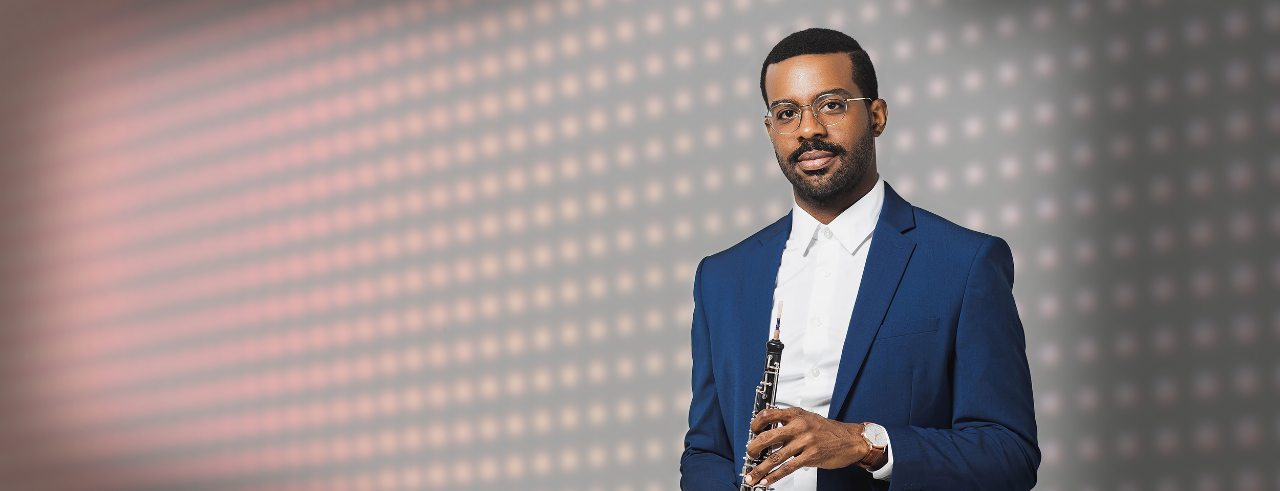
CCM Oboe Prof. Titus Underwood explores his ultimate playlist with BBC
The Emmy-winner highlights his most beloved pieces ranging from Margaret Bonds to Kanye West

UC College-Conservatory Oboe Professor Titus Underwood was recently featured on BBC’s Inside Music, sharing 16 tracks that are near and dear to his heart and carry musical influence over his performance. Underwood is the principal oboe of the Nashville Symphony Orchestra, a member of the UK-based Chineke! Orchestra, and a 2021 Sphinx Medal of Excellence recipient.
Beginning with an all-time favorite, Troubled Water by Margaret Bonds, Underwood makes a point of showcasing several Black composers on his list throughout, including Blind Tom Wiggins whom he describes as not getting, “the recognition he deserves in the classical canon.” He goes on to explain that while Wiggins had a lively career, he was enslaved for his entire life and was never credited enough for his elaborate technique and compositions.
Underwood added some classics to the mix as well, incorporating the buoyant first movement of Mozart’s Serenade in C Minor and Bach’s Brandenburg Concerto No. 2 in F Major. The listener is met with surprises along the way, as Underwood sprinkled in more modern records from artists OutKast and Sylvan Esso. “I remember when I first heard this song in college,” the Julliard-grad says of Kanye West’s Can’t Tell Me Nothing. “...It became my anthem. This is the song that I would play in my headphones when I would show up to oboe auditions.”
Underwood rounds out his selections with John Rosamond Johnson’s Fantasia on Lift Every Voice, a wind arrangement by Fred Onovwerosuoke of what is commonly referred to as the Black National Anthem. This recording features Underwood on the oboe along with 12 of his friends, all Black musicians in major symphony orchestras, including CCM Flute Professor Demarre McGill. The performance is also available to watch online.
“After [George Floyd] happened I felt this Lift Every Voice should be not just an audio piece, but a visual piece," Underwood says. "This was our way of protesting through art, this was our way of saying something through art using all these voices and platforms combined together, unified, to inspire and move people forward in the right direction.”
The full interview is available to stream on bbc.co.uk/sounds through October 16. Content disclaimer: The program contains racilly sensitive language.
Featured image at top provided by Underwood.
Impact Lives Here
The University of Cincinnati is leading public urban universities into a new era of innovation and impact. Our faculty, staff and students are saving lives, changing outcomes and bending the future in our city's direction. Next Lives Here.

Jaime Sharp
CCM Graduate Assistant, Marketing + Communications
Jaime Sharp is a master's student studying Vocal Performance at CCM. She serves as the Vice President of the CCM Graduate Student Association and Student Liaison for the CCM DEI Committee. Jaime holds a bachelor's from the University of Michigan.
Related Stories
Sugar overload killing hearts
November 10, 2025
Two in five people will be told they have diabetes during their lifetime. And people who have diabetes are twice as likely to develop heart disease. One of the deadliest dangers? Diabetic cardiomyopathy. But groundbreaking University of Cincinnati research hopes to stop and even reverse the damage before it’s too late.
Is going nuclear the solution to Ohio’s energy costs?
November 10, 2025

The Ohio Capital Journal recently reported that as energy prices continue to climb, economists are weighing the benefits of going nuclear to curb costs. The publication dove into a Scioto Analysis survey of 18 economists to weigh the pros and cons of nuclear energy. One economist featured was Iryna Topolyan, PhD, professor of economics at the Carl H. Lindner College of Business.
App turns smartwatch into detector of structural heart disease
November 10, 2025

An app that uses an AI model to read a single-lead ECG from a smartwatch can detect structural heart disease, researchers reported at the 2025 Scientific Sessions of the American Heart Association. Although the technology requires further validation, researchers said it could help improve the identification of patients with heart failure, valvular conditions and left ventricular hypertrophy before they become symptomatic, which could improve the prognosis for people with these conditions.