The Cincinnati Enquirer: UC’s Early IT program helping to curb talent shortage
Partnership allows high school students to earn college credits

The University of Cincinnati's Early Information Technology program is preparing students for in-demand jobs and helping them save money by graduating early, the Cincinnati Enquirer reported.
According to a report from consulting firm Korn Ferry, more than 85 million IT jobs worldwide could go unfilled by 2030 "because there aren't enough skilled people to take them."
Hazem Said, director of UC’s School of Information Technology, said he’s heard about the shortage from local industry partners for nearly a decade. In response, he's crafted the Early IT program and recruited more than 30 local school districts to sign on, offering any student who joins and does well automatic admission into the university.
“If our talent in Cincinnati, in Ohio, in the United States is not globally competitive, it will impact our ability as a country, as an economy, as a culture, as a philosophy to thrive in the world of tomorrow," Said said.
There are more than 1,100 high school students in the program and 1,200 university students in UC's IT college.
Colby Nolasco, a 2020 graduate of Lebanon High School, joined the Early IT program during his junior year of high school after hearing he could learn how to code his own video games.
He earned the credits equivalent to one year of college by the time he graduated from high school and is on track to graduate from the five-year master's program a year early.
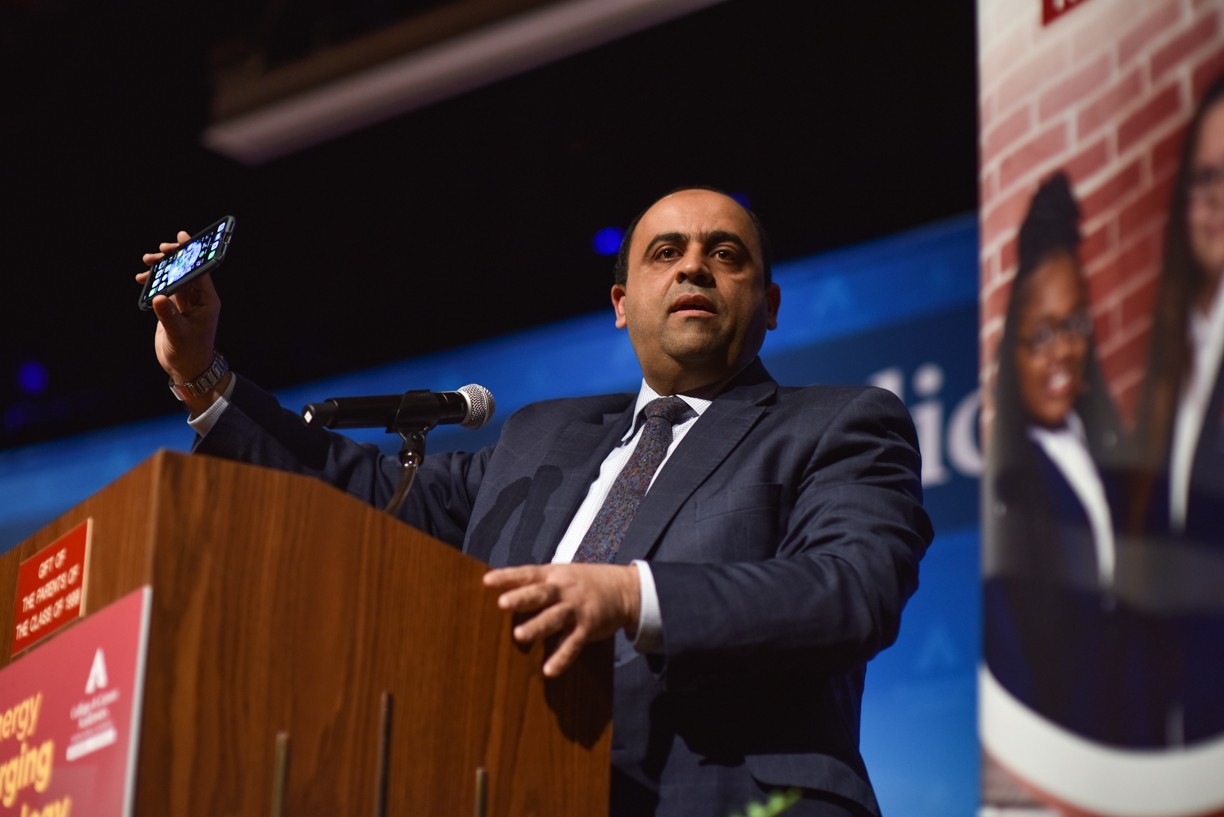
Featured image at top: Hazem Said, director of UC's School of Information Technology, addresses Akron's Kenmore-Garfield High School in February 2020 when the school joined as a partner in the Early IT Program. Photo/Shane Wynn Photography
Impact Lives Here
The University of Cincinnati is leading public urban universities into a new era of innovation and impact. Our faculty, staff and students are saving lives, changing outcomes and bending the future in our city's direction. Next Lives Here.
Related Stories
Sugar overload killing hearts
November 10, 2025
Two in five people will be told they have diabetes during their lifetime. And people who have diabetes are twice as likely to develop heart disease. One of the deadliest dangers? Diabetic cardiomyopathy. But groundbreaking University of Cincinnati research hopes to stop and even reverse the damage before it’s too late.
Is going nuclear the solution to Ohio’s energy costs?
November 10, 2025

The Ohio Capital Journal recently reported that as energy prices continue to climb, economists are weighing the benefits of going nuclear to curb costs. The publication dove into a Scioto Analysis survey of 18 economists to weigh the pros and cons of nuclear energy. One economist featured was Iryna Topolyan, PhD, professor of economics at the Carl H. Lindner College of Business.
App turns smartwatch into detector of structural heart disease
November 10, 2025

An app that uses an AI model to read a single-lead ECG from a smartwatch can detect structural heart disease, researchers reported at the 2025 Scientific Sessions of the American Heart Association. Although the technology requires further validation, researchers said it could help improve the identification of patients with heart failure, valvular conditions and left ventricular hypertrophy before they become symptomatic, which could improve the prognosis for people with these conditions.