Impossible Engineering: UC student explains tech behind Osprey precursor
Aerospace student explains why Bell XV-3 was groundbreaking

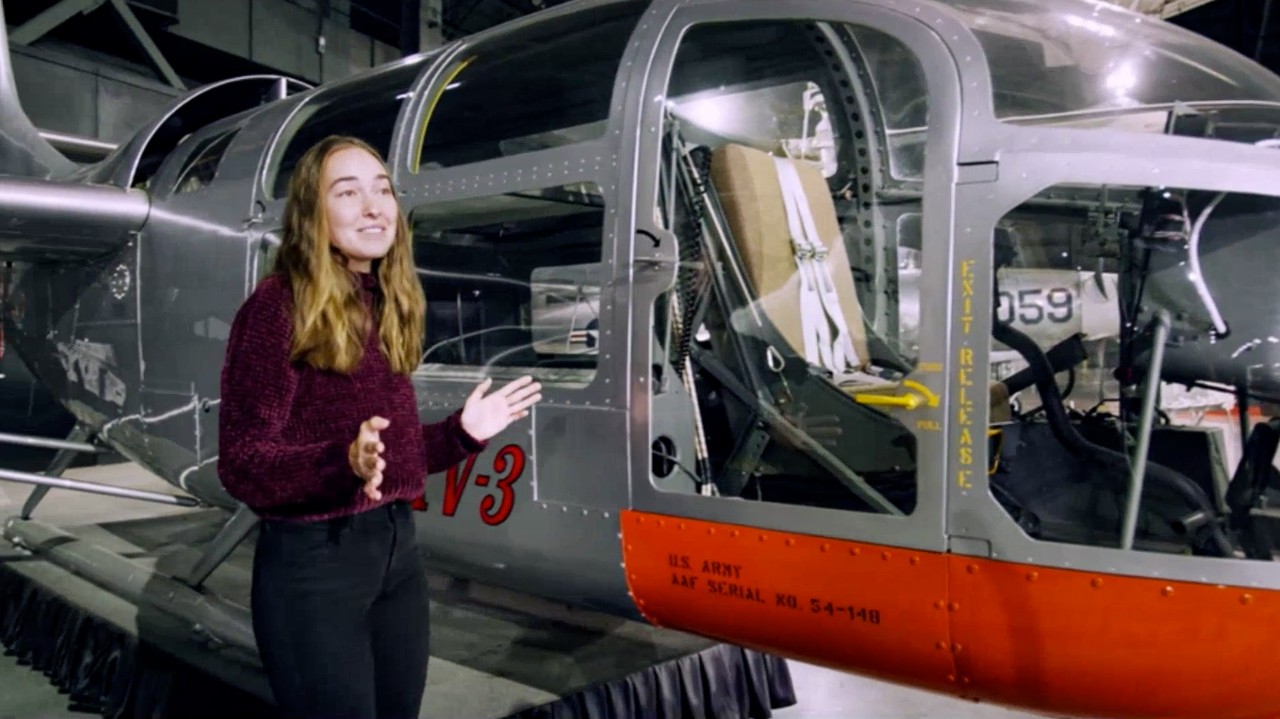
The Science Channel series "Impossible Engineering" turned to University of Cincinnati aerospace engineering student Lynn Pickering to explain the technology behind a flying marvel of aviation: the Bell XV-3.
Pickering, a doctoral student in UC's College of Engineering and Applied Science, helped interpret the groundbreaking technology behind the twin-rotor aircraft that was a precursor of the Bell Boeing V-22 Osprey for Season 10 of "Impossible Engineering."
For the episode, Pickering went to the National Museum of the U.S. Air Force in Dayton, Ohio, to see the last known XV-3, developed in 1955.
"Look at this thing! It looks straight out of a sci-fi film!" Pickering said.
Like the Osprey, the Bell XV-3 could take off vertically. Once airborne, it could rotate its twin propellers vertically, providing the longer range and faster speed of an airplane.
"This aircraft is actually the first attempt at tilt-rotor technology," Pickering said.
Pickering explained the many design and engineering challenges tilt-rotor technology presented. The aircraft were prone to structural and vibration issues.
"This is one of the most exciting pieces of aviation engineering I've ever seen," Pickering said. "The XV-3 might just be one of the most important pieces of aviation engineering. It took this concept of combining two technologies, which a lot of people thought impossible, and proved it was possible."
"Impossible Engineering" is streaming on the Science Channel.

UC aerospace engineering student Lynn Pickering helps explain the engineering behind the world's first tilt-rotor aircraft, the Bell XV-3, for the Science Channel show "Impossible Engineering." Photo/Science Channel
Related Stories
Sugar overload killing hearts
November 10, 2025
Two in five people will be told they have diabetes during their lifetime. And people who have diabetes are twice as likely to develop heart disease. One of the deadliest dangers? Diabetic cardiomyopathy. But groundbreaking University of Cincinnati research hopes to stop and even reverse the damage before it’s too late.
Is going nuclear the solution to Ohio’s energy costs?
November 10, 2025

The Ohio Capital Journal recently reported that as energy prices continue to climb, economists are weighing the benefits of going nuclear to curb costs. The publication dove into a Scioto Analysis survey of 18 economists to weigh the pros and cons of nuclear energy. One economist featured was Iryna Topolyan, PhD, professor of economics at the Carl H. Lindner College of Business.
App turns smartwatch into detector of structural heart disease
November 10, 2025

An app that uses an AI model to read a single-lead ECG from a smartwatch can detect structural heart disease, researchers reported at the 2025 Scientific Sessions of the American Heart Association. Although the technology requires further validation, researchers said it could help improve the identification of patients with heart failure, valvular conditions and left ventricular hypertrophy before they become symptomatic, which could improve the prognosis for people with these conditions.