Voice of America: Drones on a leash
UC designs semi-autonomous drone that can be operated on a tether

Voice of America in Russia highlighted the University of Cincinnati's innovations with tethered drones.
UC College of Engineering and Applied Science professor Manish Kumar and his doctoral student Shraddha Barawkar designed a semi-autonomous navigation system that enables drones to remain stable in the sky in turbulent winds or when pulled by the tether attached to the ground.
The goal is to create an easy-to-operate drone for all the myriad uses where an eye in the sky would be beneficial.
UC’s custom navigation system uses artificial intelligence based on fuzzy logic, a type of computer decision making that relies on degrees of truth rather than a binary true-false dichotomy. This makes it a more robust system because no precise inputs are required.
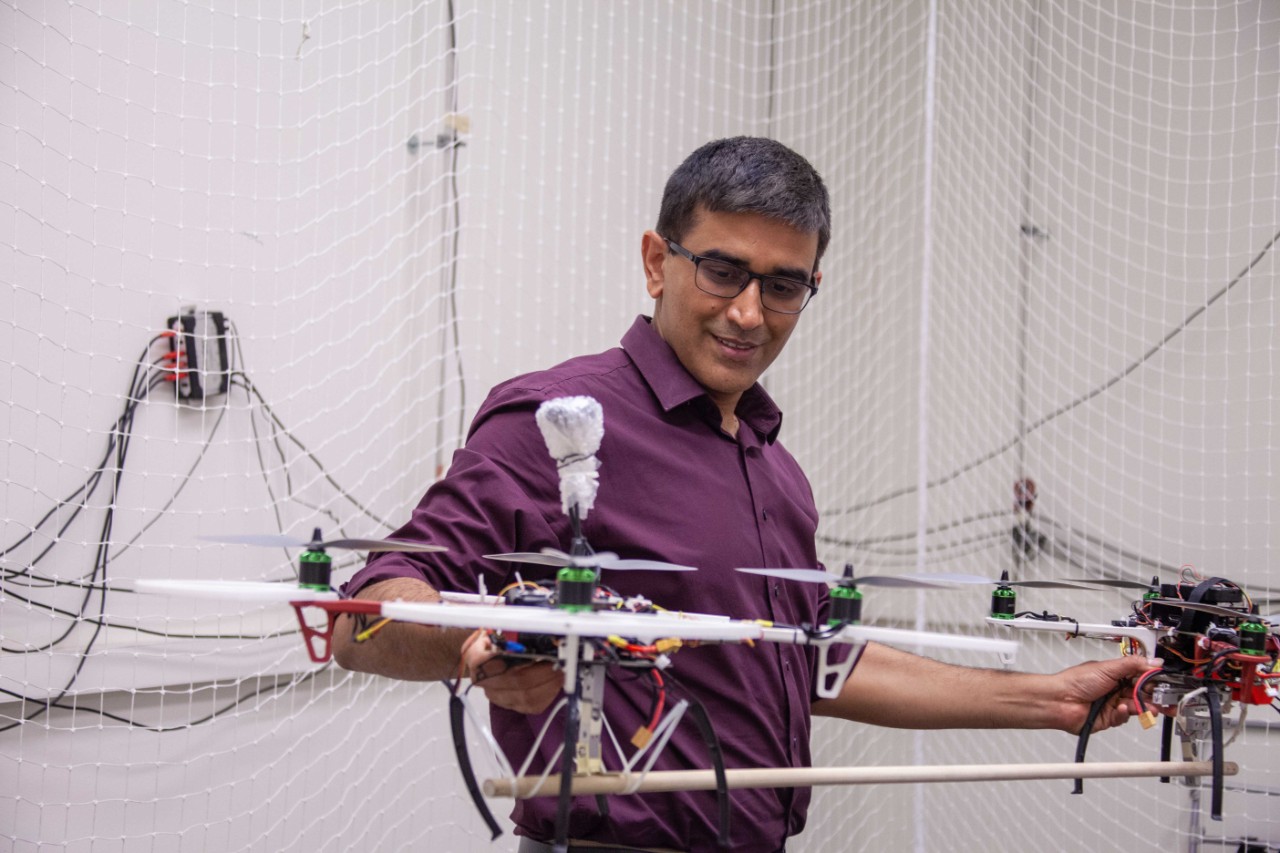
Kumar demonstrated the system in his lab using a four-rotor drone called a quadcopter attached to a wooden rod. When Kumar pushed or pulled the rod, the drone automatically tilted in the same direction, maintaining its stability and position in the air.
“The way we fly kites, we can fly drones,” Barawkar said.

UC College of Engineering and Applied Science professor Manish Kumar talks in his flight lab. Photo/Ravenna Rutledge/UC Creative + Brand
Related Stories
Sugar overload killing hearts
November 10, 2025
Two in five people will be told they have diabetes during their lifetime. And people who have diabetes are twice as likely to develop heart disease. One of the deadliest dangers? Diabetic cardiomyopathy. But groundbreaking University of Cincinnati research hopes to stop and even reverse the damage before it’s too late.
Is going nuclear the solution to Ohio’s energy costs?
November 10, 2025

The Ohio Capital Journal recently reported that as energy prices continue to climb, economists are weighing the benefits of going nuclear to curb costs. The publication dove into a Scioto Analysis survey of 18 economists to weigh the pros and cons of nuclear energy. One economist featured was Iryna Topolyan, PhD, professor of economics at the Carl H. Lindner College of Business.
App turns smartwatch into detector of structural heart disease
November 10, 2025

An app that uses an AI model to read a single-lead ECG from a smartwatch can detect structural heart disease, researchers reported at the 2025 Scientific Sessions of the American Heart Association. Although the technology requires further validation, researchers said it could help improve the identification of patients with heart failure, valvular conditions and left ventricular hypertrophy before they become symptomatic, which could improve the prognosis for people with these conditions.