Vaccine hesitant? UC study compares getting the shots and going without
UC physician discusses vaccine research findings based on computerized decision analytic model

Vaccine hesitancy is increasingly impacting the health of large segments of the American population as the COVID-19 pandemic enters its second year.
Researchers at the University of Cincinnati College of Medicine have developed a computerized decision analytic model to compare projected outcomes of three vaccine strategies: a patient opts for a messenger RNA vaccine, a patient decides to get an adenovirus vector vaccine or the patient simply forgoes a vaccine altogether.
Pfizer and Moderna produce mRNA vaccines while Johnson & Johnson manufacture an adenovirus vector vaccine. The decision analytic model uses a metric of quality adjusted life expectancy that accounts for both survival and quality of life as affected by hospitalization, COVID-19 disease and long-term post-infection complications on a patient, also commonly known as long-haul syndrome, explains Mark Eckman, MD, director and professor in the UC Division of General Internal Medicine and lead author of the study.
Eckman recently discussed the research with journalist Michael Monks on WVXU's Cincinnati Edition.
The model simulated the health outcomes for a 65-year-old and found the patient would gain a net of 7.4 days — an extra week of life — if the person received the mRNA vaccine versus opting to not vaccinate at all. Of the two strategies that include receiving a vaccine, both yield virtually equivalent results, with the mRNA vaccine demonstrating a minimal gain of roughly one day of life compared with the J&J vaccine, says Eckman.
The study findings are available online in the scholarly journal Medical Decision Making Policy & Practice. Other co-authors include Richard Lofgren, MD, President and CEO of UC Health, and faculty members in the UC Department of Internal Medicine: Margaret Powers-Fletcher, PhD, assistant professor; Jennifer Forrester, MD, associate professor; Carl Fichtenbaum, MD, professor and George Smulian, MD, professor.
"The important point is that both types of vaccines are better than no vaccine," says Eckman, also a primary care physician at UC Health, the UC affiliated health system that teaches and trains residents, medical students and other students in health care professions. "If we take a public health perspective by multiplying that gain over the vaccine eligible population, it results in a large net benefit for the nation."
Eckman says if the U.S. extends the per person benefit to the remaining unvaccinated and eligible population (individuals 12 years old and up) in the country, the aggregate benefit would be 3.92 million quality-adjusted life years for those receiving an mRNA vaccine. If the aggregate benefit were calculated using the J&J vaccine it would result in a net benefit of 3.38 million quality-adjusted life years.
"Since we did not have time to perform a clinical trial to study this question of vaccination, we developed a computer model to simulate outcomes of the strategies mentioned, using the most up-to-date and best data available," says Eckman. "Our analysis showed that both vaccines yield virtually equivalent results. The take-home message is that receiving either type of the vaccine is better than not getting vaccinated at all."
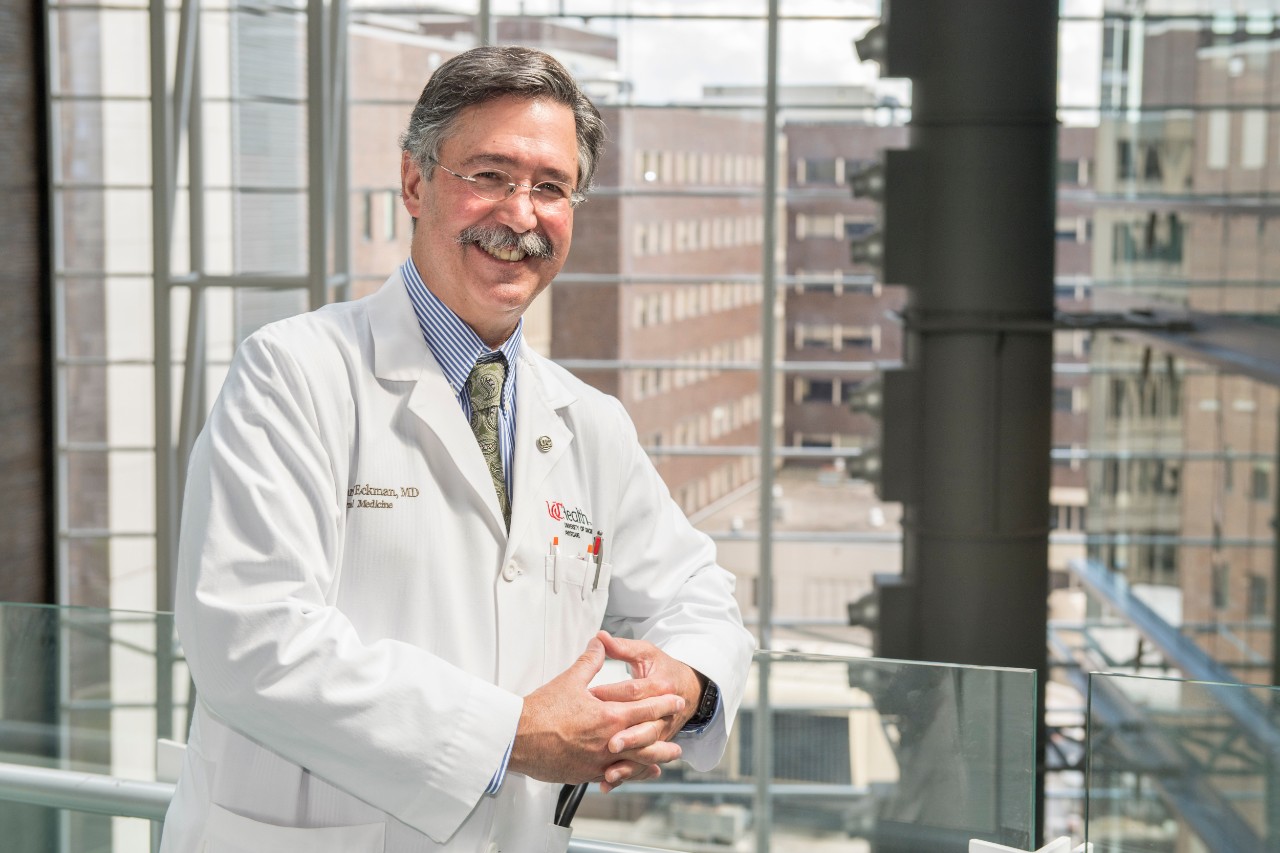
Featured image of Mark Eckman, MD, director and professor in the UC Division of General Internal Medicine, shown in UC College of Medicine. Photo by Colleen Kelley/UC Creative + Brand.
Impact Lives Here
The University of Cincinnati is leading public urban universities into a new era of innovation and impact. Our faculty, staff and students are saving lives, changing outcomes and bending the future in our city's direction. Next Lives Here.
Stay up on all UC's COVID-19 stories, or take a UC virtual visit and begin picturing yourself at an institution that inspires incredible stories.
Related Stories
Sugar overload killing hearts
November 10, 2025
Two in five people will be told they have diabetes during their lifetime. And people who have diabetes are twice as likely to develop heart disease. One of the deadliest dangers? Diabetic cardiomyopathy. But groundbreaking University of Cincinnati research hopes to stop and even reverse the damage before it’s too late.
Is going nuclear the solution to Ohio’s energy costs?
November 10, 2025

The Ohio Capital Journal recently reported that as energy prices continue to climb, economists are weighing the benefits of going nuclear to curb costs. The publication dove into a Scioto Analysis survey of 18 economists to weigh the pros and cons of nuclear energy. One economist featured was Iryna Topolyan, PhD, professor of economics at the Carl H. Lindner College of Business.
App turns smartwatch into detector of structural heart disease
November 10, 2025

An app that uses an AI model to read a single-lead ECG from a smartwatch can detect structural heart disease, researchers reported at the 2025 Scientific Sessions of the American Heart Association. Although the technology requires further validation, researchers said it could help improve the identification of patients with heart failure, valvular conditions and left ventricular hypertrophy before they become symptomatic, which could improve the prognosis for people with these conditions.