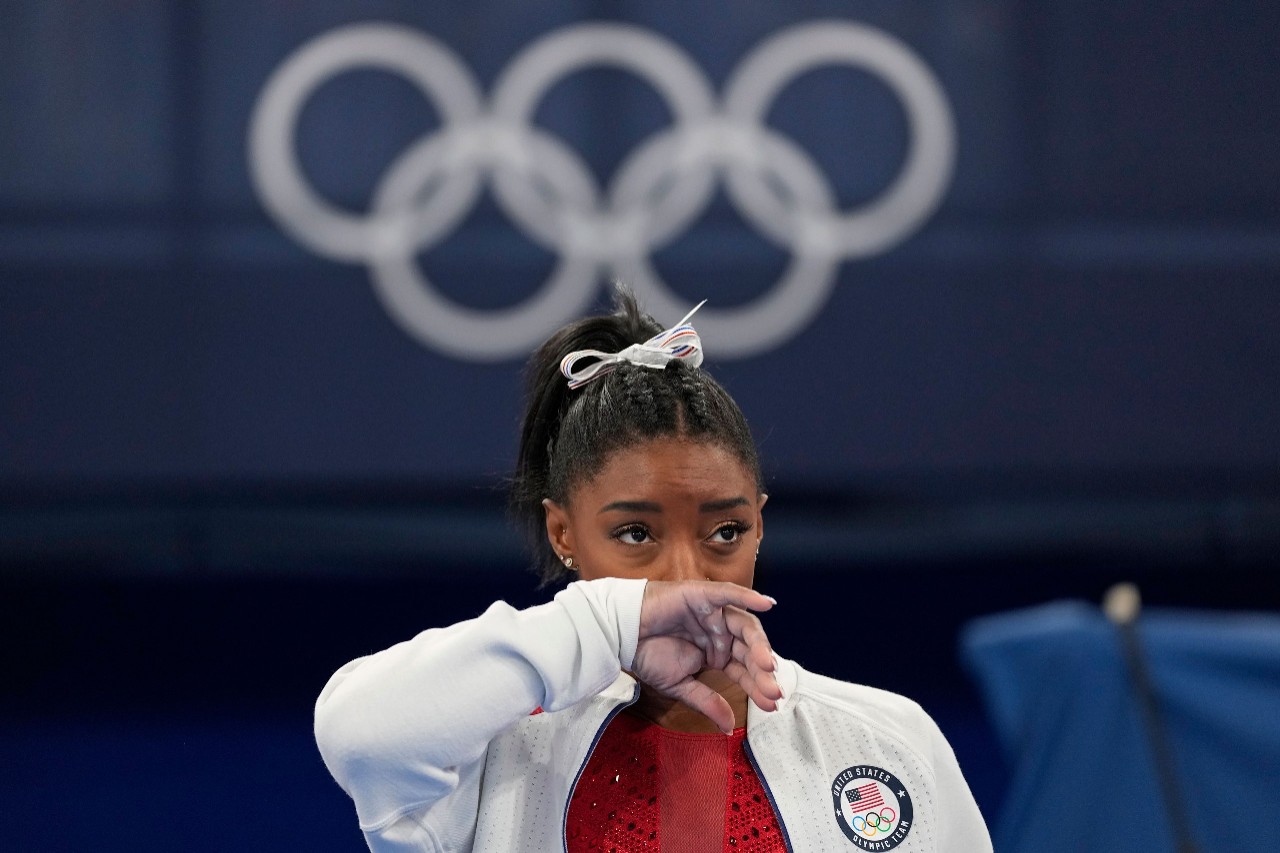
WLWT: Mental health issues prompt Simone Biles to drop out of Olympic team finals
UC psychologist says a variety of factors could be responsible

The sports world was stunned this week by the news that United States gymnast Simone Biles was dropping out of the team competition at the Olympic Games in Tokyo, citing mental health issues.
She withdrew from the team competition after making a mental mistake during her vault.
In a story produced by WLWT, Barbara Walker, PhD, of the Department of Psychiatry and Behavioral Neuroscience at the UC College of Medicine said she was not all that surprised by Biles pulling out of the group competition due to mental health concerns.
"I think everybody has their own little breaking point," Walker said. "Watching her over the years, I think that she had a lot of pressure on her when we think about, first of all, that the Olympics were postponed for a year."

Barbara Walker, PhD, of the Department of Psychiatry and Behavioral Neuroscience in the UC College of Medicine/Photo/Colleen Kelley/UC Creative + Brand
Walker talked about Biles' age and how an additional year of training brings a lot of wear and tear on an older gymnast's body.
Walker also cited the abuse Biles suffered under USA Gymnastics doctor Larry Nassar and how she recently talked about it in interviews.
She also said Olympic athletes are under different pressures this year than most: COVID-19 concerns, no crowds cheering them on and no family at the games supporting them.
"I'm sure that this has just been like a bad storm in so many ways," Walker said.
Walker hopes Biles and tennis star Naomi Osaka are changing the conversation and breaking stigmas concerning athletes and the importance of mental health.
"Athletes in general, especially elite athletes, have always been deemed as sort of these super people, right?" she said. "I'm hoping that this is not looked at as a weakness anymore."
Walker was also interviewed for a story on the same topic by WCPO-TV. See that story here.
WHIO-TV in Dayton featured Walker in their coverage of the story. See that story here.
Lead photo/Ashley Landis/Associated Press
Next Lives Here
The University of Cincinnati is classified as a Research 1 institution by the Carnegie Commission and is ranked in the National Science Foundation's Top-35 public research universities. UC's medical, graduate and undergraduate students and faculty investigate problems and innovate solutions with real-world impact. Next Lives Here.
Related Stories
Sugar overload killing hearts
November 10, 2025
Two in five people will be told they have diabetes during their lifetime. And people who have diabetes are twice as likely to develop heart disease. One of the deadliest dangers? Diabetic cardiomyopathy. But groundbreaking University of Cincinnati research hopes to stop and even reverse the damage before it’s too late.
Is going nuclear the solution to Ohio’s energy costs?
November 10, 2025

The Ohio Capital Journal recently reported that as energy prices continue to climb, economists are weighing the benefits of going nuclear to curb costs. The publication dove into a Scioto Analysis survey of 18 economists to weigh the pros and cons of nuclear energy. One economist featured was Iryna Topolyan, PhD, professor of economics at the Carl H. Lindner College of Business.
App turns smartwatch into detector of structural heart disease
November 10, 2025

An app that uses an AI model to read a single-lead ECG from a smartwatch can detect structural heart disease, researchers reported at the 2025 Scientific Sessions of the American Heart Association. Although the technology requires further validation, researchers said it could help improve the identification of patients with heart failure, valvular conditions and left ventricular hypertrophy before they become symptomatic, which could improve the prognosis for people with these conditions.