WKEF-TV Dayton: Experiencing long-term COVID side effects? What you need to know.
UC ear, nose and throat expert says sense of smell may take a while to return to normal

As vaccinations continue COVID-19 cases have been on a downward trend nationally. However, some patients who survive COVID-19 infection are reporting long-term health complications that are impacting their quality of life. Brain fog, fatigue and continuing problems with the sense of smell are among the concerns.
A National Library of Medicine study shows that 24 percent of surviving COVID-19 patients still can’t fully smell or taste seven months after recovering from the virus. Ahmad Sedaghat, MD, PhD, director of the University of Cincinnati Division of Rhinology, Allergy and Anterior Skull Base Surgery, says the majority of COVID-19 patients regain their sense of small, but he’s also seen a new trend.
“That huge peak, that huge wave of infected patients over the wintertime they were recovering their sense of smell now a few months after that they’re starting to experience these parosmia’s,” Sedaghat said.
Parosmia is experiencing distorted or foul odors even while smelling pleasant things like flowers, explains Sedaghat. He adds that parosmia is a good sign because it means nerves are in recovery mode, but right now, the only proven treatment is smell tests to retrain the brain.
“It’s more than the action of smelling things. You have to think about what those things used to smell like, because you actually want to activate your memory centers, and those activated nerves tend to reconnect,” Sedaghat said.
Listen to the full interview with Ahmad Sedaghat, MD, PhD, online.
Learn more about Sedaghat’s research on sense of smell and COVID-19.
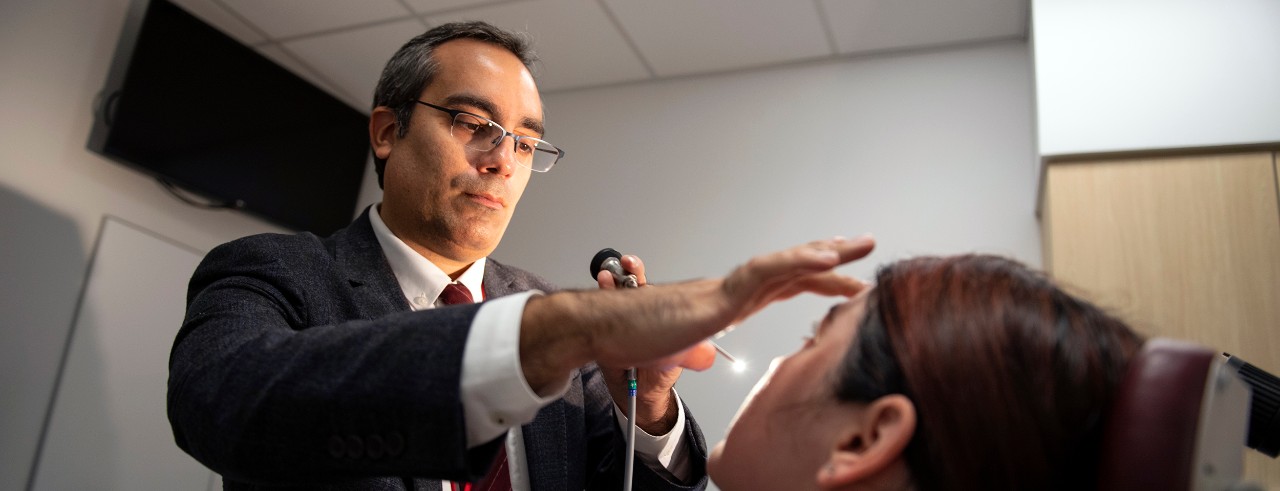
Featured image of Ahmad Sedaghat, MD, PhD, taken by Colleen Kelley/UC Creative + Brand.
Related Stories
Sugar overload killing hearts
November 10, 2025
Two in five people will be told they have diabetes during their lifetime. And people who have diabetes are twice as likely to develop heart disease. One of the deadliest dangers? Diabetic cardiomyopathy. But groundbreaking University of Cincinnati research hopes to stop and even reverse the damage before it’s too late.
Is going nuclear the solution to Ohio’s energy costs?
November 10, 2025

The Ohio Capital Journal recently reported that as energy prices continue to climb, economists are weighing the benefits of going nuclear to curb costs. The publication dove into a Scioto Analysis survey of 18 economists to weigh the pros and cons of nuclear energy. One economist featured was Iryna Topolyan, PhD, professor of economics at the Carl H. Lindner College of Business.
App turns smartwatch into detector of structural heart disease
November 10, 2025

An app that uses an AI model to read a single-lead ECG from a smartwatch can detect structural heart disease, researchers reported at the 2025 Scientific Sessions of the American Heart Association. Although the technology requires further validation, researchers said it could help improve the identification of patients with heart failure, valvular conditions and left ventricular hypertrophy before they become symptomatic, which could improve the prognosis for people with these conditions.