Faculty Awards 2021: Peng Zhang
UC chemist honored with Emerging Entrepreneurial Achievement Award

Chemist Peng Zhang is harnessing the power of nanoparticles and light to treat infection, offering treatments that could prevent superbugs that develop from antibiotic resistance.
Zhang, an associate professor in UC’s College of Arts and Sciences, is applying his research in both therapeutic and sensing applications. In his lab, Zhang uses simple light-emitting diodes to activate a nanoparticle gel, creating a reaction that kills bacteria.
“We hope we can save antibiotics for the most serious infections. Hopefully, this will reduce the occurrence of drug resistance,” Zhang said.
Zhang is the 2021 winner of UC’s Emerging Entrepreneurial Achievement Award.
“I’m very honored to receive this award,” Zhang said. “I appreciate my colleagues and the students I have had over the years. I’m very fortunate to be surrounded by wonderful people.”

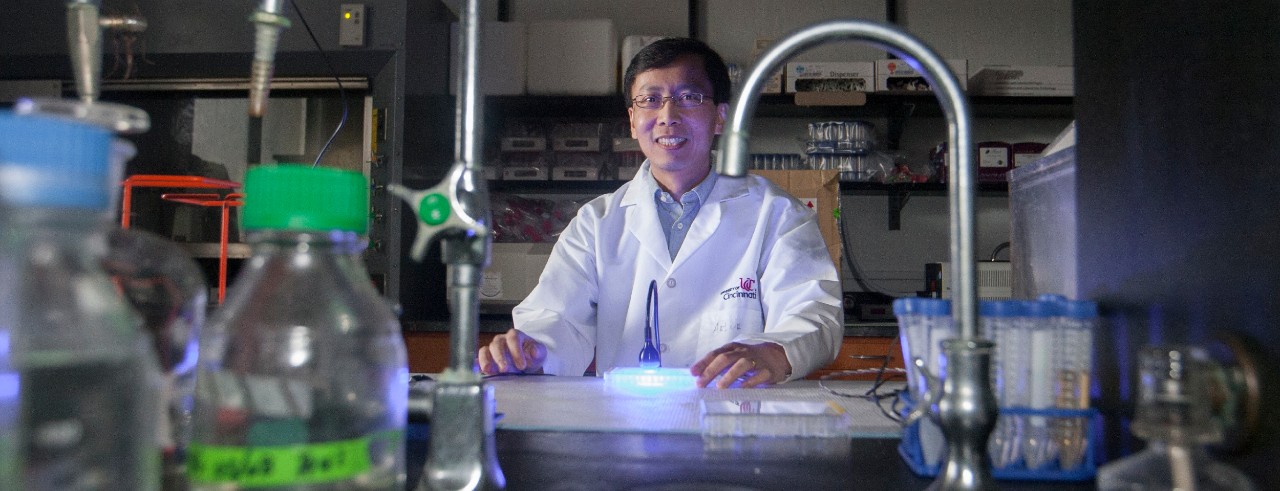
Peng Zhang, winner of the UC's 2021 Emerging Entrepreneurial Achievement Award. Photo/Joseph Fuqua II/UC Creative + Brand
Zhang and his wife, biologist Hong Tang, founded startup Alph Technologies to commercialize their projects. Together, they have collaborated on several research papers.
“Professor Zhang has been very innovative in exploiting the results from his fundamental nano-particle research to develop a potentially transformative alternative therapy for bacterial infections,” professor and head of UC’s Chemistry Department Thomas Beck said.
“Antibiotic-resistant bacterial strains have become more common. Peng’s research shows there are promising therapies that can directly treat infections using photo-sensitizers. This is a great example of research passing from the laboratory to medical applications.”
Zhang didn’t invent this treatment, but his contribution has improved its effectiveness.
“This mechanism has been around for decades. It’s not new. What is new is the nanomaterial that makes it more efficient, sometimes as much as 1,000 times more efficient,” Zhang said.
At UC, Zhang teaches classes such as undergraduate research in chemistry and analytical spectroscopy. He has collaborated with researchers across UC’s colleges. But his biggest research influence has been his wife, he said.
“My wife is critical in making these projects a success. I feel very appreciative to have her as my partner,” he said.
Their daughter, Alice Zhang, just graduated from Georgia Tech and is working as an engineer.
“I love science,” Zhang said. “I feel like chemistry has a lot to explore.”
Featured image at top of Peng Zhang/Joseph Fuqua II/UC Creative + Brand

UC associate professor Peng Zhang is harnessing the power of nanoparticles and light to fight infection. Photo/Joseph Fuqua II/UC Creative + Brand
Faculty Awards 2021
The University of Cincinnati will honor 13 awardees in a virtual ceremony at 3 p.m., Thursday, April 22. Join via WebEx.
Related Stories
Sugar overload killing hearts
November 10, 2025
Two in five people will be told they have diabetes during their lifetime. And people who have diabetes are twice as likely to develop heart disease. One of the deadliest dangers? Diabetic cardiomyopathy. But groundbreaking University of Cincinnati research hopes to stop and even reverse the damage before it’s too late.
Is going nuclear the solution to Ohio’s energy costs?
November 10, 2025

The Ohio Capital Journal recently reported that as energy prices continue to climb, economists are weighing the benefits of going nuclear to curb costs. The publication dove into a Scioto Analysis survey of 18 economists to weigh the pros and cons of nuclear energy. One economist featured was Iryna Topolyan, PhD, professor of economics at the Carl H. Lindner College of Business.
App turns smartwatch into detector of structural heart disease
November 10, 2025

An app that uses an AI model to read a single-lead ECG from a smartwatch can detect structural heart disease, researchers reported at the 2025 Scientific Sessions of the American Heart Association. Although the technology requires further validation, researchers said it could help improve the identification of patients with heart failure, valvular conditions and left ventricular hypertrophy before they become symptomatic, which could improve the prognosis for people with these conditions.