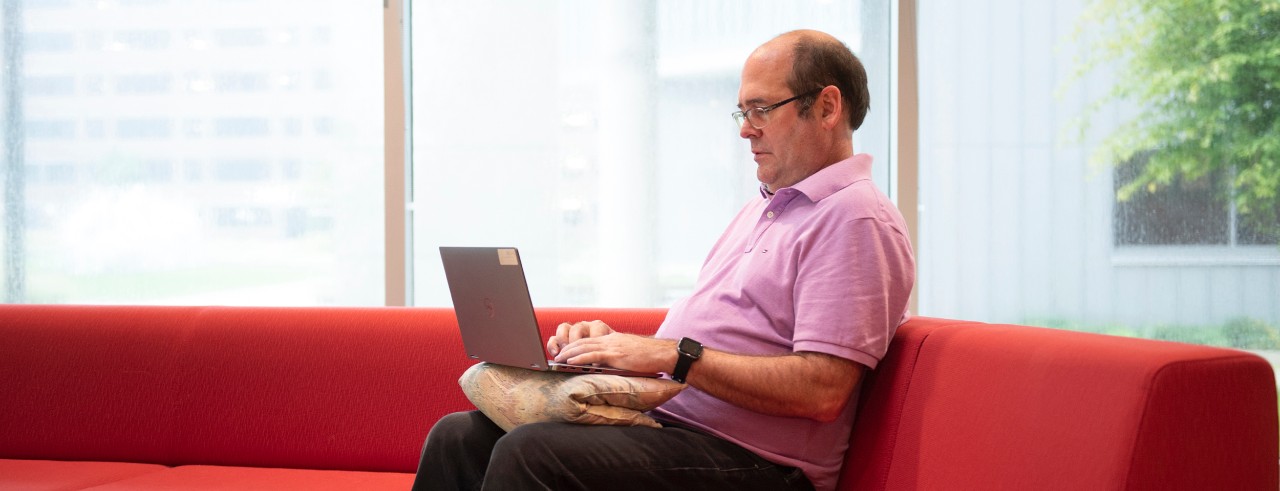
Forbes: The hidden costs when remote workers spend all day on the couch
UC ergonomics expert offers advice on ergonomics and working from home

Working from home may not be all it’s thought to be. Early in the COVID-19 pandemic workers across the nation were allowed to work remotely from home without any real instruction when it comes to proper ergonomics, according to Kermit Davis, PhD, a professor in the UC Department of Environmental and Public Health Sciences.
Research from Davis was cited in a recent Forbes magazine article. Davis conducted an ergonomic assessment of employees at the University of Cincinnati sending out an email survey to 4,500 faculty and staff after the coronavirus pandemic prompted the university to join send workers home a year ago to continue operations.
The survey had 843 people complete it. As part of the study, 41 employees sent Davis photos of workers at home workstations for ergonomic review. This subset showed some trends and offered a glimpse into what many who work from home are encountering. The findings were published in the scholarly journal Ergonomics in Design.
Collaborators on the study included Susan E. Kotowski, PhD, associate professor in the UC College of Allied Health Sciences; Denise Daniel, a student in the master’s degree program of occupational health nursing at the University of Cincinnati College of Nursing; Thomas Gerding, who is pursuing a PhD in environmental and industrial hygiene; and Jennifer Naylor, who is in the master’s degree program of occupational health nursing. Megan Syck is also a co-author and pursuing a Master of Science degree in environmental and industrial hygiene.
Davis told Forbes that an ergonomically correct at-home workstation would start with a desk, table or chair (no beds, couches or the floor) and would also include minimized glare in the work environmental along with an adjustable office chair with lumbar and arm support and an external monitor, mouse and keyboard.
Read the Forbes story discussing research from Kermit Davis, PhD.
Learn more about research from Davis concerning proper ergonomics.
Related Stories
Sugar overload killing hearts
November 10, 2025
Two in five people will be told they have diabetes during their lifetime. And people who have diabetes are twice as likely to develop heart disease. One of the deadliest dangers? Diabetic cardiomyopathy. But groundbreaking University of Cincinnati research hopes to stop and even reverse the damage before it’s too late.
Is going nuclear the solution to Ohio’s energy costs?
November 10, 2025

The Ohio Capital Journal recently reported that as energy prices continue to climb, economists are weighing the benefits of going nuclear to curb costs. The publication dove into a Scioto Analysis survey of 18 economists to weigh the pros and cons of nuclear energy. One economist featured was Iryna Topolyan, PhD, professor of economics at the Carl H. Lindner College of Business.
App turns smartwatch into detector of structural heart disease
November 10, 2025

An app that uses an AI model to read a single-lead ECG from a smartwatch can detect structural heart disease, researchers reported at the 2025 Scientific Sessions of the American Heart Association. Although the technology requires further validation, researchers said it could help improve the identification of patients with heart failure, valvular conditions and left ventricular hypertrophy before they become symptomatic, which could improve the prognosis for people with these conditions.