WVXU: UC researcher is part of Mars Perseverance mission
The rover lands on the red planet today after its seven-month journey

WVXU's Cincinnati Edition spoke to University of Cincinnati associate professor Andy Czaja about NASA's new rover mission.

New York illuminated the Empire State Building red to cheer the Mars mission. Photo/NASA/Emma Howells
Czaja, an astrobiologist, is serving on the NASA science team that will use the rover Perseverance and a helicopter called Ingenuity to explore Mars in search of evidence of ancient life. Czaja previously served on the NASA advisory board that helped decide where on Mars to send the rover.
“If life forms separately on two planets in one solar system, that means it’s fairly easy for life to get started,” Czaja said. “And if we can prove Mars witnessed a separate origin of life, that’s very exciting. It means we have a high probability of finding life elsewhere in the universe, too.”
Perseverance is the largest, heaviest rover NASA has ever built. It’s one of the world’s most advanced autonomous robots.
Czaja spoke to Cincinnati's Local 12 about his hopes for the rover's historic mission.
"It’s a really exciting spot. It’s a crater that had a lake in it at one point 46 billions of years ago,” Czaja told Local 12.
Czaja isn't UC's only connection to the next Mars mission.
Three UC College of Engineering and Applied Science graduates contributed to the Herculean feat of engineering. Sophia Mitchell, Rebecca Perkins and Stephanie Mitana played a role in preparing the rover and its complicated landing system called a sky crane.
A capsule containing the rover will enter the Mars atmosphere, deploying a parachute to slow its descent. The capsule will eject the rover attached to the sky crane that uses rockets to hover over the Mars surface, gently lowering the rover to the ground with cables.
Mitana worked on the sky crane system. Mitchell served as lead systems engineer for the gas dust removal tool on the rover's robotic arm. Perkins started her career at NASA's Jet Propulsion Laboratory in 2012 and worked on the rover system that deploys tubes to collect mineral samples.
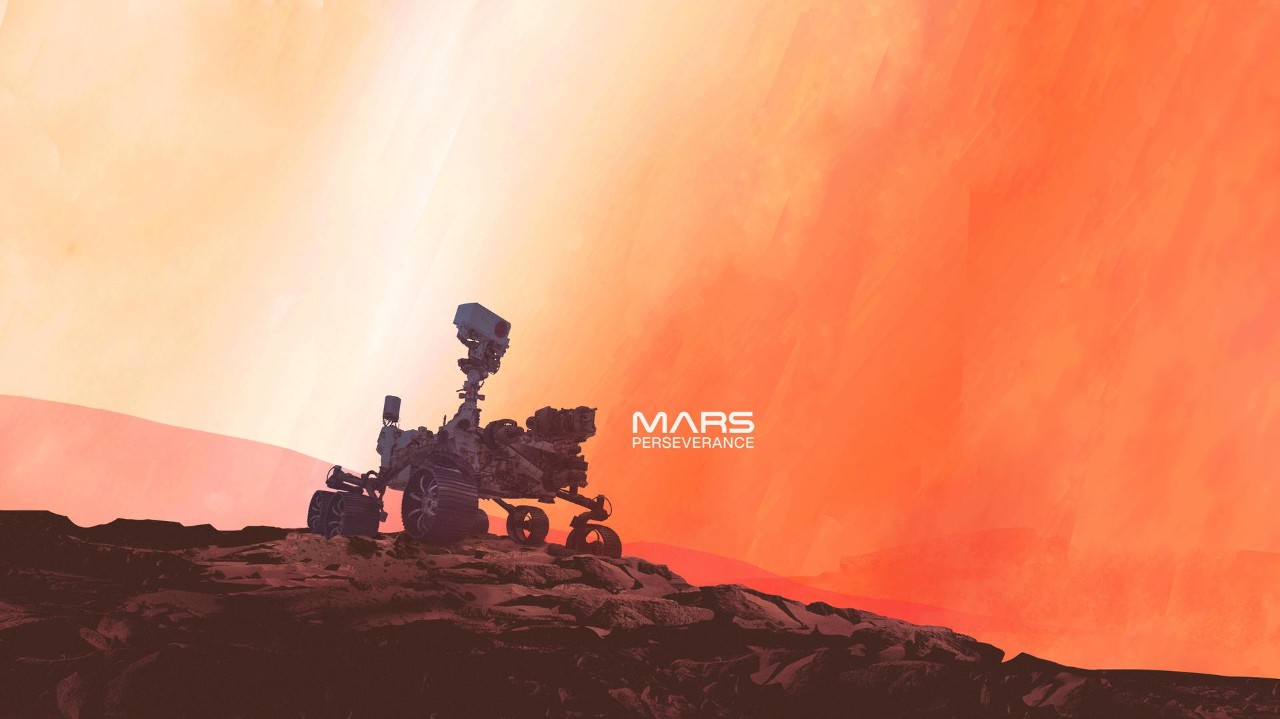
Featured image at top: An illustration of the rover Perseverance on the surface of Mars. Illustration/NASA

UC associate professor Andy Czaja is helping NASA explore Mars in a quest for evidence of ancient life. Photo/Joseph Fuqua II/UC Creative + Brand
Related Stories
Sugar overload killing hearts
November 10, 2025
Two in five people will be told they have diabetes during their lifetime. And people who have diabetes are twice as likely to develop heart disease. One of the deadliest dangers? Diabetic cardiomyopathy. But groundbreaking University of Cincinnati research hopes to stop and even reverse the damage before it’s too late.
Is going nuclear the solution to Ohio’s energy costs?
November 10, 2025

The Ohio Capital Journal recently reported that as energy prices continue to climb, economists are weighing the benefits of going nuclear to curb costs. The publication dove into a Scioto Analysis survey of 18 economists to weigh the pros and cons of nuclear energy. One economist featured was Iryna Topolyan, PhD, professor of economics at the Carl H. Lindner College of Business.
App turns smartwatch into detector of structural heart disease
November 10, 2025

An app that uses an AI model to read a single-lead ECG from a smartwatch can detect structural heart disease, researchers reported at the 2025 Scientific Sessions of the American Heart Association. Although the technology requires further validation, researchers said it could help improve the identification of patients with heart failure, valvular conditions and left ventricular hypertrophy before they become symptomatic, which could improve the prognosis for people with these conditions.