WVXU: UC researchers invents lab-on-a-chip device for cancer
UC College of Engineering and Applied Science professor is improving point of care

WVXU talked to a University of Cincinnati researcher who developed a noninvasive, point-of-care device for early cancer screening using a small amount of a patient’s body fluid such as saliva or blood.
Leyla Esfandiari, an assistant professor of biomedical and electrical engineering in UC's College of Engineering and Applied Science, has a patent pending on a small lab-on-a-chip device that can help doctors get accurate results without invasive biopsies.
"It's going to be faster, cheaper and more reliable," Esfandiari told WVXU. "The most important thing from the patient's point of view is that it's going to be minimally invasive. They are not going to take a tissue biopsy. They are going to get some blood or saliva."
Esfandiari and her research team in her Integrative Biosensing Laboratory at UC discovered a way to make that process faster, easier and more cost effective. Esfandiari frequently collaborates with colleagues from the UC College of Medicine and Cincinnati Children’s Hospital Medical Center. Conversations with those in the medical profession led her to explore a better way to isolate exosomes from the body fluids utilizing a novel label-free electrokinetic device.
Exosomes, or cell-secreted nanoscale extracellular vesicles, contain important gene regulatory contents and are highly abundant in all body fluids. They carry with them RNA and protein markers that indicate cancer and other diseases. While it’s easy to collect the body fluids, it’s challenging to extract exosomes from the fluid to identify the biomarkers.
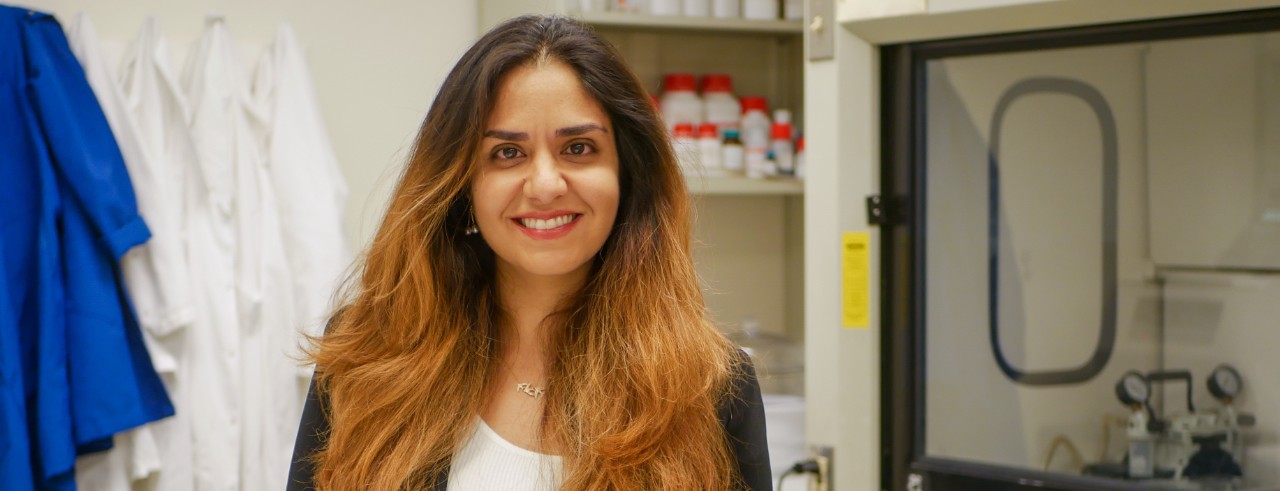
Featured image at top: UC assistant professor Leyla Esfandiari develops point-of-care devices in her lab in UC's College of Engineering and Applied Science. Photo/Corrie Mayer/CEAS Marketing

UC assistant professor Leyla Esfandiari and her research team created a lab-on-a-chip device for the early testing of cancer. Photos/Corrie Mayer/CEAS Marketing.
Related Stories
Sugar overload killing hearts
November 10, 2025
Two in five people will be told they have diabetes during their lifetime. And people who have diabetes are twice as likely to develop heart disease. One of the deadliest dangers? Diabetic cardiomyopathy. But groundbreaking University of Cincinnati research hopes to stop and even reverse the damage before it’s too late.
Is going nuclear the solution to Ohio’s energy costs?
November 10, 2025

The Ohio Capital Journal recently reported that as energy prices continue to climb, economists are weighing the benefits of going nuclear to curb costs. The publication dove into a Scioto Analysis survey of 18 economists to weigh the pros and cons of nuclear energy. One economist featured was Iryna Topolyan, PhD, professor of economics at the Carl H. Lindner College of Business.
App turns smartwatch into detector of structural heart disease
November 10, 2025

An app that uses an AI model to read a single-lead ECG from a smartwatch can detect structural heart disease, researchers reported at the 2025 Scientific Sessions of the American Heart Association. Although the technology requires further validation, researchers said it could help improve the identification of patients with heart failure, valvular conditions and left ventricular hypertrophy before they become symptomatic, which could improve the prognosis for people with these conditions.