UC hosts environmental justice talk on 'Dark Waters'
National experts will help educators frame curricular development around pollution case

Event Information (passed)
The University of Cincinnati will host the inaugural Environmental Justice and Advocacy Symposium for educators Feb. 5 that will look at a decadeslong pollution case involving a Fortune 500 company and a group of synthetic chemicals known as PFAS.
UC professor Bob Hyland will moderate a panel of environmental research experts and advocacy groups and a Cincinnati lawyer who raised public awareness about the health dangers of fluorinated pollutants. Hyland said the panelists will use the case to discuss ways educators can create a leading undergraduate curriculum around environmental justice.
Often called “forever chemicals,” PFAS are found in products as diverse and ubiquitous as umbrellas, tents, carpets, cookware and firefighting foam. But studies have found the chemicals are toxic and have been linked to birth defects, cancer and thyroid disease.
“I wanted something of local interest and global importance,” symposium organizer Hyland said.

Bill Camp, left, and Mark Ruffalo star in "Dark Waters," a 2019 movie about a legal fight over chemical pollution in Ohio and West Virginia. UC will host a symposium for educators Friday about improving curricula for environmental justice and advocacy featuring speaker and Cincinnati attorney Rob Bilott, whom Ruffalo depicts in the film. Photo/Focus Features
Panelists include environmental lawyer Rob Bilott of the Cincinnati firm Taft, Stettinius & Hollister, whose legal work against chemical maker DuPont was depicted in the 2019 Mark Ruffalo movie “Dark Waters.” The film chronicles Bilott’s yearslong civil case involving a West Virginia farmer whose livestock allegedly were poisoned by toxic runoff of DuPont chemicals. DuPont also faced a class-action pollution complaint filed by 80,000 residents of Ohio and West Virginia.
DuPont in January announced a $4 billion resolution of legal claims relating to environmental liability for pollution from its handling of PFAS.
“Mr. Bilott is a local hero and an internationally recognized expert in environmental liability relating to PFAS exposure,” Hyland said.
Panelist Susan Pinney, an epidemiologist in UC’s College of Medicine, found in a 2017 study that residents in parts of Ohio had higher-than-normal levels of these chemicals in blood samples taken over a 22-year span, likely caused by contamination in drinking water.
In breakout sessions, panelists will be joined by other members of the Environmental Justice Interdisciplinary Faculty Team at UC: Lora Arduser (English), Nicholas Dunning (geography), Professor Leah Stewart (English), David Stradling (history), and Susanna Tong (environmental studies).
In congressional hearings on PFAS in 2019, DuPont said it was committed to environmental cleanups of sites where it produced or disposed of the chemicals. And it recommended a clearinghouse to share best practices to detect, measure and clean up the chemicals that it produced.
Democratic U.S. Rep. Harley Rouda of California called PFAS an urgent environmental and health concern.
“This is not a small or emerging or ambiguous problem. This is a full-blown crisis,” Rouda said.
Hyland said UC’s interdisciplinary approach to research and pedagogy creates a formidable public resource.
“We have experts at UC who are uniquely positioned to address these issues,” Hyland said. “That’s why for so many reasons UC is poised to be a leader on environmental justice curriculum. Students from across disciplines regularly articulate to us that they want to pursue careers in the environmental justice space.”
Panelists include:
- Rob Bilott, environmental attorney with Taft, Stettinius & Hollister
- Linda Birnbaum, former director of the National Institute for Environmental Health Sciences at the National Institutes of Health
- Kacee Deener, deputy director of the Environmental Protection Agency’s Office of Science Advisor, Policy and Engagement
- Susan Pinney, professor and epidemiologist in UC’s Department of Environmental Health
- Marilyn Wall, Sierra Club
- Emily Donovan, co-founder of North Carolina advocacy group Clean Cape Fear
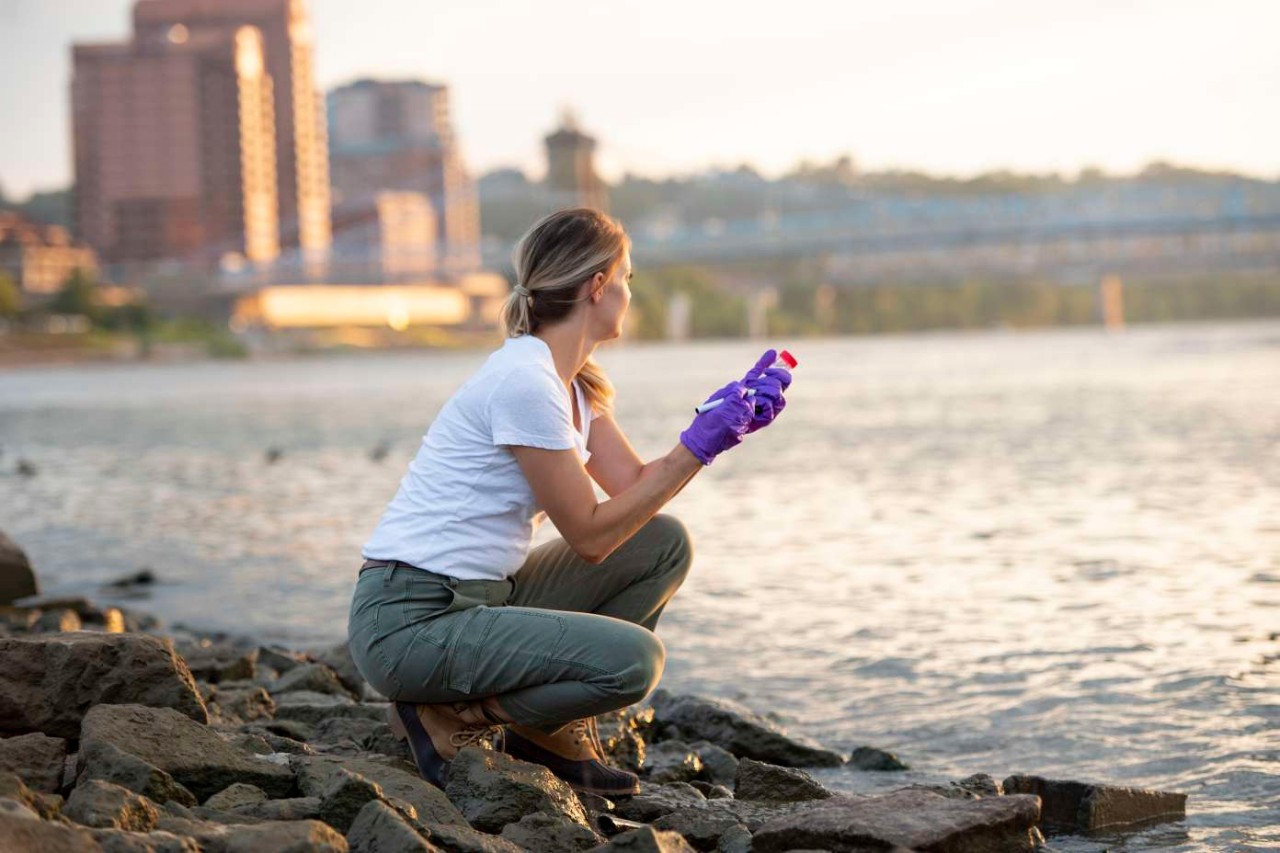
Featured image at top: A UC student takes a water sample on the Ohio River. UC will host the inaugural Environmental Justice and Advocacy Symposium for educators Feb. 5. Photo/Colleen Kelley/UC Creative + Brand
Impact Lives Here
The University of Cincinnati is leading public urban universities into a new era of innovation and impact. Our faculty, staff and students are saving lives, changing outcomes and bending the future in our city's direction. Next Lives Here.
Stay up on all UC's COVID-19 stories, or take a UC virtual visit and begin picturing yourself at an institution that inspires incredible stories.
Related Stories
Sugar overload killing hearts
November 10, 2025
Two in five people will be told they have diabetes during their lifetime. And people who have diabetes are twice as likely to develop heart disease. One of the deadliest dangers? Diabetic cardiomyopathy. But groundbreaking University of Cincinnati research hopes to stop and even reverse the damage before it’s too late.
App turns smartwatch into detector of structural heart disease
November 10, 2025

An app that uses an AI model to read a single-lead ECG from a smartwatch can detect structural heart disease, researchers reported at the 2025 Scientific Sessions of the American Heart Association. Although the technology requires further validation, researchers said it could help improve the identification of patients with heart failure, valvular conditions and left ventricular hypertrophy before they become symptomatic, which could improve the prognosis for people with these conditions.
Combination immunotherapy helps overcome melanoma treatment resistance
November 10, 2025

MSN highlighted research led by the University of Cincinnati Cancer Center's Trisha Wise-Draper showing a combination of immunotherapy medications can activate a robust immune response and help overcome treatment resistance in patients with refractory melanoma.