MSN: Combo therapy for head and neck cancer
UC researchers tested a new combination therapy showing reduced growth of head and neck cancer

UC researchers have tested a new combination therapy that showed reduced growth of head and neck cancer in an animal-based study. These results were published in the journal Cancer Letters.
Christina Wicker, PhD, a postdoctoral fellow in the lab of Vinita Takiar, MD, PhD, led this research and says head and neck cancer is the sixth most common cancer worldwide.
"Head and neck cancer, like any cancer, is truly life-altering. Head and neck cancer could impact your throat, tongue or nose and patients often can't swallow, talk or eat; it truly takes away some of the most social, enjoyable parts of life," she says.
"Until now, no one has examined if this drug has the potential to improve radiation treatment in head and neck cancer."
Read the UC News story about Wicker's research.
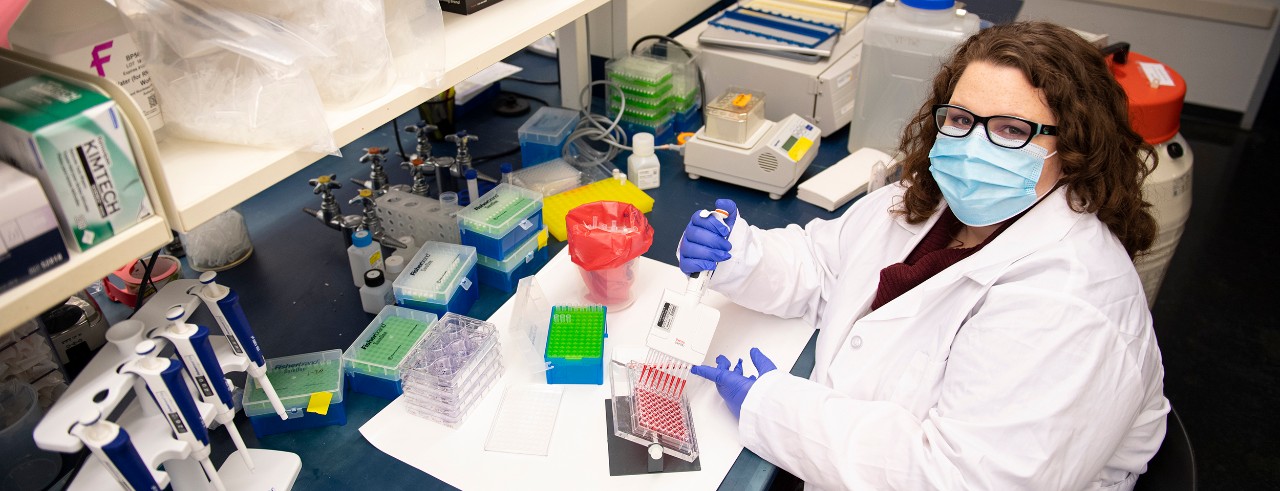
Featured photo of Christina Wicker working in the lab by Colleen Kelley.
Impact Lives Here
The University of Cincinnati is leading public urban universities into a new era of innovation and impact. Our faculty, staff and students are saving lives, changing outcomes and bending the future in our city's direction. Next Lives Here.
Stay up on all UC's COVID-19 stories, or take a UC virtual visit and begin picturing yourself at an institution that inspires incredible stories.
Related Stories
Sugar overload killing hearts
November 10, 2025
Two in five people will be told they have diabetes during their lifetime. And people who have diabetes are twice as likely to develop heart disease. One of the deadliest dangers? Diabetic cardiomyopathy. But groundbreaking University of Cincinnati research hopes to stop and even reverse the damage before it’s too late.
Is going nuclear the solution to Ohio’s energy costs?
November 10, 2025

The Ohio Capital Journal recently reported that as energy prices continue to climb, economists are weighing the benefits of going nuclear to curb costs. The publication dove into a Scioto Analysis survey of 18 economists to weigh the pros and cons of nuclear energy. One economist featured was Iryna Topolyan, PhD, professor of economics at the Carl H. Lindner College of Business.
App turns smartwatch into detector of structural heart disease
November 10, 2025

An app that uses an AI model to read a single-lead ECG from a smartwatch can detect structural heart disease, researchers reported at the 2025 Scientific Sessions of the American Heart Association. Although the technology requires further validation, researchers said it could help improve the identification of patients with heart failure, valvular conditions and left ventricular hypertrophy before they become symptomatic, which could improve the prognosis for people with these conditions.