WVXU: UC observatory could help protect drinking water
UC assistant professor Reza Soltanian is studying water pollution

WVXU spoke to a University of Cincinnati hydro-geologist about a project to study how river pollution affects underground sources of drinking water.
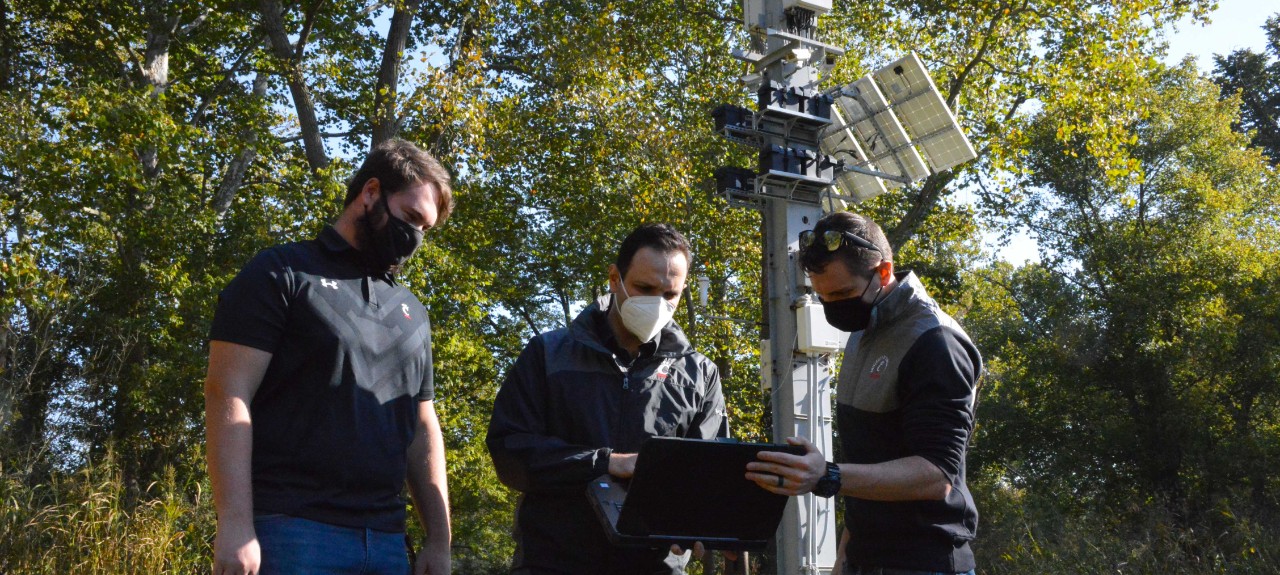
UC College of Arts and Sciences assistant professor Reza Soltanian and his students spent the summer installing new sensors at the Theis Environmental Monitoring and Modeling Site along the Great Miami River in Crosby Township.
With new monitoring wells and sensors, UC has created one of the most sophisticated water-monitoring projects of its kind in partnership with Duke Energy and Great Parks of Hamilton County. It can monitor pollution and track the flow of river water into the ground – a source of drinking water for more than 2 million people in southwest Ohio.
"We're trying to monitor all the chemicals coming from the Great Miami Valley Watershed that drains into the Ohio River," Soltanian said.
Postdoctoral researcher Corey Wallace is working on the project through a National Science Foundation grant.
"This is kind of flagship site. If we can show the capabilities of all these different sensors and technologies, our hope is they can apply them to other critical zones around the country to get a better understanding of what's going on in their groundwater," Wallace told WVXU.
"What we are finding as we are doing our research is you have to have a concrete, real-time measurement of the things happening in the water," Soltanian said.
For example, the observatory has the ability to track a pollution plume if a spill occurs upstream, he said.
Likewise, the observatory can track and transmit data on pollution and water flow even when the entire site along the river is underwater, which happens occasionally during spring floods.
Featured image at top: UC student Tyler McGarr, left, UC assistant professor Reza Soltanian and postdoctoral fellow Corey Wallace check a live feed of data streaming from UC's Theis Environmental Monitoring and Modeling Site. Photo/Michael Miller

UC assistant professor Reza Soltanian is helping to understand how rivers influence drinking water at UC's groundwater observatory. Photo/Michael Miller
Related Stories
Sugar overload killing hearts
November 10, 2025
Two in five people will be told they have diabetes during their lifetime. And people who have diabetes are twice as likely to develop heart disease. One of the deadliest dangers? Diabetic cardiomyopathy. But groundbreaking University of Cincinnati research hopes to stop and even reverse the damage before it’s too late.
Is going nuclear the solution to Ohio’s energy costs?
November 10, 2025

The Ohio Capital Journal recently reported that as energy prices continue to climb, economists are weighing the benefits of going nuclear to curb costs. The publication dove into a Scioto Analysis survey of 18 economists to weigh the pros and cons of nuclear energy. One economist featured was Iryna Topolyan, PhD, professor of economics at the Carl H. Lindner College of Business.
App turns smartwatch into detector of structural heart disease
November 10, 2025

An app that uses an AI model to read a single-lead ECG from a smartwatch can detect structural heart disease, researchers reported at the 2025 Scientific Sessions of the American Heart Association. Although the technology requires further validation, researchers said it could help improve the identification of patients with heart failure, valvular conditions and left ventricular hypertrophy before they become symptomatic, which could improve the prognosis for people with these conditions.