Smithsonian: UC student interprets bison 'mummy'
Smithsonian turns to UC researchers to explain significance of extinct bison find

Smithsonian Magazine turned to a University of Cincinnati paleoecologist and his student to help interpret the significance of a rare mummified steppe bison found in Alaska.
The dessicated carcass of the now extinct bison was preserved in the permafrost until it was discovered in 1951. It's on display at the Smithsonian National Museum of Natural History.
Researchers using modern technology are keenly interested in these preserved specimens, which can unlock secrets about life on Earth 28,000 years ago.

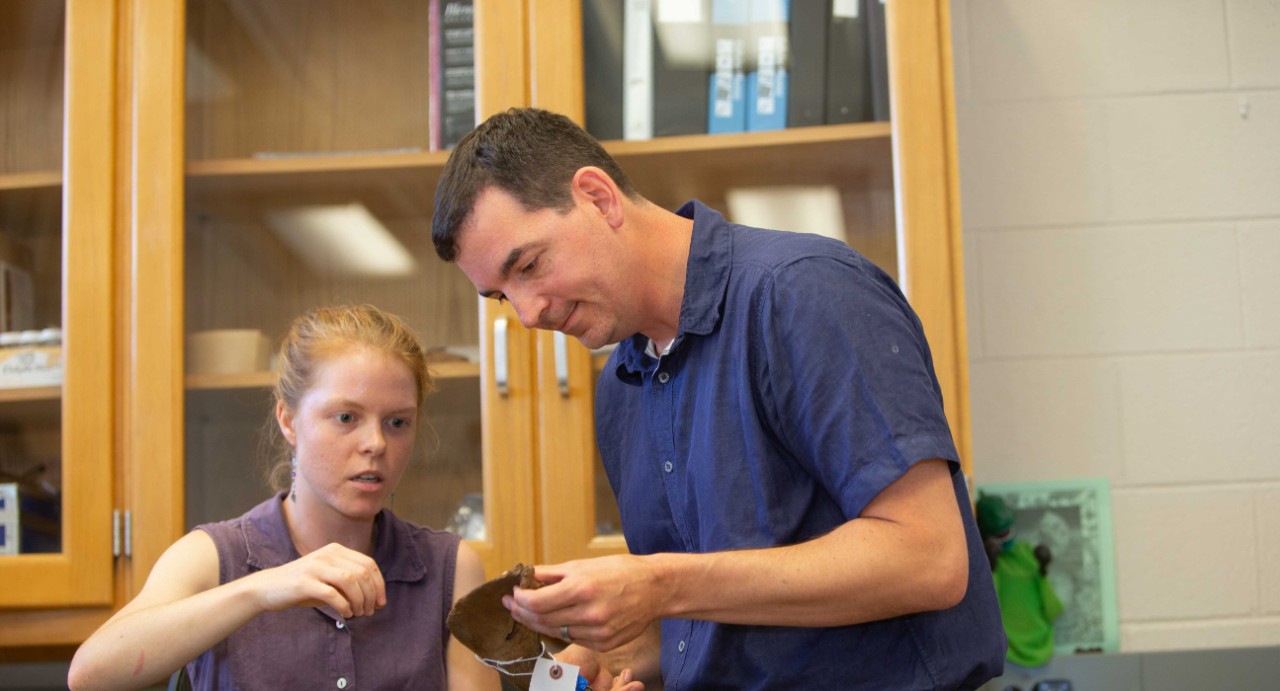
UC doctoral student Abby Kelly examines a horse jawbone in a geology lab. Photo/Andrew Higley/UC Creative + Brand
Smithsonian talked to Joshua Miller, an assistant professor of geology in UC's College of Arts and Sciences, and UC doctoral student Abby Kelly. They are using isotopic analysis and other tools to study extinct populations of animals that lived during the Pleistocene's ice ages.
Miller has studied ancient ecosystems around the world, from Yellowstone National Park in Wyoming to Amboseli National Park in Kenya.
"By studying mummies and fossils from periods prior to the Anthropocene, we can track how populations and ecosystems changed through time in the absence of outsize human impacts,” Miller told Smithsonian. “This allows us to think more critically about how we impact living populations and informs strategies for how we preserve species and ecosystems today.”
Researchers are interested in the Pleistocene in part because it was a time of dramatic changes in climate.
"Bison are relative newcomers to North America, having migrated across the Bering Land Bridge about 200,000 to 170,000 years ago," Kelly told Smithsonian.
Today, North America is home to wood bison and American bison.
Featured image at top: UC student Abby Kelly and UC assistant professor Joshua Miller study an ancient horse jawbone in a geology lab. Photo/Andrew Higley/UC Creative + Brand
Related Stories
Sugar overload killing hearts
November 10, 2025
Two in five people will be told they have diabetes during their lifetime. And people who have diabetes are twice as likely to develop heart disease. One of the deadliest dangers? Diabetic cardiomyopathy. But groundbreaking University of Cincinnati research hopes to stop and even reverse the damage before it’s too late.
Is going nuclear the solution to Ohio’s energy costs?
November 10, 2025

The Ohio Capital Journal recently reported that as energy prices continue to climb, economists are weighing the benefits of going nuclear to curb costs. The publication dove into a Scioto Analysis survey of 18 economists to weigh the pros and cons of nuclear energy. One economist featured was Iryna Topolyan, PhD, professor of economics at the Carl H. Lindner College of Business.
App turns smartwatch into detector of structural heart disease
November 10, 2025

An app that uses an AI model to read a single-lead ECG from a smartwatch can detect structural heart disease, researchers reported at the 2025 Scientific Sessions of the American Heart Association. Although the technology requires further validation, researchers said it could help improve the identification of patients with heart failure, valvular conditions and left ventricular hypertrophy before they become symptomatic, which could improve the prognosis for people with these conditions.