Meet the women tackling tough conversations about race at UC


I

t’s been said that one should never discuss religion and politics in polite conversation. Similarly, race and gender have long been considered taboo topics best avoided to prevent conflict. That strategy might work at some dinner tables, but for a group of University of Cincinnati women, tackling tough conversations, challenging perspectives and being vulnerable are the keys to growth and understanding.


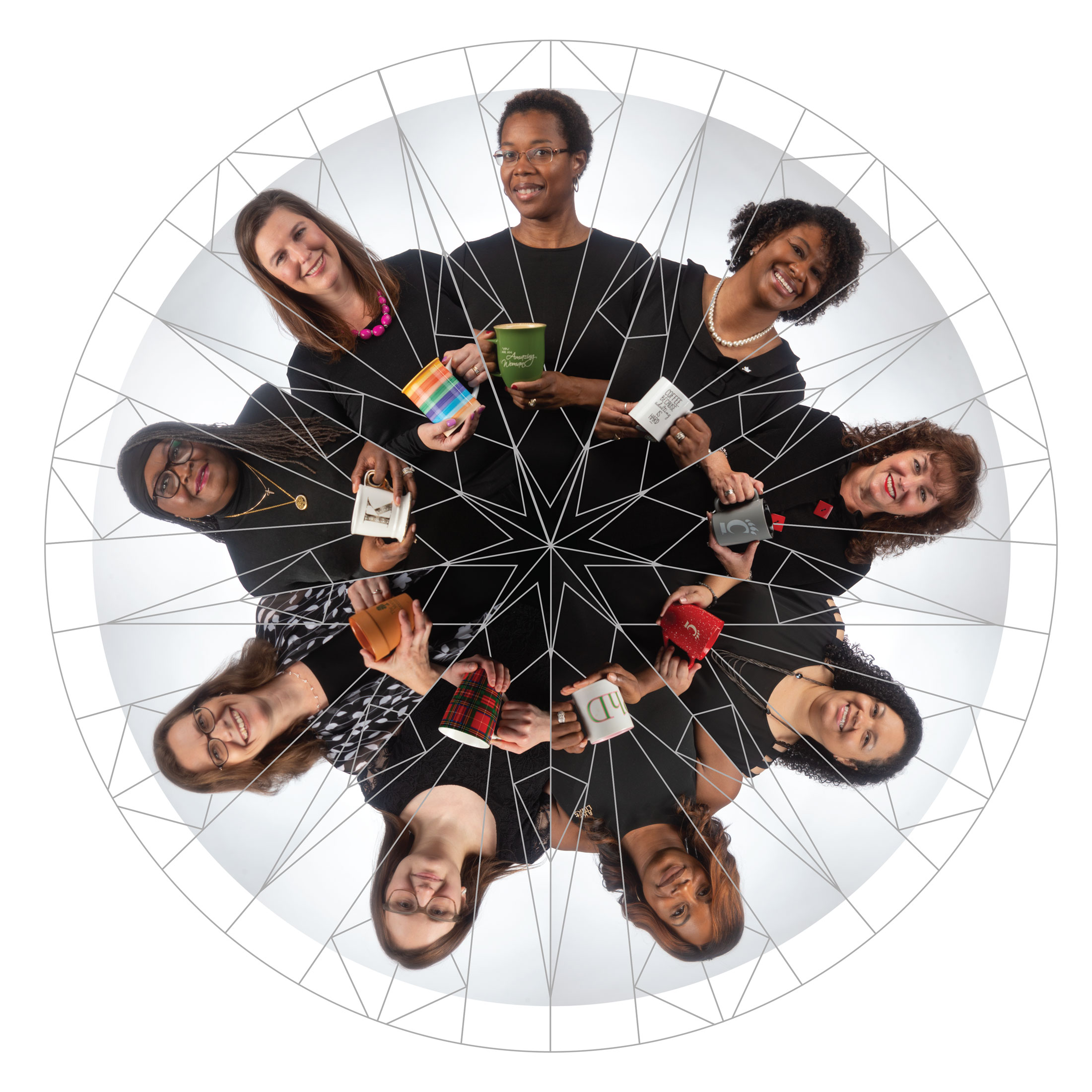
This idea led to the formation of the UC faculty group BRIDGE — Building Racial Awareness and Insight through Dialogue and Education — in spring 2019, long before current racial tensions spilled over into the streets. The group of 11 women — faculty and support staff, near evenly Black and white — meet regularly to talk about issues of race and gender in academia specific to UC, but more importantly about the academy at large, say BRIDGE co-founders Keisha Love, associate vice provost for faculty affairs and special initiatives, and Karen Faaborg, professor emeritus and former vice provost of academic personnel.

And what they have hit upon with the group, they say, is a means and model to address these tensions: open, raw, heartfelt dialogue that reveals their true selves and their experiences as women, especially women of color, at the university level. They say what research bears out is that women, specifically minorities, are often overlooked, unheard and undervalued by both administration and students, and the UC group is a way to address and remedy issues of bias and racism. So much so that they are already in talks to implement the group model to others across campus.

Their first meeting was a casual lunch, when the two talked about a mutual interest: what it meant to be a woman in academia and the racial divides. But they quickly realized they connected in a way that they knew was powerful. The conversation was so “rich,” Love says, that they decided they wanted to invite more women to the table.

An image of UC's BRIDGE program in which members appear to be in a kaleidascope

“From the beginning we all wanted to find a way to open up to each other. We were all there with our hearts in the right place. But it’s when we started seeing our different reactions to different situations that we began to realize where the gulf is,” Faaborg says.


The co-founders say they approached their initial meeting using exercises with prompts and questions that require responses to start the dialogue. 


In one exercise, several large sheets of paper were tacked to the walls around the room and each sheet had a topic. Participants then wrote their feelings and thoughts about the topic. “What was interesting was that all the white women felt one kind of way and all the Black women felt another way,” says member Karen Bankston, a professor emeritus in the College of Nursing with two decades of experience in hospital administration. This exercise then led to a broader discussion about how Black and white women manage emotions in the workplace, among other things.


“We realized that we are culturally different. Crying is something that you will not see Black women do. This realization came out because we were being vulnerable with each other. It helped enlighten both parties, both Black and white women,” says Love.


Approaching these discussions with vulnerability is key, Love says, which is echoed by other members.

“Before this group I can’t remember the last time I had an open, honest, vulnerable conversation about my experiences. It’s a huge win,” says Whitney Gaskins, assistant dean and assistant professor in UC’s Office of Inclusive Excellence & Community Engagement.

There have been multiple initiatives and actions with respect to equity and inclusion at the university, Faaborg says, “but I think what we have done in our BRIDGE group is create a safe space for the kind of painful discussions that will lead to truly meaningful change for both the Black and white women. Those kinds of discussions are not possible in more formal settings.”

Love says the group is designed to be a safe place to engage in discourse that reveals true feelings, an environment where participants can be heard without fear of judgment. “We put two rules in place: You have to respect the experiences of the other person and we won’t talk in generalities [i.e. all white women act this way or all Black women do this].” 

That doesn’t mean that what gets expressed doesn’t “sting” on occasion, Gaskins says. “We are talking in real time with our feelings, out loud, but we still very much want to make sure that we are all OK afterward.”

“The women in this group are successful Black and white women…and what we are realizing is that we can serve as sponsors to other women and start to close the divide,” says Faaborg.

“There has to be a catalyst for change, and we are those people,” says member Littisha Bates, an associate professor of sociology and associate dean for inclusive excellence and community partnership, College of Arts and Sciences and co-founder of the Black Faculty Association. If the model can be replicated, she says, “We will be able to see institutional change happen.”


Additional credits

Photography by Joseph Fuqua II/UC Creative + Brand

Photo illustrations by Margaret Weiner/UC Creative + Brand

Digital design by Kerry Overstake

FEATURE STORIES

1

Lindner graduate students shine in international simulation competition

November 10, 2025

Five master’s of information systems (MS IS) students took home fifth place out of 23 universities at the International ERPsim Competition hosted by HEC Montreal during the recent spring semester. The competition tests students’ knowledge of enterprise resource planning (ERP) software and their ability to adapt to challenging business problems.

2

Sugar overload killing hearts

November 10, 2025

Two in five people will be told they have diabetes during their lifetime. And people who have diabetes are twice as likely to develop heart disease. One of the deadliest dangers? Diabetic cardiomyopathy. But groundbreaking University of Cincinnati research hopes to stop and even reverse the damage before it’s too late.

3

Is going nuclear the solution to Ohio’s energy costs?

November 10, 2025

The Ohio Capital Journal recently reported that as energy prices continue to climb, economists are weighing the benefits of going nuclear to curb costs. The publication dove into a Scioto Analysis survey of 18 economists to weigh the pros and cons of nuclear energy. One economist featured was Iryna Topolyan, PhD, professor of economics at the Carl H. Lindner College of Business.

4

App turns smartwatch into detector of structural heart disease

November 10, 2025

An app that uses an AI model to read a single-lead ECG from a smartwatch can detect structural heart disease, researchers reported at the 2025 Scientific Sessions of the American Heart Association. Although the technology requires further validation, researchers said it could help improve the identification of patients with heart failure, valvular conditions and left ventricular hypertrophy before they become symptomatic, which could improve the prognosis for people with these conditions.

DEPARTMENTS