WVXU: Satellites zoom in on invasive plants in Cincinnati
UC research offers new tool to fight Amur honeysuckle

WVXU examined an innovative project by the University of Cincinnati to use satellite images to identify invasive Amur honeysuckle from space.
UC biology professor Denis Conover showed WVXU examples of the invasive Asian bush during a field trip with his Classification of Flowering Plants class at Burnet Woods.
Conover and UC geography graduate Bridget Taylor found that Landsat-8 images taken from orbit could identify the invasive bushes with 82% accuracy. Their study was published in the journal Ecological Restoration.
Amur honeysuckle and other invasive plants can crowd out native wildflowers and other plants.
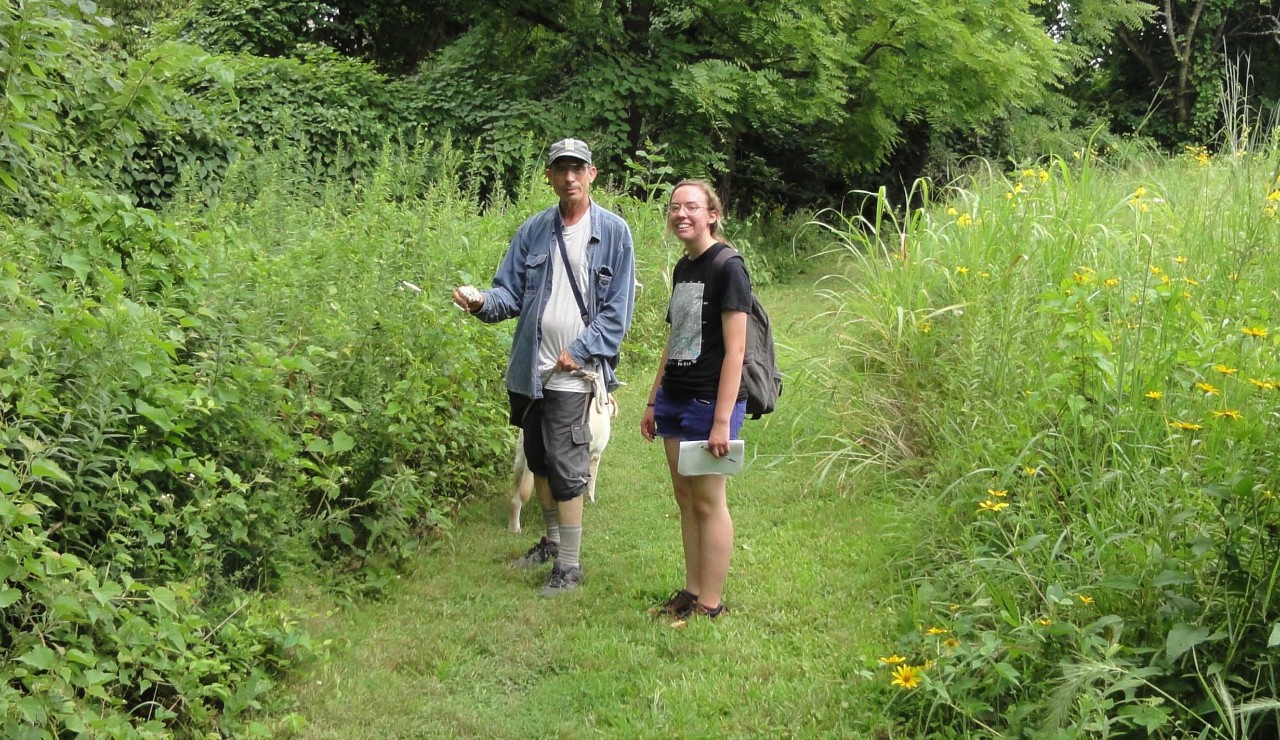
Featured image at top: UC biology professor Denis Conover and UC graduate Bridget Taylor collaborated on a study of nonnative and invasive Amur honeysuckle. Photo/Richard Beck

UC biology professor Denis Conover spoke to WVXU about a research project that used Landsat-8 satellite images to identify invasive and nonnative Amur honeysuckle from space. Here he holds a native woody plant called devil's walking stick. Photo/Joseph Fuqua II/UC Creative + Brand
Related Stories
Sugar overload killing hearts
November 10, 2025
Two in five people will be told they have diabetes during their lifetime. And people who have diabetes are twice as likely to develop heart disease. One of the deadliest dangers? Diabetic cardiomyopathy. But groundbreaking University of Cincinnati research hopes to stop and even reverse the damage before it’s too late.
Is going nuclear the solution to Ohio’s energy costs?
November 10, 2025

The Ohio Capital Journal recently reported that as energy prices continue to climb, economists are weighing the benefits of going nuclear to curb costs. The publication dove into a Scioto Analysis survey of 18 economists to weigh the pros and cons of nuclear energy. One economist featured was Iryna Topolyan, PhD, professor of economics at the Carl H. Lindner College of Business.
App turns smartwatch into detector of structural heart disease
November 10, 2025

An app that uses an AI model to read a single-lead ECG from a smartwatch can detect structural heart disease, researchers reported at the 2025 Scientific Sessions of the American Heart Association. Although the technology requires further validation, researchers said it could help improve the identification of patients with heart failure, valvular conditions and left ventricular hypertrophy before they become symptomatic, which could improve the prognosis for people with these conditions.