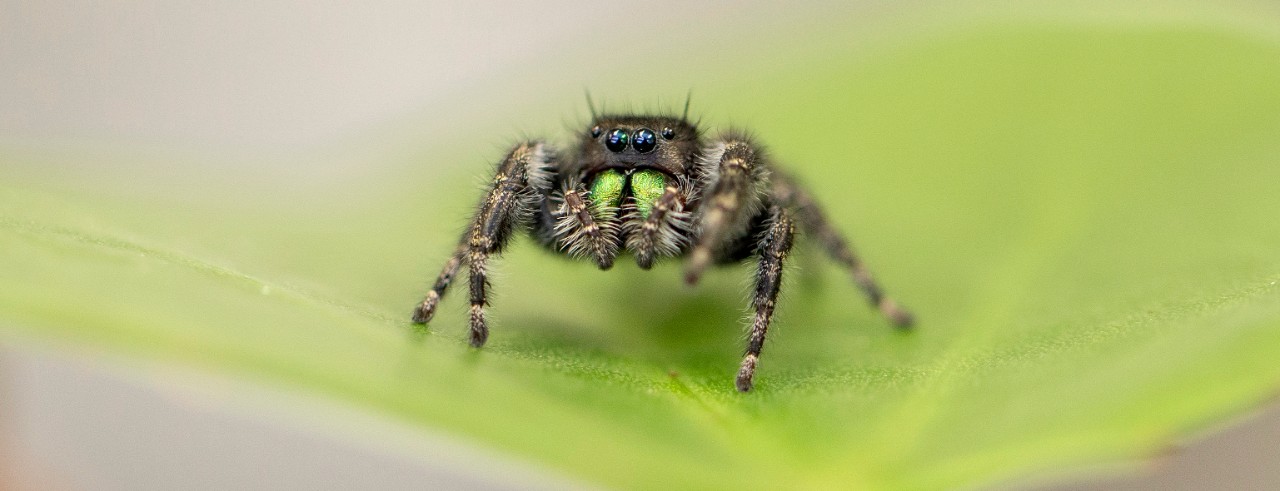
Cincinnati Edition: UC studies surprising spider vision
UC associate professor Nathan Morehouse talks about his international jumping spider project

University of Cincinnati biologist Nathan Morehouse talked to WVXU's Cincinnati Edition about the surprising color vision of jumping spiders.
Morehouse, an associate professor of biology in UC's College of Arts and Sciences, is in the middle of a five-year research project funded by the National Science Foundation to study jumping spiders around the world. So far, he and his research team have been to India, Singapore, Malaysia and South Africa to study the evolution of spider vision.
Found on six continents, jumping spiders are ubiquitous and legion. There are more kinds of jumping spiders than mammals. So there is still a lot to learn about them, he said.
"They're everywhere. They're up in high alpine meadows and down in lowland rainforests or along beaches. They are here in Cincinnati, but they're also everywhere else in the world," Morehouse told WVXU.

UC biologist Nathan Morehouse uses microspectrophotometry to measure how the photoreceptor cells in spiders absorb light. Photo/Jay Yocis/UC Creative + Brand
Peacock jumping spiders use bold colors to attract mates during their courtship displays.
"We've discovered that peacock jumping spiders have independently evolved the ability to see color as well as birds of paradise," Morehouse said. "They have four different color-sensitive cell types in their eyes."
Morehouse's team has learned that some drab-colored spiders, too, have similarly keen color vision.
"We're finding really interesting paradoxes or puzzles at the same time we're solving some," Morehouse said.

UC biologist Nathan Morehouse, right, explores the rainforest of Singapore with his research collaborators. Photo/Provided
Likewise, Morehouse and his students have learned more about how baby jumping spiders see the world so well.
Using research tools such as micro-spectrophotometry in UC's biology lab, Morehouse and his students found baby spiders have virtually the same photoreceptors and optics as adult spiders, albeit on a much smaller scale.
"They can see the world in the same fine detail they see as adults from the first day out of their egg case," Morehouse said. "They're less sensitive to light. ... They're a little stumbly. They look a little drunk."
Morehouse said spiders are unappreciated creatures.
"Most people are terrified of spiders, but they shouldn't be. They're really quite harmless and they do a lot of fantastic things for us," he said.
For example, spiders catch and eat a lot insects like mosquitoes that pose threats to human health, Morehouse said.
Cincinnati Edition host Michael Monks was unconvinced.
"Dr. Morehouse, I do hope you'll come back," Monks said. "But please don't bring any of them in."
Featured image at top: A jumping spider in UC associate professor Nathan Morehouse's biology lab. Photo/Joseph Fuqua II/UC Creative + Brand

UC associate professor Nathan Morehouse studies jumping spiders in his biology lab. Photo/Jay Yocis/UC Creative + Brand
Impact Lives Here
The University of Cincinnati is leading public urban universities into a new era of innovation and impact. Our faculty, staff and students are saving lives, changing outcomes and bending the future in our city's direction. Next Lives Here.
Stay up on all UC's COVID-19 stories, read more #UCtheGood content, or take a UC virtual visit and begin picturing yourself at an institution that inspires incredible stories.
Related Stories
Sugar overload killing hearts
November 10, 2025
Two in five people will be told they have diabetes during their lifetime. And people who have diabetes are twice as likely to develop heart disease. One of the deadliest dangers? Diabetic cardiomyopathy. But groundbreaking University of Cincinnati research hopes to stop and even reverse the damage before it’s too late.
Is going nuclear the solution to Ohio’s energy costs?
November 10, 2025

The Ohio Capital Journal recently reported that as energy prices continue to climb, economists are weighing the benefits of going nuclear to curb costs. The publication dove into a Scioto Analysis survey of 18 economists to weigh the pros and cons of nuclear energy. One economist featured was Iryna Topolyan, PhD, professor of economics at the Carl H. Lindner College of Business.
App turns smartwatch into detector of structural heart disease
November 10, 2025

An app that uses an AI model to read a single-lead ECG from a smartwatch can detect structural heart disease, researchers reported at the 2025 Scientific Sessions of the American Heart Association. Although the technology requires further validation, researchers said it could help improve the identification of patients with heart failure, valvular conditions and left ventricular hypertrophy before they become symptomatic, which could improve the prognosis for people with these conditions.