Fierce Biotech: Making 'cold' tumors responsive to immunotherapy
UC research points to combination therapy involving the immune system for breast cancer

Some cancers create a hostile environment that allows them to evade immune attacks. That's why many patients with cancer don't respond to immuno-oncology treatments. Scientists are looking for ways to turn these so-called “cold” tumors into “hot” ones that are susceptible to immunotherapy.
A research study by scientists at the University of Cincinnati have discovered proteins that can be targeted to overcome resistance to cancer immunotherapy in animal models.
Syn Kok Yeo, PhD, research instructor in the department of cancer biology at the UC College of Medicine and a member in the lab of Jun-Lin Guan, PhD, the Francis Brunning Professor and Cancer Biology Department Chair, describes his research. He is a member of the UC Cancer Center.
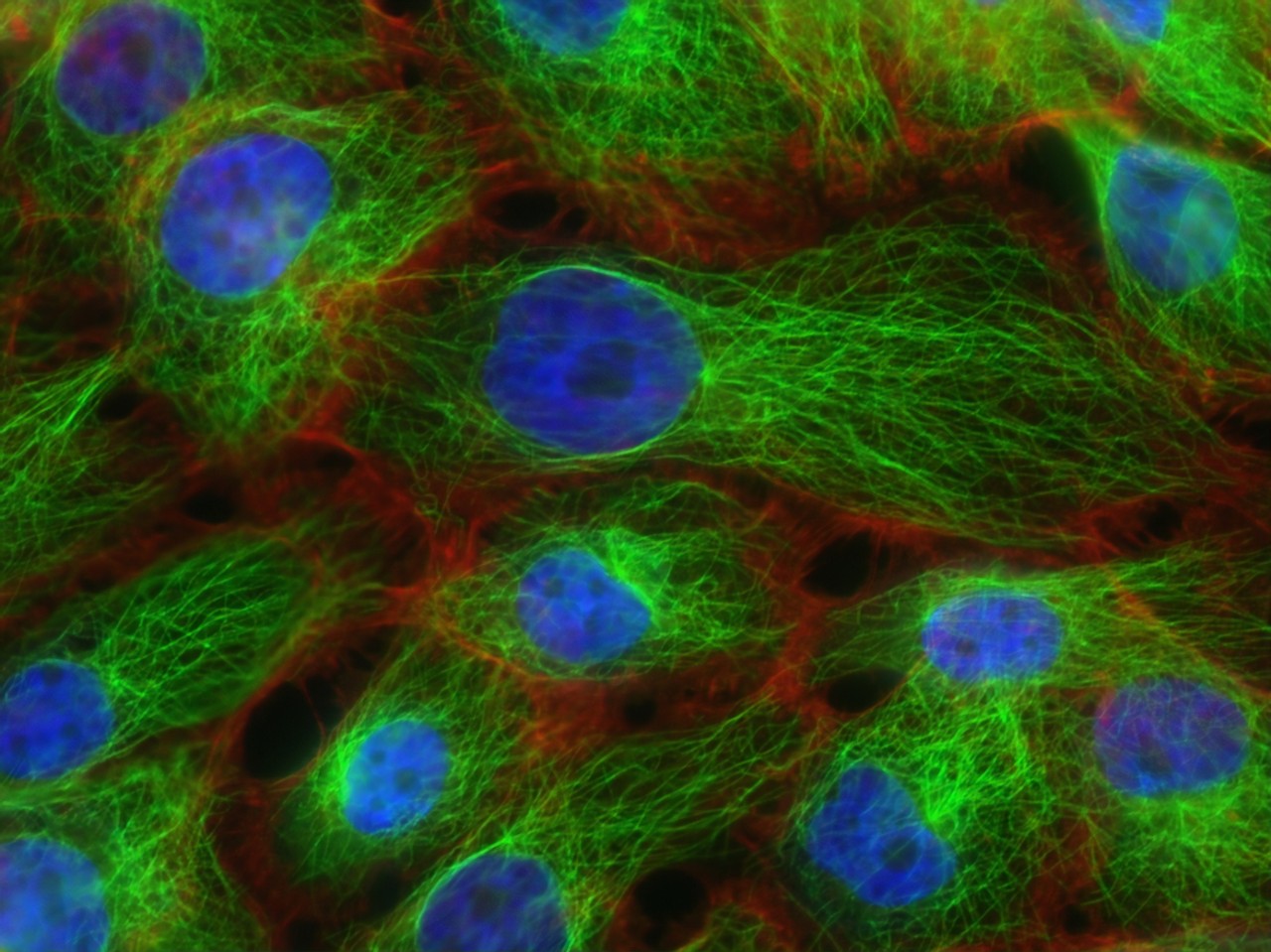
Featured photo of stress fibers and microtubules in human breast cancer cells. Courtesy of the National Cancer Institute.
Next Lives Here
The University of Cincinnati is classified as a Research 1 institution by the Carnegie Commission and is ranked in the National Science Foundation's Top-35 public research universities. UC's graduate students and faculty investigate problems and innovate solutions with real-world impact. Next Lives Here.
Related Stories
Sugar overload killing hearts
November 10, 2025
Two in five people will be told they have diabetes during their lifetime. And people who have diabetes are twice as likely to develop heart disease. One of the deadliest dangers? Diabetic cardiomyopathy. But groundbreaking University of Cincinnati research hopes to stop and even reverse the damage before it’s too late.
Is going nuclear the solution to Ohio’s energy costs?
November 10, 2025

The Ohio Capital Journal recently reported that as energy prices continue to climb, economists are weighing the benefits of going nuclear to curb costs. The publication dove into a Scioto Analysis survey of 18 economists to weigh the pros and cons of nuclear energy. One economist featured was Iryna Topolyan, PhD, professor of economics at the Carl H. Lindner College of Business.
App turns smartwatch into detector of structural heart disease
November 10, 2025

An app that uses an AI model to read a single-lead ECG from a smartwatch can detect structural heart disease, researchers reported at the 2025 Scientific Sessions of the American Heart Association. Although the technology requires further validation, researchers said it could help improve the identification of patients with heart failure, valvular conditions and left ventricular hypertrophy before they become symptomatic, which could improve the prognosis for people with these conditions.