Short Vine: New digital journal for undergraduates makes its debut
Poems, short stories and photography from across the globe featured in UC's digital literary journal

A national literary journal for undergraduates called Short Vine has been launched by the University of Cincinnati’s Department of English in the College of Arts and Sciences.
The digital publication’s name is derived from a popular street near the center of UC’s campus and journal categories include fiction, poetry, literary nonfiction, art and photography.

Photography by Orion Alvarez, "Makes me wish for summer," is featured in the first edition of Short Vine. Alvarez is a fine arts student in UC's College of Design, Architecture, Art & Planning (DAAP).
“Undergraduate literary magazines are important in that they provide an opportunity for new authors, especially young writers who are just starting to test the waters, to discover their voice, their passion and the topics and genres that are meaningful to them,” says faculty adviser Kristen Iversen, professor of English and nationally acclaimed author.
Short Vine, Iversen says, has its roots as a small publication run by student volunteers, originally founded in 2003 by Katie Hartsock, who was at the time an undergraduate student in creative writing, with James Cummins, then a UC professor of English, as the first faculty adviser. Hartsock embarked on an impressive writing career and is currently an assistant professor of English at Oakland University.

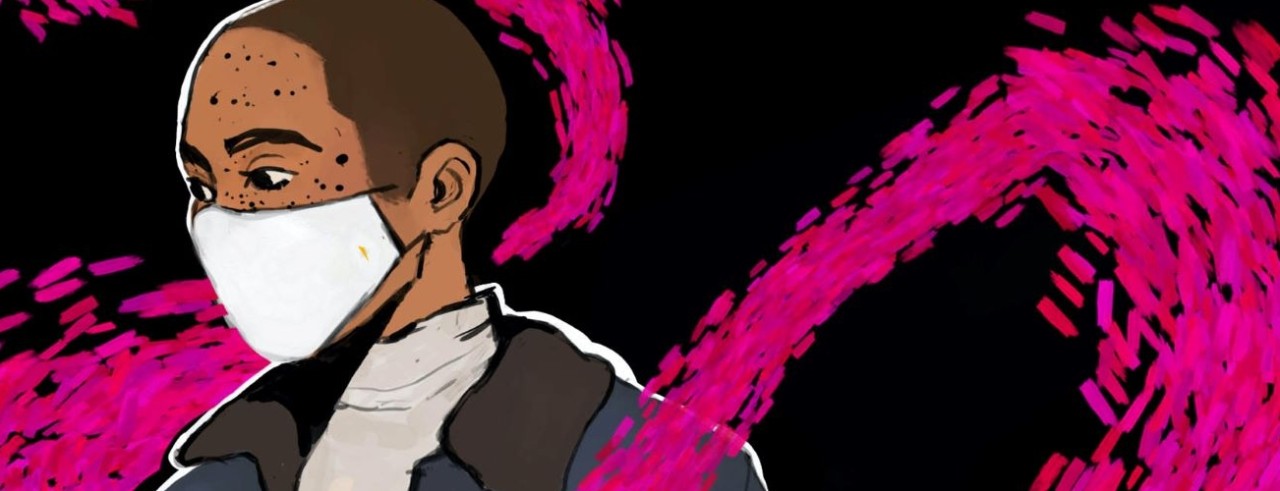
The first issue of Short Vine is themed "Quarantine Chronicles." Cover art/Orion Alvarez.
In spring of 2020 the UC literary journal was incorporated into the college’s Literary Publishing course, which Iversen teaches. Under her guidance, 14 students in the course transformed the publication into a digitized national-level journal, with a new website, new logo and new focus — to attract contributions from UC and around the globe.
The topic for the first issue was COVID-19, which drew 64 submissions of fiction, poetry and literary nonfiction and nine submissions of art and photography.
Among the poetry published is “Lost Spring” by Madison Hornikel, an undergraduate at Kent State University. “I was absolutely shocked to find out I had been selected. This was the first time I had ever submitted work to be published, and I’m so grateful to the Short Vine team for publishing my poem!”
Who knew the end of the world would be this sunny?
It’s as if someone forgot to tell Persephone
that the mortals’ winter rages on.
Do we confuse her?
Us, shut inside long after the bitter wind’s end
while her flowers bloom just beyond our reach.
The world taunts us from the window,
the trees’ leaves like fingers beckoning that we join them,
the birds’ siren songs luring us from safety.
Odysseus sails us further into terror.
We have stopped up our ears for safety, but his remain open
not out of curiosity, but of spite.
Adviser Iversen says that students taking the course read all the submissions and decide what to accept; they communicate with the authors and artists; they design the cover and the journal pages and they do all the editing and proofreading. Two graduate students who are assistant editors with The Cincinnati Review, UC’s graduate-level literary journal, provided students a training session on proofreading strategies.
“My greatest passion in life is the art of storytelling, so it was a pleasure to see individuals from around the world using stories as a way to process the tumultuous times we are living in.,"
Peter Nelson UC undergraduate and Short Vine fiction editor
Third-year UC student Peter Nelson served as a fiction editor. It was his responsibility to read, select and edit the fictional submissions individuals sent in for publication.
“My greatest passion in life is the art of storytelling, so it was a pleasure to see individuals from around the world using stories as a way to process the tumultuous times we are living in,” says Nelson.
Nelson’s own nonfiction work, “Under Siege,” appears in the first issue. The experience of writing the piece, he says, “was rewarding in and of itself because it reminded me of my versatility as a writer; I usually write science fiction and fantasy, but this time I chose to write nonfiction.”
For most students, this will be their first published work, says Iversen. “They have something important to say, and now that voice has been heard and reached a significant audience.”
Additionally, she says, students in the Literary Publishing class receive valuable writing and editing experience that can translate easily into a job or internship.
Short Vine is now on Submittable, an online service, and accepts submissions from all over the world, as long as the writer or artist is an undergraduate student. Submission for the fall issue will begin Sept. 1, 2020.
Feature image is a cropped section of the Short Vine cover art. Image/Orion Alvarez
Impact Lives Here
The University of Cincinnati is leading public urban universities into a new era of innovation and impact. Our faculty, staff and students are saving lives, changing outcomes and bending the future in our city's direction. Next Lives Here.
Related Stories
Sugar overload killing hearts
November 10, 2025
Two in five people will be told they have diabetes during their lifetime. And people who have diabetes are twice as likely to develop heart disease. One of the deadliest dangers? Diabetic cardiomyopathy. But groundbreaking University of Cincinnati research hopes to stop and even reverse the damage before it’s too late.
Is going nuclear the solution to Ohio’s energy costs?
November 10, 2025

The Ohio Capital Journal recently reported that as energy prices continue to climb, economists are weighing the benefits of going nuclear to curb costs. The publication dove into a Scioto Analysis survey of 18 economists to weigh the pros and cons of nuclear energy. One economist featured was Iryna Topolyan, PhD, professor of economics at the Carl H. Lindner College of Business.
App turns smartwatch into detector of structural heart disease
November 10, 2025

An app that uses an AI model to read a single-lead ECG from a smartwatch can detect structural heart disease, researchers reported at the 2025 Scientific Sessions of the American Heart Association. Although the technology requires further validation, researchers said it could help improve the identification of patients with heart failure, valvular conditions and left ventricular hypertrophy before they become symptomatic, which could improve the prognosis for people with these conditions.