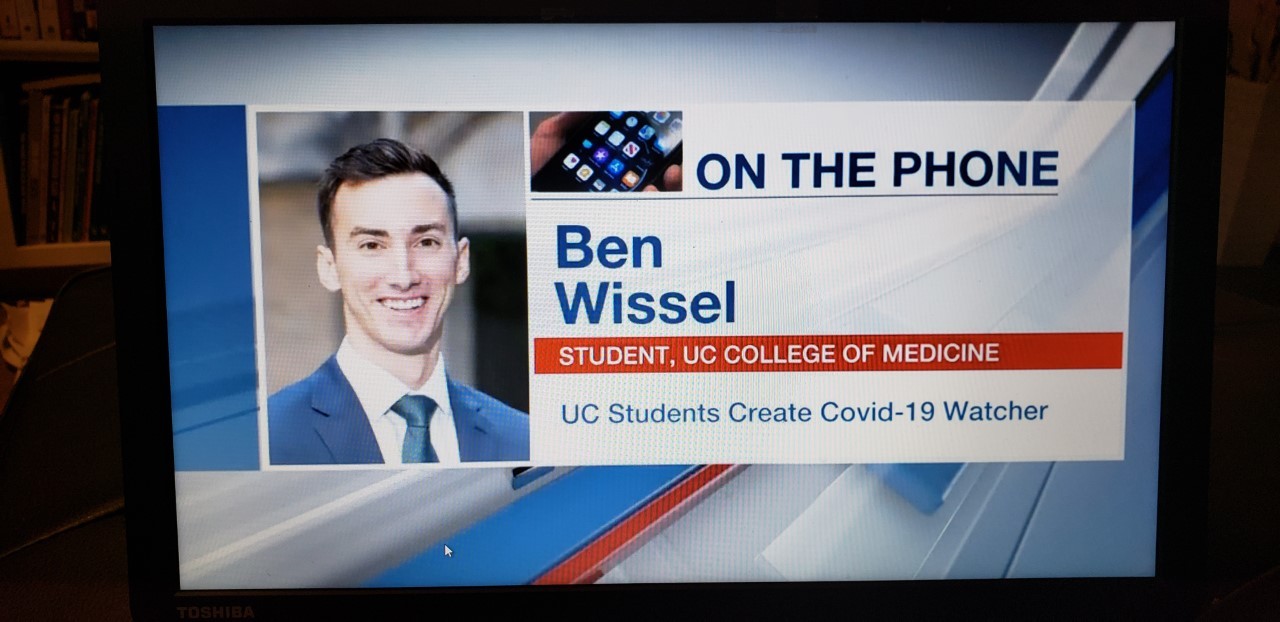
Fox 19: UC students create COVID-19 Watcher
Biomedical Informatics students in the College of Medicine track COVID-19 cases

University of Cincinnati students Benjamin Wissel, part of the MD/PhD program, and Pieter-Jan Van Camp, MD, a doctoral student in biomedical informatics, have developed the COVID-19 Watcher. The two UC students, with support from UC faculty and Cincinnati Children’s staff, created an Interactive Dashboard during the spring when there were few options for tracking COVID-19 cases in cities like Cincinnati.
The COVID-19 Watcher displays data from every county and 188 metropolitan areas in the country. Features of the dashboard include ranking of the worst affected areas and auto-generating plots that depict temporal changes in testing capacity, cases and deaths. The COVID-19 Watcher can provide the public with real-time updates of outbreaks in their area. The app pulls in data from the New York Times, which has been tracking COVID-19 cases since January, and merges it with sources from the U.S. Census to map cases for each county and metropolitan area.
Listen to Wissel’s interview with Fox 19.
Related Stories
Sugar overload killing hearts
November 10, 2025
Two in five people will be told they have diabetes during their lifetime. And people who have diabetes are twice as likely to develop heart disease. One of the deadliest dangers? Diabetic cardiomyopathy. But groundbreaking University of Cincinnati research hopes to stop and even reverse the damage before it’s too late.
Is going nuclear the solution to Ohio’s energy costs?
November 10, 2025

The Ohio Capital Journal recently reported that as energy prices continue to climb, economists are weighing the benefits of going nuclear to curb costs. The publication dove into a Scioto Analysis survey of 18 economists to weigh the pros and cons of nuclear energy. One economist featured was Iryna Topolyan, PhD, professor of economics at the Carl H. Lindner College of Business.
App turns smartwatch into detector of structural heart disease
November 10, 2025

An app that uses an AI model to read a single-lead ECG from a smartwatch can detect structural heart disease, researchers reported at the 2025 Scientific Sessions of the American Heart Association. Although the technology requires further validation, researchers said it could help improve the identification of patients with heart failure, valvular conditions and left ventricular hypertrophy before they become symptomatic, which could improve the prognosis for people with these conditions.