‘Watcher’ tracks coronavirus in Cincinnati and beyond
Two UC students develop interactive dashboard to keep tabs on pandemic

Two University of Cincinnati students have developed an interactive dashboard which shows COVID-19 cases and deaths in Greater Cincinnati and other major U.S. cities. Known as the COVID-19 Watcher, it joins a list of options available to the public to track the novel coronavirus.
Benjamin Wissel, a student in the UC College of Medicine’s Medical Scientist Training Program, and Pieter-Jan Van Camp, MD, a doctoral student in the Biomedical Informatics Graduate program, developed their app during the spring when there were no options for tracking city data. Since then the New York Times has added this feature to their dashboard as well.
“People are connected and viruses spread through city infrastructures,” says Wissel. “Our app is especially relevant in places like Cincinnati, whose metro area is split between three different states. The public benefits from additional sources that can provide up-to-date COVID-19 data for the country, state, county and city level.”

Ben Wissel. Photo/Cincinnati Children's.
Wissel and Van Camp published research on their dashboard recently in the Journal of the American Medical Informatics Association. Their dashboard is also listed on the Centers for Disease and Prevention Control website under the heading Cincinnati Children’s Hospital’s COVID-19 Watcher.
The COVID-19 Watcher displays data from every county and 188 metropolitan areas in the country. Features of the dashboard include ranking of the worst affected areas and auto-generating plots that depict temporal changes in testing capacity, cases and deaths. The COVID-19 Watcher can provide the public with real-time updates of outbreaks in their area.
“The New York Times has been tracking COVID-19 since January, and they released their data to the public in late March of this year,” says Wissel. “Our app pulls in their data, merges it with sources from the U.S. Census Bureau to map cases for each county to metropolitan areas, and then visualizes the data.”
Wissel says users of the dashboard can compare their city with others.
“Outbreaks started at different times in different cities, so it is insightful to compare the progression of the virus spreading in your city compared to other cities who started before you,” explains Wissel. “It is very hard to think of things in terms of exponential growth, but seeing case numbers from a city that is, for example, five days ahead of you can give you an idea of where your city might be in five days.”

Pieter-Jan Van Camp, MD. Photo Cincinnati Children's.
Van Camp says users can explore the interactive dashboard’s possibilities.
“I think one of the dashboard’s more interesting features is the option to adjust the data by the size of the population per capita,” says Van Camp. “This way, you can compare the outbreak in different regions, regardless of high or low population, on a relative scale.”
Other co-authors on research include Michal Kouril, PhD, UC assistant professor of pediatrics and Cincinnati Children’s researcher; Chad Weis, senior systems analyst at Cincinnati Children’s; Tracy Glauser, MD, UC professor of pediatrics and associate director of the Cincinnati Children's Research Foundation; Peter White, PhD, adjunct professor of biomedical informatics at UC; Isaac Kohane, MD, PhD, chair of the Department of Biomedical Informatics Harvard Medical School; and Judith Dexheimer, PhD, UC associate professor of pediatrics and Cincinnati Children’s researcher.
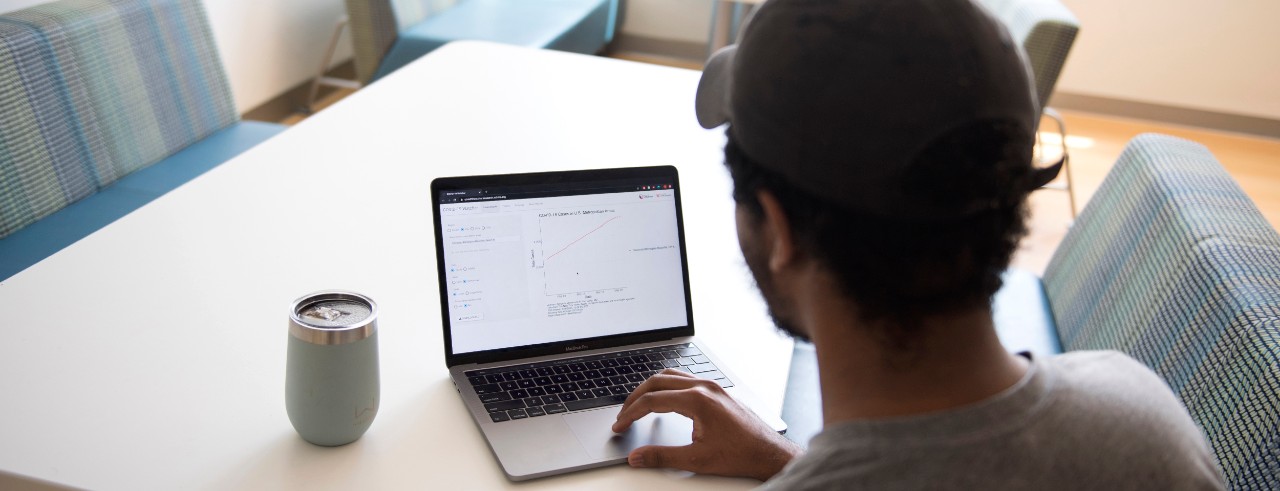
Featured image at top: The COVID-19 Watcher helps track cases of the novel coronavirus in Cincinnati and beyond. Photo/Colleen Kelley/UC Creative + Brand.
Impact Lives Here
The University of Cincinnati is leading public urban universities into a new era of innovation and impact. Our faculty, staff and students are saving lives, changing outcomes and bending the future in our city's direction. Next Lives Here.
Stay up on all UC's COVID-19 stories, read more #UCtheGood content, or take a UC virtual visit and begin picturing yourself at an institution that inspires incredible stories.
Related Stories
Sugar overload killing hearts
November 10, 2025
Two in five people will be told they have diabetes during their lifetime. And people who have diabetes are twice as likely to develop heart disease. One of the deadliest dangers? Diabetic cardiomyopathy. But groundbreaking University of Cincinnati research hopes to stop and even reverse the damage before it’s too late.
App turns smartwatch into detector of structural heart disease
November 10, 2025

An app that uses an AI model to read a single-lead ECG from a smartwatch can detect structural heart disease, researchers reported at the 2025 Scientific Sessions of the American Heart Association. Although the technology requires further validation, researchers said it could help improve the identification of patients with heart failure, valvular conditions and left ventricular hypertrophy before they become symptomatic, which could improve the prognosis for people with these conditions.
Combination immunotherapy helps overcome melanoma treatment resistance
November 10, 2025

MSN highlighted research led by the University of Cincinnati Cancer Center's Trisha Wise-Draper showing a combination of immunotherapy medications can activate a robust immune response and help overcome treatment resistance in patients with refractory melanoma.