Quanta Magazine: UC physicist discusses rare quark anomalies
Theoretical physicist Jure Zupan says we need more data to declare 'new physics'

Quanta Magazine spoke to a University of Cincinnati theoretical physicist for his take on intriguing results from recent experiments at CERN's particle accelerator.
The Large Hadron Collider in Europe has observed unusual and unexpected behavior of B mesons, one of six types of subatomic particles called quarks that make up most of the visible matter in the universe.
According to Quanta, a team composed of hundreds of international researchers at CERN found that the decay of B mesons "conflicts slightly with the predictions of the Standard Model of particle physics, the reigning set of equations describing the subatomic world."
The team observed 4,500 rare B meson decays. From Quanta:
Statistically, the deviation in the angular pattern is equivalent to flipping a coin 100 times and getting 66 heads, rather than the usual 50 or so. For a fair coin, the odds of such a deviation are about 1 in 1,000.
But amid oodles of particle collisions, statistical fluctuations are bound to arise, so a 1-in-1,000 deviation doesn’t count as hard proof of a break with the Standard Model.
If this is new physics, it's not significant enough.
Jure Zupan, UC theoretical physicist in Quanta Magazine
UC theoretical physicist Jure Zupan told Quanta that researchers must accumulate enough B meson decays to demonstrate a deviation of 1 in 1.7 million. This is the equivalent of getting heads 75 times in 100 coin tosses.
"If this is new physics, it's not significant enough," he said.
Zupan, a professor of physics in UC's College of Arts and Sciences, was the 2019 winner of the prestigious Friedrich Wilhelm Bessel Award from the Alexander von Humboldt Foundation in recognition of his lifetime achievement in research on dark matter, antimatter and quarks.
Zupan said research at particle physics labs around the world help us get closer to understanding the origins of the universe.
"The main question we’re addressing is: Why are we here? How is it possible?” he said. “Why did matter dominate over antimatter? It’s a fundamental question of particle physics. We still don’t know the answer.”
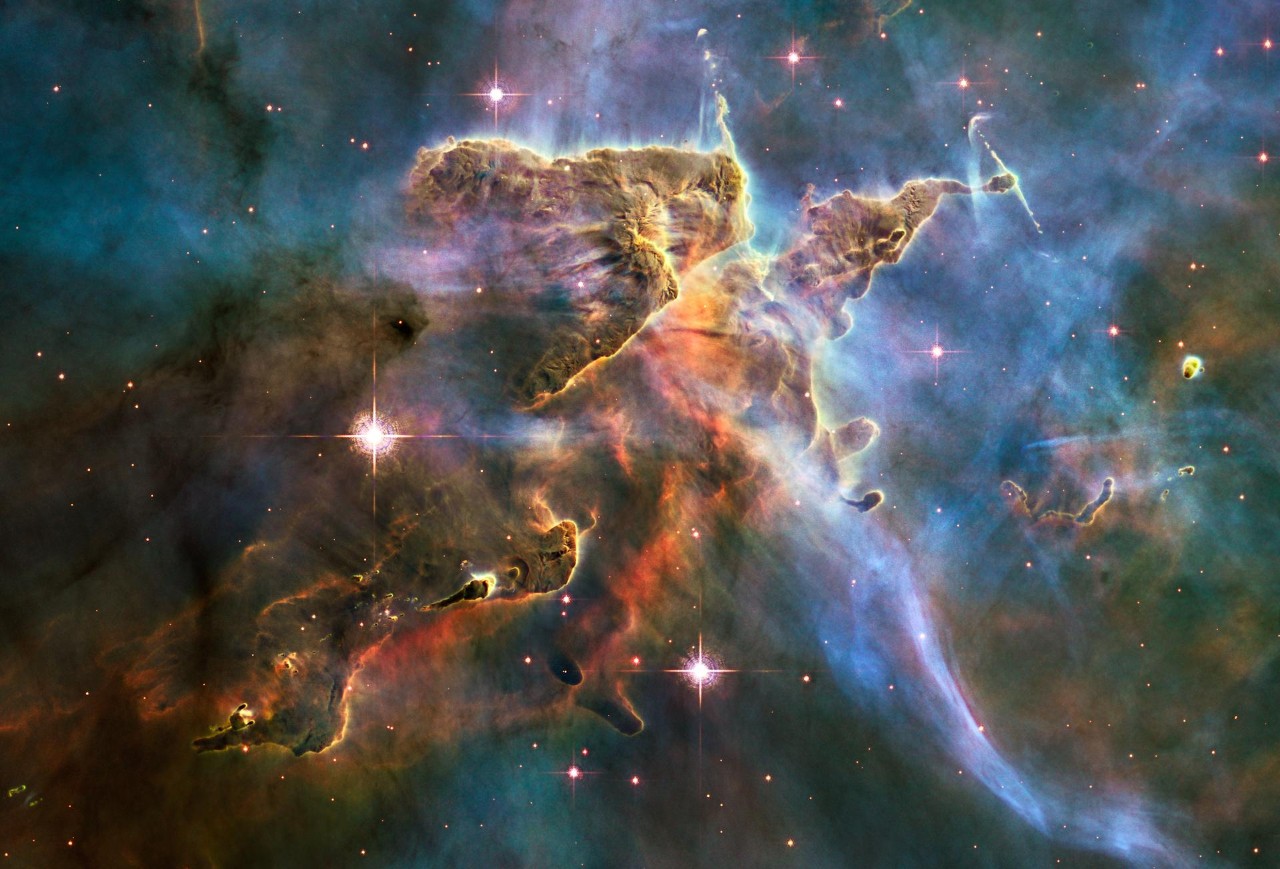
Featured image at top: A cloud of interstellar gas billows around the Carina Nebula captured by NASA's Hubble Space Telescope. Photo/NASA Goddard

University of Cincinnati physicist Jure Zupan has worked at particle accelerator labs around the world. Photo/Joseph Fuqua II/UC Creative + Brand
Related Stories
Sugar overload killing hearts
November 10, 2025
Two in five people will be told they have diabetes during their lifetime. And people who have diabetes are twice as likely to develop heart disease. One of the deadliest dangers? Diabetic cardiomyopathy. But groundbreaking University of Cincinnati research hopes to stop and even reverse the damage before it’s too late.
Is going nuclear the solution to Ohio’s energy costs?
November 10, 2025

The Ohio Capital Journal recently reported that as energy prices continue to climb, economists are weighing the benefits of going nuclear to curb costs. The publication dove into a Scioto Analysis survey of 18 economists to weigh the pros and cons of nuclear energy. One economist featured was Iryna Topolyan, PhD, professor of economics at the Carl H. Lindner College of Business.
App turns smartwatch into detector of structural heart disease
November 10, 2025

An app that uses an AI model to read a single-lead ECG from a smartwatch can detect structural heart disease, researchers reported at the 2025 Scientific Sessions of the American Heart Association. Although the technology requires further validation, researchers said it could help improve the identification of patients with heart failure, valvular conditions and left ventricular hypertrophy before they become symptomatic, which could improve the prognosis for people with these conditions.