UC researcher studies potential target for cancer
Pharmacy faculty member receives American Cancer Society grant to study breast cancer biomarker

There are innumerable intricacies to the development of cancer, including breast cancer which is the second leading cause of cancer death for women.
One protein known as HER2, which can cause a more aggressive cancer, has already been a target for research and treatment in breast cancer. Now a different target — another protein, HER3 — is emerging as a potential crucial biomarker in some of these cases.
And Joan Garrett, PhD, assistant professor of pharmaceutical sciences at the University of Cincinnati's James L. Winkle College of Pharmacy, hopes to learn more about HER3 and its role in breast cancer development.
“Our research is focused on understanding if mutations of a protein called HER3 are involved in causing breast cancers,” says Garrett, who is also a member of the UC Cancer Center.
Garrett recently received a $792,000 Research Scholar Grant from the American Cancer Society for this work.

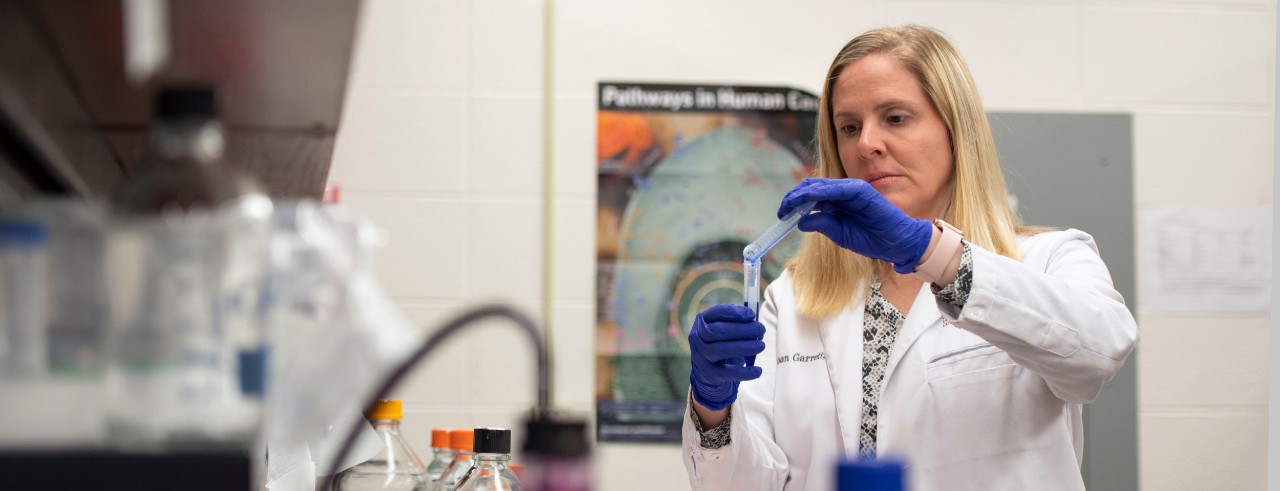
Joan Garrett, PhD, pictured here in her lab, is studying a potential new biomarker for breast cancer that could open the door to new targeted treatments. Photo/Colleen Kelley/UC Creative + Brand
“Our lab hopes to determine whether variants of HER3 are in the driver's seat for causing breast cancer or if they are simply passengers along for the ride,” she says. “We hope to find the driver variants of HER3 causing breast cancer and identify the most effective treatment options for women who have these variants.”
Garrett, who came to the UC in 2015, has always focused on better understanding the pathways and signals that lead to cancer development.
“I am personally committed to discovering those intricate and important interactions that occur in our bodies and cells with the goal to stop cancer in its tracks and impact the lives of cancer patients everywhere,” she says. “Our lab’s work covers the gamut of basic cancer biology through translational studies and involvement with clinical trials.
“We hope that results from this study provide more clues into targeting and treating a cancer that affects one in eight women in the U.S.”
Featured image of Joan Garrett in a lab at the Winkle College of Pharmacy/Colleen Kelley/UC Creative + Brand
Next Lives Here
The University of Cincinnati is classified as a Research 1 institution by the Carnegie Commission and is ranked in the National Science Foundation's Top-35 public research universities. UC's graduate students and faculty investigate problems and innovate solutions with real-world impact. Next Lives Here.
Related Stories
Sugar overload killing hearts
November 10, 2025
Two in five people will be told they have diabetes during their lifetime. And people who have diabetes are twice as likely to develop heart disease. One of the deadliest dangers? Diabetic cardiomyopathy. But groundbreaking University of Cincinnati research hopes to stop and even reverse the damage before it’s too late.
App turns smartwatch into detector of structural heart disease
November 10, 2025

An app that uses an AI model to read a single-lead ECG from a smartwatch can detect structural heart disease, researchers reported at the 2025 Scientific Sessions of the American Heart Association. Although the technology requires further validation, researchers said it could help improve the identification of patients with heart failure, valvular conditions and left ventricular hypertrophy before they become symptomatic, which could improve the prognosis for people with these conditions.
Combination immunotherapy helps overcome melanoma treatment resistance
November 10, 2025

MSN highlighted research led by the University of Cincinnati Cancer Center's Trisha Wise-Draper showing a combination of immunotherapy medications can activate a robust immune response and help overcome treatment resistance in patients with refractory melanoma.