U.S. News & World Report: UC’s OIP frees man after 45+ years in prison

An Ohio man who was freed with the help of the Ohio Innocence Project at the University of Cincinnati College of Law after serving nearly 46 years in prison for a crime he did not commit is making headlines across the nation.
Isiah Andrews, now 82, thought he’d die in prison after he was convicted in 1975 of the murder of his wife of just three weeks, Regina Andrews. But on May 6, Andrews, who’s always maintained his innocence, finally walked free after a team of UC faculty, attorneys and students discovered evidence that strongly implicated another man, Willie Watts, committed the murder, but that evidence had been unlawfully suppressed from Andrews' defense for 45 years.
OIP attorneys argued that if Andrews’ defense had known about Watts during his original trial in 1975, there is a reasonable chance he may have been acquitted—and Cuyahoga County Common Pleas Judge Robert McClelland agreed. On May 1, McClelland threw out Andrews’ conviction and ordered a new trial on the basis Andrews’ defense was never provided evidence regarding Watts.
“It’s hard to say that Isiah Andrews is lucky after all the wrongs that have been done to him the course of his life,” said Brian Howe, an OIP staff attorney and assistant professor of clinical law at the UC college. “But in 99 times out of 100, he would have died in prison. This would have been successfully covered up. No one would have found out about Willie Watts.”
“There are so many cases where the evidence never comes out and the person maintains their innocence until they die, and the case is forgotten,” said Howe. “How many other people are out there who just don’t get lucky like that?”
Here’s a round-up of some of the media coverage generated by Andrews’ case:
- U.S. News & World Report: Ohio Man Granted New Trial in 1974 Slaying of His Wife
- Cleveland.com: Cleveland man released from prison after winning new trial in wife’s 1974 slaying that he says he didn’t commit
- Cleveland 19: 82-year-old man granted new trial in Cuyahoga County after maintaining innocence in 1974 murder of wife
- Cleveland.com: Cleveland man convicted in 1975 of murder wins new trial over withheld report pointing to different suspect
- Courtroom Strategy: Ohio Man Spent 45 Years in Jail for Murder While Proof of True Killer Sat in Police Files
- ClevelandScene: Judge Grants New Trial for Cleveland Man Who's Maintained Innocence in 1974 Murder of His Wife After Undisclosed Police Reports Surface
- The Telegraph
- The Hour
- The Darien Times
- WHK Radio
- Seattle PI
- Erie News Now
- The Dispatch
- Record-Patriot
- 21 WFMJ
- Midland Daily News
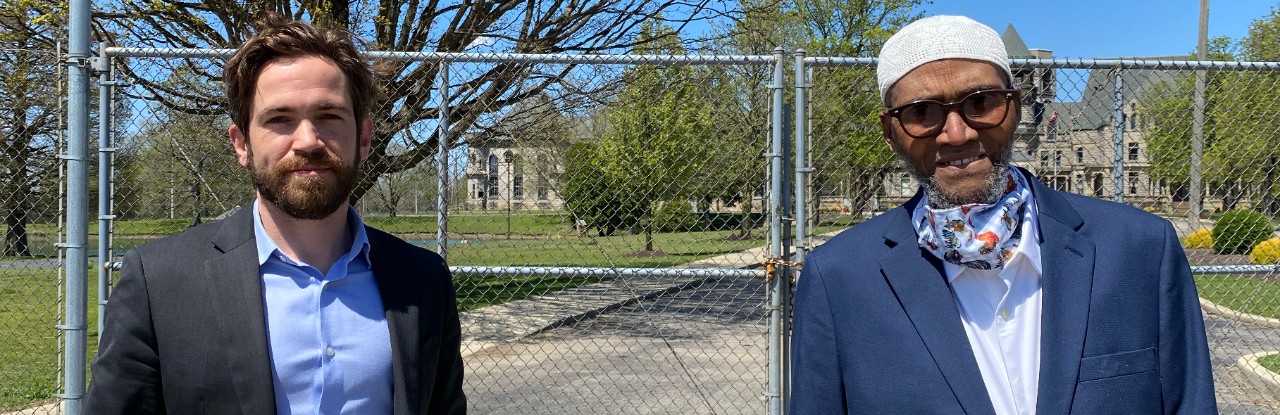
Featured image at top: Brian Howe and Isiah Andrews after Andrews' release on Wednesday, May 6, 2020. Photo: Mark Godsey
Related Stories
Sugar overload killing hearts
November 10, 2025
Two in five people will be told they have diabetes during their lifetime. And people who have diabetes are twice as likely to develop heart disease. One of the deadliest dangers? Diabetic cardiomyopathy. But groundbreaking University of Cincinnati research hopes to stop and even reverse the damage before it’s too late.
Is going nuclear the solution to Ohio’s energy costs?
November 10, 2025

The Ohio Capital Journal recently reported that as energy prices continue to climb, economists are weighing the benefits of going nuclear to curb costs. The publication dove into a Scioto Analysis survey of 18 economists to weigh the pros and cons of nuclear energy. One economist featured was Iryna Topolyan, PhD, professor of economics at the Carl H. Lindner College of Business.
App turns smartwatch into detector of structural heart disease
November 10, 2025

An app that uses an AI model to read a single-lead ECG from a smartwatch can detect structural heart disease, researchers reported at the 2025 Scientific Sessions of the American Heart Association. Although the technology requires further validation, researchers said it could help improve the identification of patients with heart failure, valvular conditions and left ventricular hypertrophy before they become symptomatic, which could improve the prognosis for people with these conditions.