Cincinnati media talk to UC researchers about COVID-19 projections
UC research group provides blueprint for reopening Ohio

Researchers with the University of Cincinnati spoke to Cincinnati news media about their latest projections for COVID-19, which could help Ohio reopen more safely.
WCPO's Josh Bazan interviewed UC College of Pharmacy Dean Neil MacKinnon and UC assistant professor Diego Cuadros, members of UC's Geospatial Health Advising Group.

WCPO's Josh Bazan talks to UC assistant professor of geography Diego Cuadros about Ohio's plan to reopen safely during a pandemic. Photo/WCPO
Ohio is reopening businesses gradually while maintaining social distancing wherever possible.
"If everything opened at once, our analysis shows, we would have a second surge and a huge impact on our health care system we couldn't handle," MacKinnon told WCPO.
"I think all of us would like things to open up much quicker, but it really follows this prudent, cautious phased-in approach."
The Cincinnati Enquirer also cited UC's analysis in a report on Ohio's reopening.
According to UC's analysis, a significant relaxation of closures and social distancing could force Ohio to return to stricter closures in as soon as six weeks to prevent Ohio intensive-care units from being overwhelmed.
WLWT-5 reported on these possible intermittent closures if the virus begins to surge again.
"There could be more resistance to going back to stricter social distancing approaches," said Cuadros, an assistant professor of geography in UC's College of Arts and Sciences.
"That’s why it’s important to start telling people now what could happen,” he said.
UC’s College of Pharmacy and its departments of math and geography conducted its analysis using data collected from March 1-23 before Ohio implemented its stay-at-home order. During that period the virus was on pace to cause 13,000 hospitalizations, killing 1,080 people in Ohio by April 15 until the state enacted measures such as mandatory closures and other social-distancing practices.
UC’s analysis found that social distancing saved 687 lives and cut hospitalizations by more than 10,500 cases through April 15.
Now UC researchers project Ohio will see an estimated 4,816 new hospitalizations and 1,073 deaths by June 1 under current social-distancing policies.
UC researchers determined that social distancing has cut the growth rate of coronavirus infections in Ohio by about 35%. Relaxing these measures moderately (defined as policy changes that reduce this mitigation impact by 50%) will lead to an estimated 7,682 hospitalizations and 1,367 deaths. Relaxing the social-distancing policies significantly (defined as policy changes that reduce the mitigation impact by 70%) will lead to an estimated 10,846 hospitalizations and 1,629 deaths by June 1, UC researchers say.
Likewise, moderate reopening in Ohio will mean 67 of Ohio’s 88 counties will reach full ICU bed capacity by June 30. Significant reopening will lead to ICU bed capacity by June 13 and more than 7,000 ICU beds statewide would be needed by June 30.
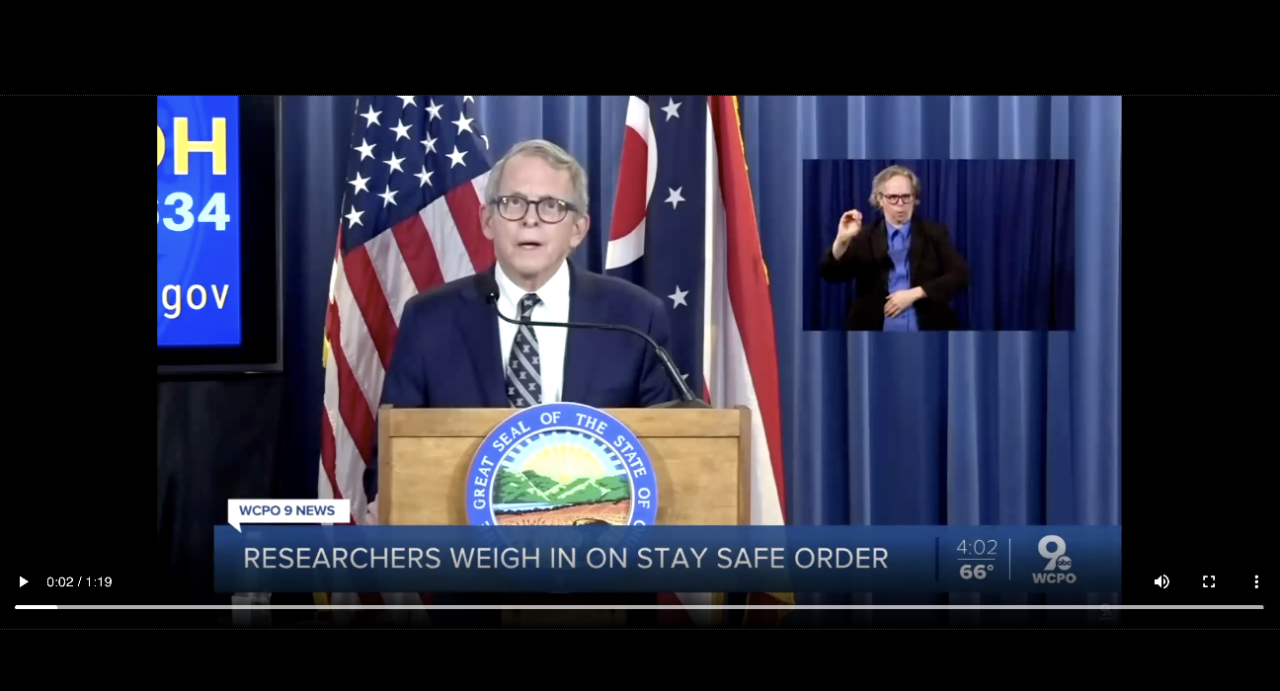
Featured image at top: Ohio Gov. Mike DeWine talks about reopening Ohio. Photo/WCPO
UC's projections for June

UC's Geospatial Health Advising Group projects deaths from coronavirus under different social-distancing standards. Graphic/UC
Impact Lives Here
The University of Cincinnati is leading public urban universities into a new era of innovation and impact. Our faculty, staff and students are saving lives, changing outcomes and bending the future in our city's direction. Next Lives Here.
Stay up on all UC's COVID-19 stories, read more #UCtheGood content, or take a UC virtual visit and begin picturing yourself at an institution that inspires incredible stories.
Related Stories
Sugar overload killing hearts
November 10, 2025
Two in five people will be told they have diabetes during their lifetime. And people who have diabetes are twice as likely to develop heart disease. One of the deadliest dangers? Diabetic cardiomyopathy. But groundbreaking University of Cincinnati research hopes to stop and even reverse the damage before it’s too late.
Is going nuclear the solution to Ohio’s energy costs?
November 10, 2025

The Ohio Capital Journal recently reported that as energy prices continue to climb, economists are weighing the benefits of going nuclear to curb costs. The publication dove into a Scioto Analysis survey of 18 economists to weigh the pros and cons of nuclear energy. One economist featured was Iryna Topolyan, PhD, professor of economics at the Carl H. Lindner College of Business.
App turns smartwatch into detector of structural heart disease
November 10, 2025

An app that uses an AI model to read a single-lead ECG from a smartwatch can detect structural heart disease, researchers reported at the 2025 Scientific Sessions of the American Heart Association. Although the technology requires further validation, researchers said it could help improve the identification of patients with heart failure, valvular conditions and left ventricular hypertrophy before they become symptomatic, which could improve the prognosis for people with these conditions.