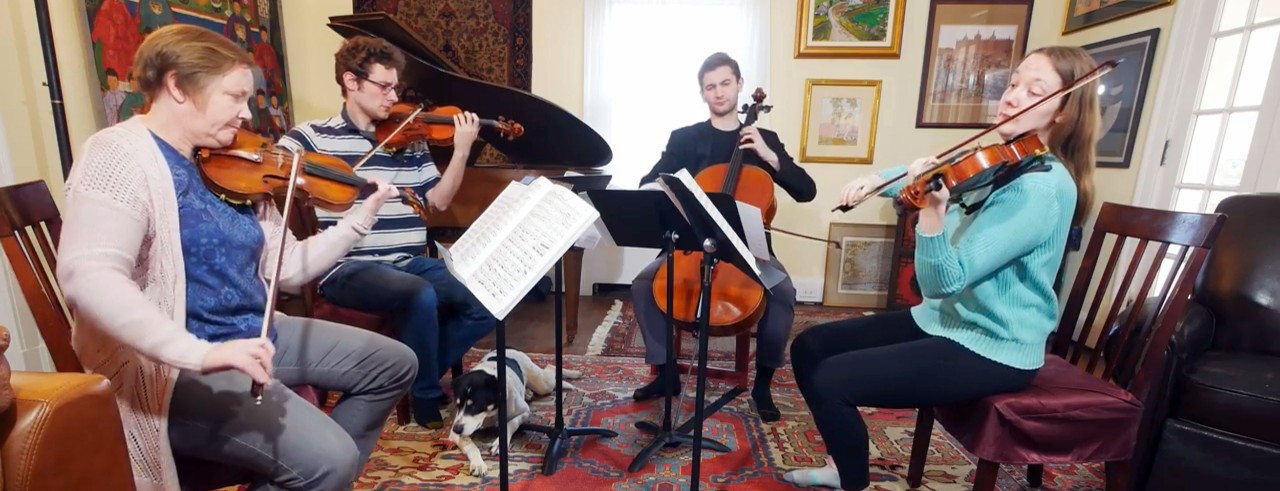
Musical family gives living room performance of Beethoven String Quartet
A professional violinist, two CCM students and a Schulich School of Music student make music at home

A family of musicians stuck at home during the pandemic found a perfect venue for a chamber music performance — their living room. The four string players, including two UC College-Conservatory of Music students, performed the first movement of Beethoven’s String Quartet in D Major, Op. 18, No. 3 and shared it online for music lovers everywhere to enjoy.
The home concert features Cleveland Orchestra violinist Kathleen Collins and her children: Daniel Fields, a student violinist at CCM; Matthew Fields, a student cellist at the Schulich School of Music of McGill University; and Maya Fields, a student violist at CCM.
The performance received rave reviews from the family’s live-audience member, Cleo the dog. Tune into the performance on CCM’s YouTube channel.
Video provided by Maya Fields
Impact Lives Here
The University of Cincinnati is leading public urban universities into a new era of innovation and impact. Our faculty, staff and students are saving lives, changing outcomes and bending the future in our city's direction. Next Lives Here.
Read more #UCtheGood stories, or take a UC virtual visit and begin picturing yourself at an institution that inspires incredible stories.
Related Stories
Sugar overload killing hearts
November 10, 2025
Two in five people will be told they have diabetes during their lifetime. And people who have diabetes are twice as likely to develop heart disease. One of the deadliest dangers? Diabetic cardiomyopathy. But groundbreaking University of Cincinnati research hopes to stop and even reverse the damage before it’s too late.
App turns smartwatch into detector of structural heart disease
November 10, 2025

An app that uses an AI model to read a single-lead ECG from a smartwatch can detect structural heart disease, researchers reported at the 2025 Scientific Sessions of the American Heart Association. Although the technology requires further validation, researchers said it could help improve the identification of patients with heart failure, valvular conditions and left ventricular hypertrophy before they become symptomatic, which could improve the prognosis for people with these conditions.
Combination immunotherapy helps overcome melanoma treatment resistance
November 10, 2025

MSN highlighted research led by the University of Cincinnati Cancer Center's Trisha Wise-Draper showing a combination of immunotherapy medications can activate a robust immune response and help overcome treatment resistance in patients with refractory melanoma.