UC Faculty Awards 2020: Colin Bischoff
College of Arts and Sciences faculty honored with Innovative Uses of Technology in Teaching Award

As a Stanford and Harvard educated physicist, Colin Bischoff has problem-solving in his DNA. So when the assistant professor discovered a computational challenge in his upper-division astrophysics classes, it wasn’t long before he came up with a solution.
As data informing the study of astronomy grows exponentially, it becomes increasingly challenging for students to collect, synthesize and apply the information using traditional classroom methods. Increasingly, high-performance computing is required to convert that data into science. To compound the problem, with no computer programming prerequisites for the astrophysics program, students come to the classes with varying levels of coding ability.
Enter the Jupyter Notebook format. An interactive web application that combines text, figures and editable blocks of code, the Jupyter Notebook is a powerful tool for explaining data, Bischoff says. He first encountered the application in 2013 as a teaching fellow in data science for Harvard University, and selected it to help level the computational playing field in his Introduction to Astrophysics I and II classes in 2016.
Used in conjunction with the programming language Python, the technology is enabling students to elevate their understanding of physics and astrophysics by working through problems that would have been impossible to do using traditional classroom methods.
For this inspired application of computer science to the astrophysics curriculum, Bischoff has received the 2020 Innovative Uses of Technology in Teaching Award. “The combination of Python programming language and Jupyter Notebook format that Colin has used is a promising option that will compound as it is adopted for other courses,” says Leigh Smith, professor and head of the Physics Department.
Rather than run the program on students’ personal computers—which often run the gamut from Windows to Mac to Linux systems—the classes make use of the Ohio Supercomputer Center (OSC), a Columbus-based service of the Ohio Department of Education which provides access to supercomputing, storage and software resources. Use of the OSC not only provides students a uniform computing environment, but gives them valuable experience in using shared, high-performance computing systems, Bischoff says.
Use of the OSC has “allowed me to greatly increase the efficiency of my research … A large part of my success in research over the past year is due to the OSC, which I would not have utilized without the experiences I had in Astrophysics I and II,” says Joseph Clayton Peacock, an undergraduate who has applied these learnings to his Capstone class.
“I’m not trying to teach a computer science class, but this should at least let students pick up skills that will give them both a better appreciation for what astrophysics is, and also tools that they can take on to other classes,” Bischoff says. “A lot of our students are going on to PhD programs, and these are the kinds of technical tools that they need to succeed.”
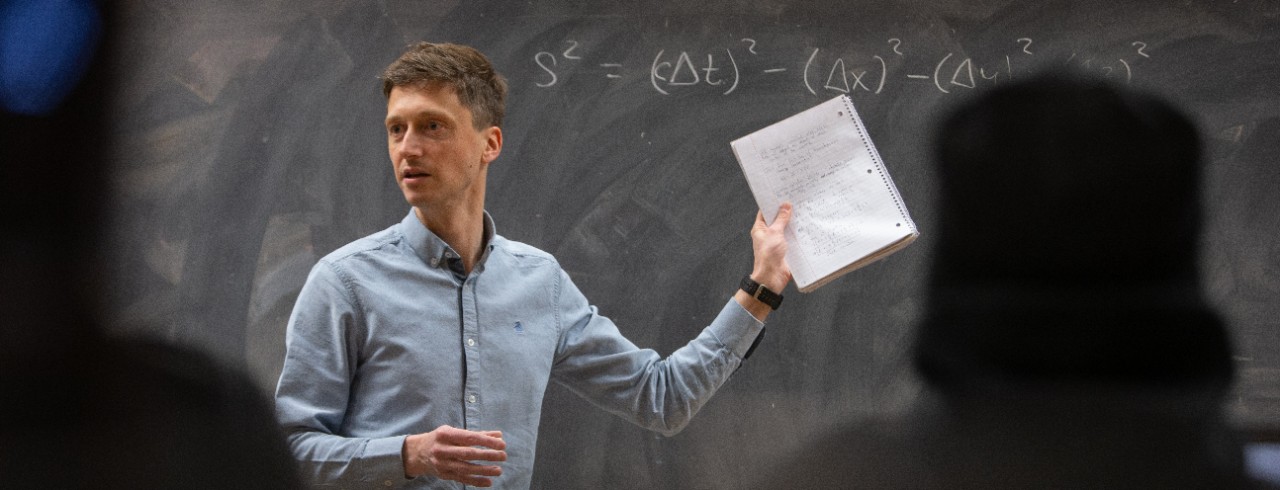
Featured image at top: Assistant professor of physics Colin Bischoff, recipient of a 2020 Innovative Uses of Technology in Teaching Award. Photo/Lisa Ventre/UC Creative Services
UC Faculty Awards
UC is saluting the 16 winners of our 2020 All-University Faculty Awards in a three-part series in UC News weekly through April 22. Beginning April 23, all winners will also be showcased on the Faculty Awards website.
Related Stories
Sugar overload killing hearts
November 10, 2025
Two in five people will be told they have diabetes during their lifetime. And people who have diabetes are twice as likely to develop heart disease. One of the deadliest dangers? Diabetic cardiomyopathy. But groundbreaking University of Cincinnati research hopes to stop and even reverse the damage before it’s too late.
Is going nuclear the solution to Ohio’s energy costs?
November 10, 2025

The Ohio Capital Journal recently reported that as energy prices continue to climb, economists are weighing the benefits of going nuclear to curb costs. The publication dove into a Scioto Analysis survey of 18 economists to weigh the pros and cons of nuclear energy. One economist featured was Iryna Topolyan, PhD, professor of economics at the Carl H. Lindner College of Business.
App turns smartwatch into detector of structural heart disease
November 10, 2025

An app that uses an AI model to read a single-lead ECG from a smartwatch can detect structural heart disease, researchers reported at the 2025 Scientific Sessions of the American Heart Association. Although the technology requires further validation, researchers said it could help improve the identification of patients with heart failure, valvular conditions and left ventricular hypertrophy before they become symptomatic, which could improve the prognosis for people with these conditions.