UC Faculty Awards 2020: Alvaro Puga
Alvaro Puga honored with George Rieveschl Award for Distinguished Scientific Research

Alvaro Puga says researchers don’t make “discoveries.”
“We find,” he says. “It means we did the work and fixed a problem.”
Puga, a professor of environmental health in the College of Medicine, has spent his career finding out why certain cells do what they do.
“We are all organisms that come with a complex set of instructions needed to develop; those instructions are given to us by our genome,” he says. “Exposure to environmental agents can interfere and cause improper functioning of the genome. This is the basis for my work.”

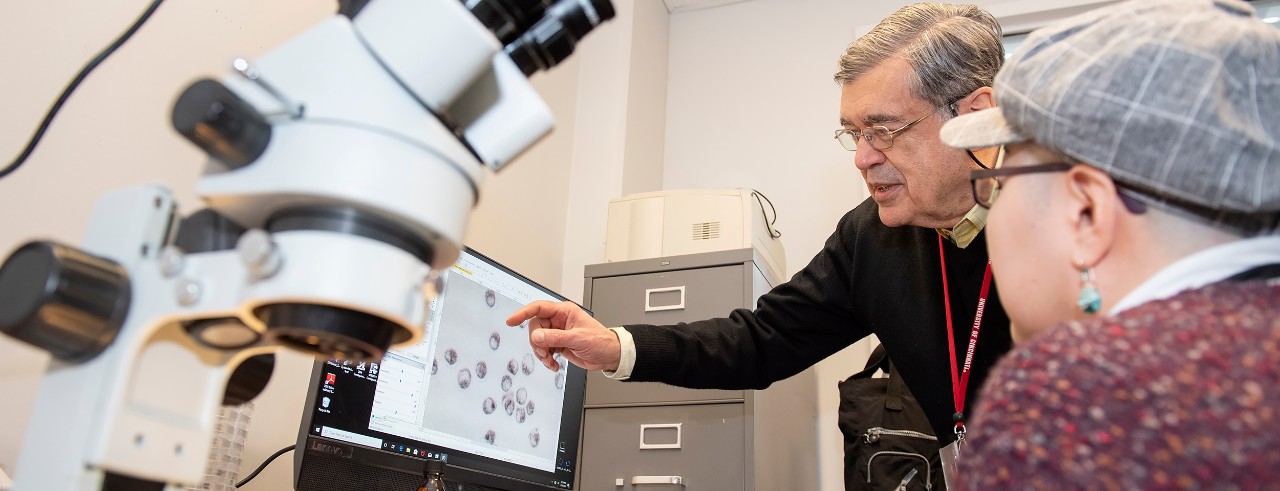
Alvaro Puga, winner of the 2020 George Rieveschl Award for Distinguished Scientific Research, working in his lab in February. Photo credit: Colleen Kelley/UC Creative + Brand
Throughout his career, nearly 30 years of which has been at UC, Puga has “found” the impact of the chemical compound dioxin on the development of cardiovascular disease and the toxicological effects of metals, like chromium, on DNA — only a few of his accomplishments.
“My lab has uncovered, over the years, that dioxin, which is a chemical now found in every living organism, binds to a certain receptor in people and impacts the development of the embryo, even from the time the organism is in utero,” he says. “We can’t reverse the exposure to dioxin, but knowing how it affects the system, we can uncover how other agents like it might impact the function of our genes and help us stop disease development before it starts.
“Research is like opening a box, where you find another box inside, with another box inside it. Our work is never done; we never get to the bottom of the box.”
“Research is like opening a box, where you find another box inside, with another box inside it. Our work is never done; we never get to the bottom of the box.”
Alvaro Puga
It’s this tenacity and love for his work that has earned Puga UC’s 2020 George Rieveschl Jr. Award for Distinguished Scientific Research.
“Dr. Puga’s vision of biomedical research is broad and inclusive,” says Mario Medvedovic, professor and director of the Division of Biostatistics and Bioinformatics within UC’s College of Medicine, who nominated Puga for the award. “He has been an early adopter of new technologies and research areas and an outstanding and supportive collaborator. Through these collaborations, he had a profoundly positive influence on research programs of his colleagues, including my own.”
Puga is not only recognized at UC by colleagues but also is known nationally for his contributions. He is an elected fellow of the American Association for the Advancement of Science as well as the Academy of Toxicological Sciences.

Alvaro Puga in the lab with one of his students in February. Photo credit: Colleen Kelley/UC Creative + Brand
And when he’s not making scientific strides in the lab, he likes to spend his time finding new recipes in the kitchen.
“I used to scuba dive as a pastime; now, I enjoy cooking,” Puga says. “I’d compare research to cooking, with different ingredients in the right amounts combined to successfully create a dish.”
“I judge abilities in the lab by how well someone can cook,” he says, with a laugh.
Featured photo by Colleen Kelley/UC Creative + Brand.
UC Faculty Awards
UC is saluting the 16 winners of our 2020 All-University Faculty Awards in a three-part series in UC News weekly through April 22. Beginning April 23, all winners will also be showcased on the Faculty Awards website.
Related Stories
Sugar overload killing hearts
November 10, 2025
Two in five people will be told they have diabetes during their lifetime. And people who have diabetes are twice as likely to develop heart disease. One of the deadliest dangers? Diabetic cardiomyopathy. But groundbreaking University of Cincinnati research hopes to stop and even reverse the damage before it’s too late.
Is going nuclear the solution to Ohio’s energy costs?
November 10, 2025

The Ohio Capital Journal recently reported that as energy prices continue to climb, economists are weighing the benefits of going nuclear to curb costs. The publication dove into a Scioto Analysis survey of 18 economists to weigh the pros and cons of nuclear energy. One economist featured was Iryna Topolyan, PhD, professor of economics at the Carl H. Lindner College of Business.
App turns smartwatch into detector of structural heart disease
November 10, 2025

An app that uses an AI model to read a single-lead ECG from a smartwatch can detect structural heart disease, researchers reported at the 2025 Scientific Sessions of the American Heart Association. Although the technology requires further validation, researchers said it could help improve the identification of patients with heart failure, valvular conditions and left ventricular hypertrophy before they become symptomatic, which could improve the prognosis for people with these conditions.