LiveScience: UC research shows spider butts look like faces
The spider's abdomen looks like a wasp's or mantis' head. Researchers say it fools computers, too.

LiveScience examined University of Cincinnati biology research into why some jumping spiders use biomimicry in mating dances.
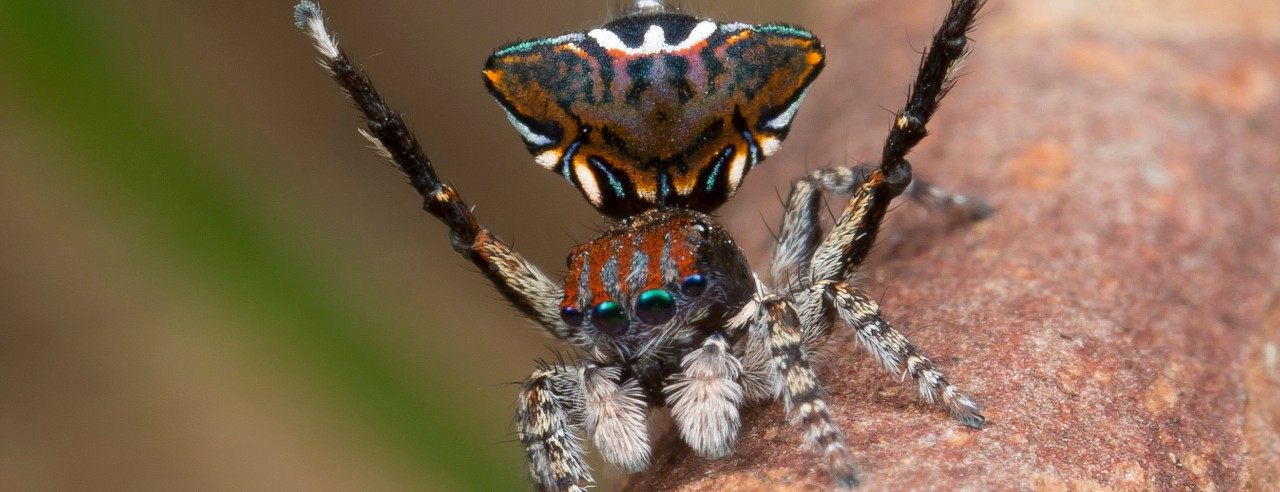
UC biology student Olivia Harris observed that the raised abdomens of peacock jumping spiders during their courting dance looked to her like the angular head and eyes of predators that eat spiders — wasps and preying mantises.
But to determine if what she was seeing was just her imagination, she enlisted the help of artificial intelligence to see if it was fooled, too.
She used images of peacock jumping spiders taken by internationally renowned photographer and Australian scientist Jurgen Otto, whose stunning photos and videos of the colorful spiders have appeared in National Geographic and Smithsonian.

A jumping spider in UC professor Nathan Morehouse's lab. Photo/Joseph Fuqua II/UC Creative Services
Harris asked artificial intelligence to tell the spiders apart from images of preying mantises, wasps and other insects. The spider abdomens fooled the computer about 5 percent of the time.
"One of the species is actually named Maratus vespa," she said. "Vespa is Latin for wasp. So we're not the first scientists to see the faces of invertebrate predators in these little spiders."
Spiders are notoriously cannibalistic. Courting males walk a fine line between seducing females and ending up as a snack.
Harris said mimicking a predator might give females just enough pause to halt a deadly ambush so the male can begin his courting display.
"Our hypothesis is the males are trying to exploit the females' anti-predator response of freezing when scared. This would help him capture the female's attention without immediately becoming prey himself," Harris said.
Harris presented her findings at the Society of Integrative and Comparative Biology conference this month.
Featured image at top: A jumping spider's raised abdomen looks so much like the angular head of a preying mantis or wasp that it fooled a computer some of the time. Photo/Jurgen Otto/www.peacockspider.org
Next Lives Here
The University of Cincinnati is classified as a Research 1 institution by the Carnegie Commission and is ranked in the National Science Foundation's Top-35 public research universities. UC's graduate students and faculty investigate problems and innovate solutions with real-world impact. Next Lives Here.
Become a Bearcat
- Apply online or get more information about undergraduate enrollment by calling 513-556-1100.
- Learn more about UC's many undergraduate and graduate programs.
Related Stories
How AI might help nonprofits
November 7, 2025
University of Cincinnati Professor Victoria LaPoe examined whether people respond differently to AI-created messaging in nonprofit advertising.
Shining like a disco ball: Rachel Hoermann’s story of finding passion and purpose at UC
November 6, 2025
Rachel Hoermann has dreamed of becoming a writer since childhood. But like many who grew up in Ohio’s rust belt, the idea of going to college felt out of reach. For years, she cycled through work that never quite satisfied her creative drive. That changed when she came across a box that once belonged to her father—a discovery that would alter the course of her life.
New hires reflect UC’s commitment to research, innovation and impact
November 6, 2025
With the 2025-26 school year in full swing, the College of Arts and Sciences has welcomed five faculty members to lead departments that span from chemistry to journalism. Dean James Mack said these new hires “reflect our unwavering commitment to ‘Discovery in Action,’ as we continue to enhance our academic and research excellence”. With these additions, the future of UC is in good hands, and students can look forward to new opportunities for learning, research, and innovation.