
WCPO-TV: UC researchers aim to create low-cost 3D printed skull implants
WCPO-TV: UC researchers aim to create low-cost 3D printed skull implants
UC engineers and physicians develop method to make cranial reconstruction possible around the globe

Researchers with the University of Cincinnati's College of Medicine and College of Engineering and Applied Science have joined forces to create a custom and cost-effective cranial implant. The researchers discussed the project with WCPO-TV.

Sam Anand, mechanical engineering professor
The team’s goal is to develop a no-cost shareware software product for developing an accurate digital 3D model of a skull bone flap using only a CT scan of the head.
The custom component or mold can then be 3D printed. The software is envisioned as a one-stop solution that can be used by non-experts in battlefield situations and also in undeveloped countries where patients may not be able to afford the normally high cost of a traditionally manufactured cranial flap, said Sam Anand, Ph.D., UC professor of mechanical engineering.
The skull graft would help patients whose skulls were damaged or in cases where doctors remove part of the skull to alleviate swelling and bleeding caused by a head injury.
Dr. Jonathan Forbes, UC assistant professor of neurosurgery, was inspired by his experience in Afghanistan treating patients while in the U.S. Air force.
“Overseas, where resources are more limited, patients don’t have access to what is called patient-specific cranial implants,” Forbes told WCPO-TV. “So instead … it’s often cement or titanium mesh, more rudimentary options for reconstructing the skull.”
Forbes, Anand and their research team plan to make the software free when it’s completed in early 2020.
“We don’t want to make any money off of this. We want to spread the word that this can be done,” Anand told WCPO-TV.
Read more about the research here.
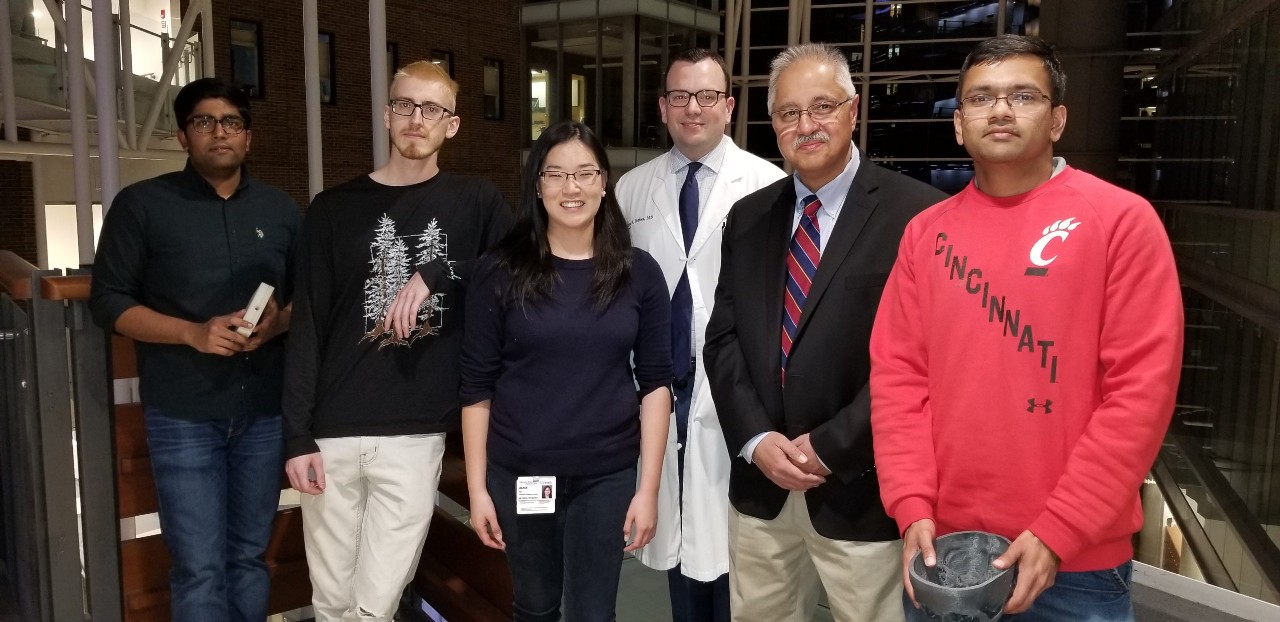
The project is a team effort with members from the College of Engineering and Applied Science and the College of Medicine at the University of Cincinnati. Photo/Provided.
Featured image at top: Baldwin Hall at UC. Photo/UC Creative Services.
Related Stories
UC launches Bearcats Affordability Grant
January 7, 2026
The University of Cincinnati is making college more attainable for students across Ohio with the creation of the Bearcats Affordability Grant. The new grant will provide a pathway to tuition-free college for students of families who make less than $75,000 per year. Beginning in fall 2026, the Bearcats Affordability Grant will cover the remaining cost of tuition for Ohio residents who are Pell eligible.
Sugar overload killing hearts
November 10, 2025
Two in five people will be told they have diabetes during their lifetime. And people who have diabetes are twice as likely to develop heart disease. One of the deadliest dangers? Diabetic cardiomyopathy. But groundbreaking University of Cincinnati research hopes to stop and even reverse the damage before it’s too late.
App turns smartwatch into detector of structural heart disease
November 10, 2025

An app that uses an AI model to read a single-lead ECG from a smartwatch can detect structural heart disease, researchers reported at the 2025 Scientific Sessions of the American Heart Association. Although the technology requires further validation, researchers said it could help improve the identification of patients with heart failure, valvular conditions and left ventricular hypertrophy before they become symptomatic, which could improve the prognosis for people with these conditions.