Renovation project at UC Blue Ash wins design award


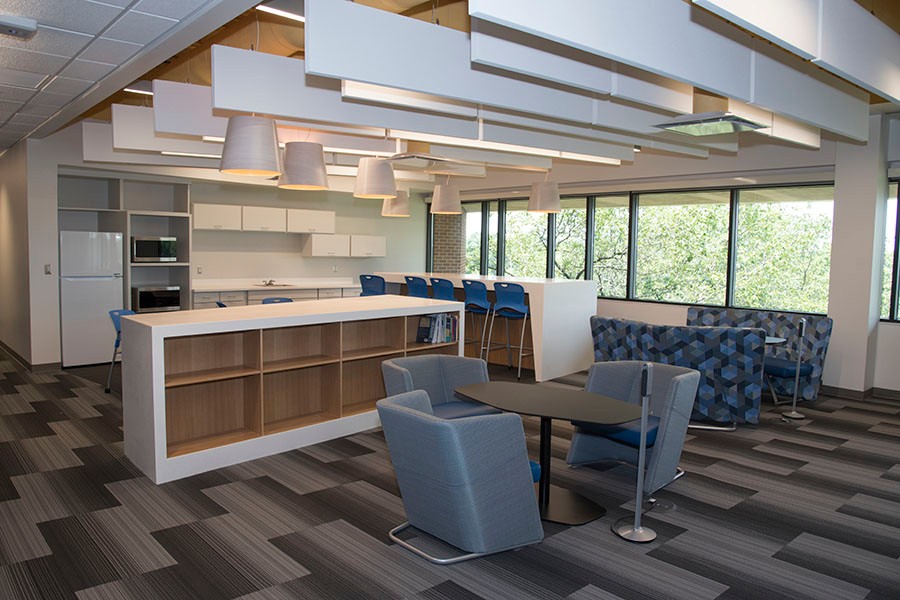
The renovated third floor in Muntz Hall includes new spaces for students and innovative classrooms that accommodate today's technology, including some rooms that are enclosed in glass.
A major renovation project at the University of Cincinnati Blue Ash College is earning praise from design experts.
The design for the first two phases in the renovation of Muntz Hall, which covered the entire third floor of the three-story building, was recently recognized at the 2019 Cincinnati Design Awards. The project received an Honor Award for interior architecture, the top award for the category. A total of 27 projects earned recognition at the 2019 CDA’s; only nine received Honor Awards. Find more details at the Cincinnati Design Awards website.
In recognizing the UC Blue Ash project, the judges noted that they appreciated the process (surveys and utilization study) and the result. They also liked the student social spaces and the revitalization of the academic and office spaces.
Muntz Hall was the original building on the UC Blue Ash campus when the college was founded in 1967. It was expanded in 1974 but has not been updated in any significant way since then.
“The first phases of investment and modernization continues the plan to holistically create new learning, collaboration, and related faculty support spaces that ensure UC Blue Ash has the appropriate resources to support forward-looking pedagogies and great student outcomes,” says John K. Seibert, interim associate vice president of UC’s Planning, Design and Construction. “The continued vision to give faculty the tools for teaching and guiding students in modernized space is just part of that commitment.”
The first two phases of the renovation project completely repurposed the existing space on the third floor to create 17 new classrooms, 45 faculty offices, 6 conference rooms and several new spaces where students can study or relax while charging their phone or laptop.
The new spaces for students include a unique bench design that impressed the judges, as well as brightly colored chairs with small desktops, moveable tables and charging stations. The classrooms are also modern and feature plenty of natural light, bringing a completely new look and feel to the 52-year-old building.
UC’s Planning, Design and Construction is overseeing the renovation project and Emersion Design is leading the design work. Phase three of the project is under construction; it focuses on similar updates to the second floor of Muntz Hall. That phase is scheduled to be complete by the summer. If all funding is approved, the project will include six phases with work being completed over a four-to-five-year period to accommodate continued occupancy and use of the building.
About UC Blue Ash College
UC Blue Ash College is a regional college within the University of Cincinnati. It offers one of the best values in higher education with access to a nationally recognized UC education in more than 50 degree and certificate programs, as well as tuition that is about half of most colleges and universities. The college is located on a scenic 135-acre wooded campus in the heart of Blue Ash, Ohio. To learn more, call 513-745-5600, visit us online, like us on Facebook or follow us on Twitter and Instagram.
Tags
Related Stories
Sugar overload killing hearts
November 10, 2025
Two in five people will be told they have diabetes during their lifetime. And people who have diabetes are twice as likely to develop heart disease. One of the deadliest dangers? Diabetic cardiomyopathy. But groundbreaking University of Cincinnati research hopes to stop and even reverse the damage before it’s too late.
App turns smartwatch into detector of structural heart disease
November 10, 2025

An app that uses an AI model to read a single-lead ECG from a smartwatch can detect structural heart disease, researchers reported at the 2025 Scientific Sessions of the American Heart Association. Although the technology requires further validation, researchers said it could help improve the identification of patients with heart failure, valvular conditions and left ventricular hypertrophy before they become symptomatic, which could improve the prognosis for people with these conditions.
Combination immunotherapy helps overcome melanoma treatment resistance
November 10, 2025

MSN highlighted research led by the University of Cincinnati Cancer Center's Trisha Wise-Draper showing a combination of immunotherapy medications can activate a robust immune response and help overcome treatment resistance in patients with refractory melanoma.